Dark, Schopenhauer, and the Question of Free Will
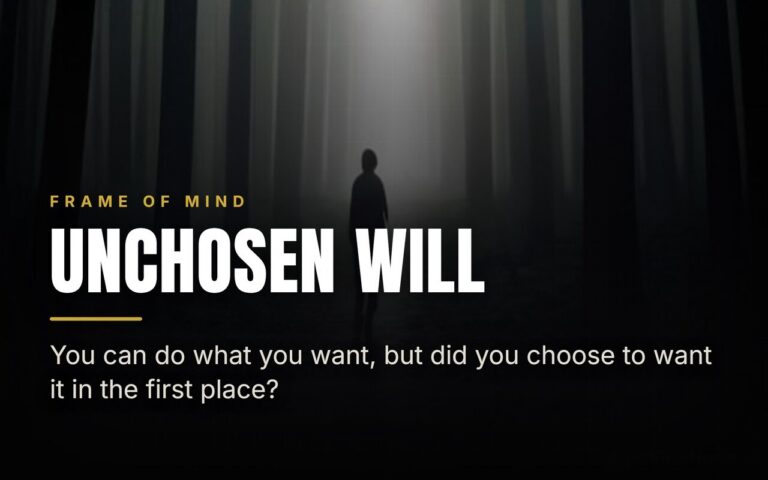
The Netflix series Dark hides a real philosophical argument inside its time loops: Schopenhauer's claim that you can want what you want,…
The Netflix series Dark hides a real philosophical argument inside its time loops: Schopenhauer's claim that you can want what you want,…
Kierkegaard, Nietzsche, and Hermann Hesse each saw stepping away from the crowd as essential — not as escape, but as the only…
The Godfather sells Michael Corleone as an innocent dragged into crime. Coppola's film suggests something colder: a man who found opportunity in…
Sartre said man is condemned to be free. Spinoza said free will is an illusion. A clear walk through two of philosophy's…
Why a single melody can undo you when words can't: Schopenhauer's Will, Proust's unconscious, and Nietzsche's Apollo and Dionysus, through music.
How The Handmaid's Tale dramatizes biopolitics and Foucault's Panopticon — turning names, bodies, and surveillance into the machinery of total control.
A look at hyper-awareness — the psychological state where the mind's usual protective filters are missing — through Camus's absurd and The…
Sherlock Holmes and Dr. House both treat the world as a solvable puzzle. What their shared philosophy of logical reduction and cynicism…
Behavioral conditioning, learned helplessness, and Schopenhauer's illusion of will: how Oldboy turns a revenge thriller into a philosophy lesson about fate.