Sartre, Spinoza, and Two Rival Ideas of Freedom
Sartre said man is condemned to be free. Spinoza said free will is an illusion. A clear walk through two of philosophy's most opposed ideas about freedom.

In the twentieth century, the French philosopher Jean-Paul Sartre emerged as one of the most prominent faces of existentialism. He lived through World War II and watched many ideas people had assumed were fixed collapse. He believed man is born into a world that carries no ready-made meaning and no pre-written message. You’re simply born… and then you start writing your own story. Hence his famous line, “existence precedes essence.”
Sartre: Condemned to Be Free
The phrase might seem obscure at first… but its meaning is very simple. A knife was made to cut… so it had a function before it even existed. A person, though, isn’t born with a function, an identity, or a written fate. You’re born first… then you make yourself through your actions and choices. In Sartre’s view, you can’t escape responsibility. Even when you say “I had no choice,” you’ve really chosen to surrender to circumstance. Even silence becomes a decision. Even standing still becomes a stance.
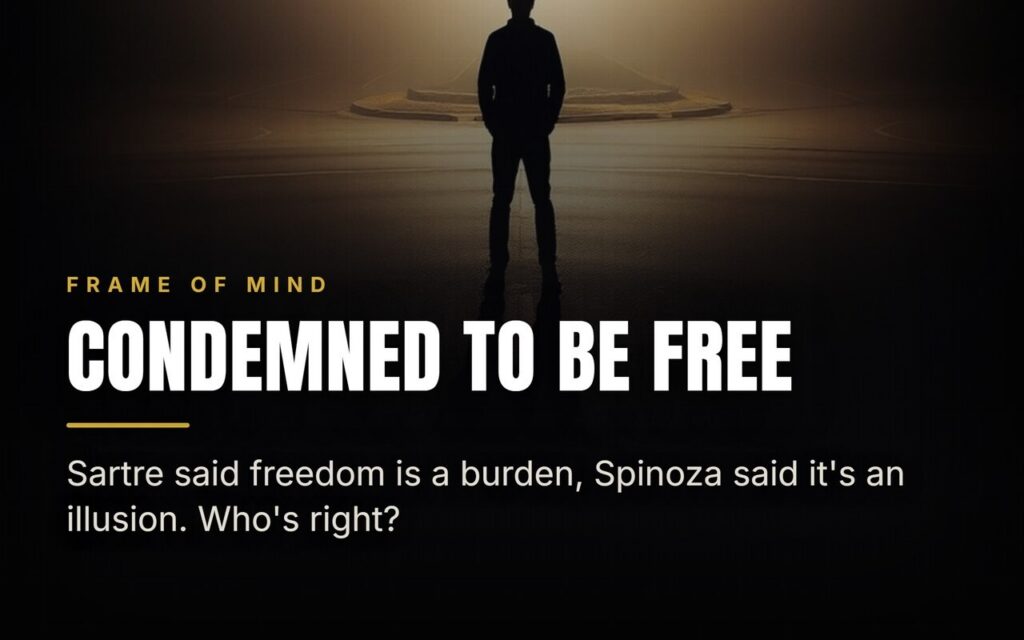
That’s why he said what became one of the most famous lines in the history of philosophy… “Man is condemned to be free.” The phrase might sound contradictory… how can a person be condemned to freedom? Because for him, freedom isn’t a comfortable privilege… it’s a heavy burden. You’re forced to choose every day… forced to bear the consequences of every choice… and you can’t fully pin the blame on society, family, or fate.
Spinoza’s Stone
But what if freedom itself is just a lovely feeling… more than it is a fact? Long before Sartre, the Dutch philosopher Baruch Spinoza looked at the world in a completely different way. He saw the whole universe as something like a vast machine, moving according to precise laws. Nothing happens out of nowhere… every event grows out of one that came before it… and every cause gives birth to a new cause. Man is part of this chain… not an exception to it. When Spinoza says free will is just an illusion… he doesn’t mean man is a puppet on strings, as some imagine. What he means is that man feels free because he knows his desires… but doesn’t know the causes that produced those desires. Picture a stone hurled forcefully through the air… if that stone had awareness, it would think it was flying by its own will… while the truth is that a force set it moving from the start. In Spinoza’s view, man is like that stone… he knows he wants something… but doesn’t always know why he wanted it.
Freedom as Understanding
Hence his famous line, “Freedom is the recognition of necessity.” Meaning true freedom isn’t about breaking the laws of the universe… it’s about understanding them.
Sartre’s clearest illustration of this wasn’t abstract at all. In a wartime lecture later published as Existentialism Is a Humanism, he described a student who came to him during the German occupation, torn between two duties that could not both be honored: leaving to join the Free French forces fighting from abroad, or staying behind to care for a mother who had already lost one son and depended on him entirely. No system of ethics could settle the question in advance. Kantian duty offered no ranking between country and family; Christian charity commanded both and adjudicated neither. The young man had to invent the answer himself, in the moment, and then live with having invented it. That, for Sartre, is what freedom actually feels like from the inside, not a seminar topic but a decision with no safety net underneath it.
Spinoza’s determinism looks like the flat opposite of that scene, but it has more give in it than the stone metaphor suggests. He didn’t think all human bondage was equal. A person driven by passions they don’t understand, jealousy, blind ambition, fear reacting to fear, is in what Spinoza calls bondage, pushed around by causes external to their own reasoning. But a person who comes to understand those causes, who traces a desire back to where it actually originates, becomes what he calls an adequate cause of their own actions. The chain of causation never breaks, but a person’s relationship to it changes completely. Spinoza wasn’t arguing that self-understanding is pointless, only that self-understanding is the only freedom on offer, and it has to be earned through the intellect rather than assumed as a birthright.
Put side by side, the two philosophers argue less than they first appear to. Sartre insists a person is never let off the hook, even when circumstances look like an excuse. Spinoza insists a person is never as free as they feel, even when a choice looks wide open. Neither one hands out comfort. What they agree on, from opposite directions, is that freedom is not the default setting of being human, it’s a demand: either to keep authoring yourself without a script, or to keep tracing your own causes until you actually understand them. Most people spend their lives doing neither, which may be the real condition both men were describing.