The Handmaid’s Tale and the Politics of the Body
How The Handmaid's Tale dramatizes biopolitics and Foucault's Panopticon — turning names, bodies, and surveillance into the machinery of total control.

In the world of Gilead, because of a global fertility crisis, women are no longer treated as people. Their entire existence has been reduced to their biological function. The series applies, in terrifying fashion, the concept of biopolitics — where power no longer settles for ruling land and borders, but rules bodies and biological functions themselves.
The Politics of the Body
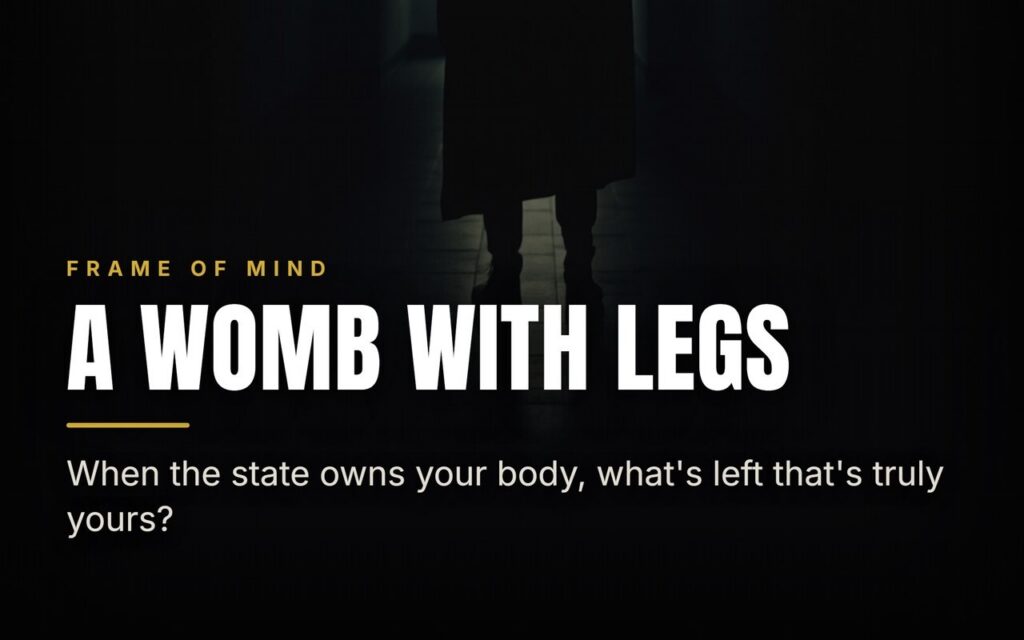
June (Offred) is “a womb with legs.” The red uniform is the packaging that marks her function. When the state becomes the owner of your body, pregnancy stops being a personal choice and becomes a national duty, and abortion or contraception becomes treason. Here, the distance between “the personal” and “the political” is erased completely.
Stripping the Name
Why are they forced to change their names? “Offred” literally means “Of Fred” — belonging to Fred. In psychology and sociology, a name is the core of identity. When power strips away your name, it severs your connection to your past, your history, your humanity. You’re no longer an independent being; you’re an attachment to one. This technique was used historically in slavery and in internment camps — turning a person into a number or a label to break their spirit and make them easier to control.
The most complex and controversial character is Serena Joy. She helped write the laws of this very system, only to later become a victim of it herself — forbidden from the reading and writing that had once been her profession. Serena represents the group that trades away their own sex’s freedom in exchange for the illusion of power or protection. But she learns too late that the jailer can also be a prisoner in the cell she built. Extreme patriarchy spares no one, not even those who helped construct it.
The Ceremony itself is where this theory turns into liturgy. Once a month, the Commander, his Wife, and the Handmaid perform a scripted tableau lifted from the story of Rachel and Bilhah in Genesis: Serena grips June’s hands from behind while Fred does what the state has scheduled him to do, and everyone recites the justification as though reading from a hymnal. Nothing about the room is private, and nothing about the act is spontaneous — it’s timed, witnessed, and repeated on a calendar, which is exactly the point. Biopolitics doesn’t need to hide the body’s function behind romance or desire; it can schedule reproduction the way a factory schedules a shift, and dress the schedule up as scripture so no one has to call it what it is.
The Panopticon of Gilead
The official greeting in Gilead is a constant reminder of surveillance — not just God’s surveillance, but the watching of spies, “the Eyes.” This recalls philosopher Michel Foucault’s theory of the Panopticon: a prison where the guard can see every prisoner without ever being seen himself. In Gilead, the fear that your neighbor, your friend, or your driver might be a spy makes everyone practice self-surveillance. Power here doesn’t need to beat you every day — it just needs to plant a tiny policeman inside your mind that stops you from even thinking about rebellion.
It would be a mistake to read this as a story about men versus women, full stop. Gilead sorts everyone by reproductive and economic utility, and plenty of men lose out too — the Guardians denied wives, the Economen scraping by with Econowives who must cook, clean, and bear children with no household help at all, the men shipped to the Colonies alongside the Unwomen when they’re judged surplus to the system’s needs. The Commanders keep power precisely by convincing everyone else, male and female, that scarcity is natural rather than engineered. That doesn’t soften what happens to Handmaids specifically — their bodies absorb a cost no man in Gilead is ever asked to pay — but it does show that biopower’s real talent is classification itself, sorting bodies into tiers of usefulness, and letting the tier absorb the blame that should fall on the system that built it.
Despite the utter darkness, the series is an anthem to resistance. But it isn’t resistance by the sword — it’s resistance by memory. When June carves the phrase “Nolite te bastardes carborundorum” (don’t let the bastards grind you down), or whispers her real name in the dark, she’s declaring: “I am still here… my mind is still mine.”
Margaret Atwood’s novel doesn’t end with June’s whispered name; it ends with a coda set two hundred years later, a symposium of historians picking through Gilead’s remains with the mild curiosity of people cataloging a dead regime, arguing over transcription and tone, unsure whether it’s even polite to judge. It’s a colder ending than the show’s, and a more unsettling one, because it suggests biopower’s afterlife is just as dangerous as its reign: once the bodies are gone, the archive can turn atrocity into a footnote, a panel discussion, a case study delivered with a shrug. Gilead’s real threat was never that it might last forever. It’s that it might eventually be discussed calmly.