The Uncomfortable Biology Behind Why We Fall in Love
A hard look at where love actually comes from: evolutionary biology, the drive to survive, and why the feeling might be older than language itself.

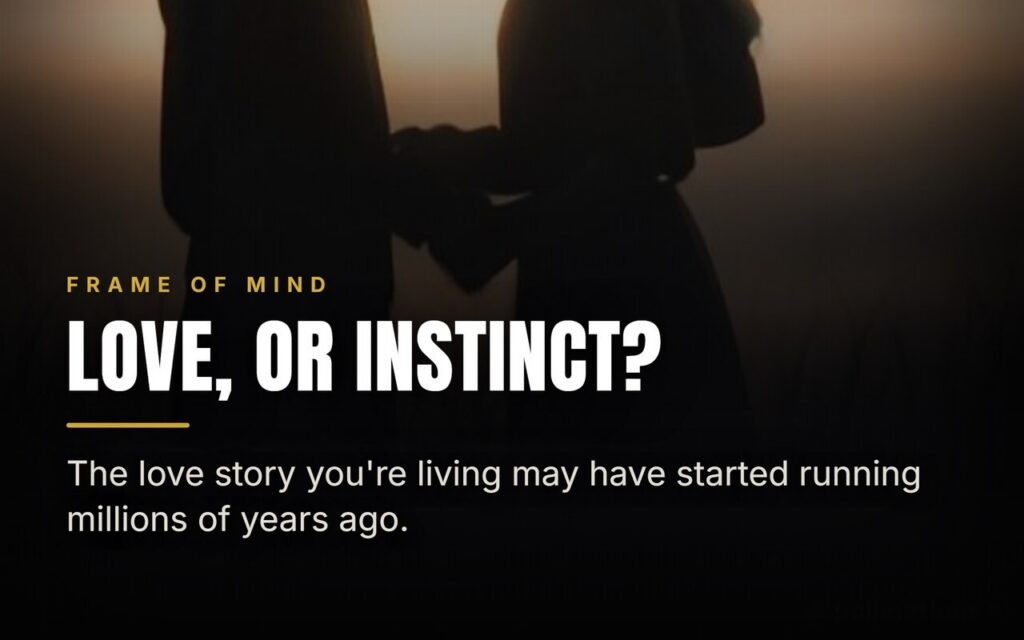
If someone told you that the greatest love story of your life might have started millions of years before you were born, and that the thing making you say “I love her” is the very same system that drove the first human on Earth to ensure life continued, would you believe it? Or would you feel like this idea is demolishing the most beautiful feeling humanity has ever known?
A Philosopher’s Uncomfortable Claim
A philosopher once said a terrifying sentence: man doesn’t fall in love because he is free, but because he is being used. The first time you hear it, it sounds needlessly dark, maybe even insulting to the most beautiful experience any human can live. But every big idea started the same way, by asking a question people refused to hear.
Is love really the pure feeling poets have sung about for thousands of years? Or are we living inside a story written by someone else long ago, each of us playing our role while thinking we’re the hero? Since humans learned to write, love has been present, in Greek mythology, in Arabic poetry, in novels, in songs, in cinema, even in ads selling a ring or a rose as the key to happiness, as if the whole world agreed that love is the most important experience in a human life. But strangely, every field tells a different story. The biologist says one thing, the philosopher says another, the psychologist explains it differently, the religious man sees it from another angle, and society imposes its own rules on it.
Maybe love itself isn’t one thing. Maybe we’re giving the same name to different things.
Before Love Had a Name
Go back millions of years, before cities, before languages, before religions, when early humans ran through the forests hunting for food and trying to escape predators. Back then there were no love poems, no red roses, no engagement rings, not even the word “romance.” There was only one goal: survival.
This is where evolutionary biology comes in, the branch of science that studies why certain traits appeared in living things, and how nature kept them because they helped the species survive. This science says nature was never interested in your happiness. That’s the first shock. We imagine the universe rewards humans for their happiness, but nature has no concept called happiness at all. It has only one concern: will the species continue, or go extinct?
Anthropologist Helen Fisher’s brain-imaging work on early romantic love gives that survival logic an uncomfortably literal shape. Scanning people who described themselves as newly, intensely in love, she found activity concentrated in the same dopamine-rich reward circuitry, including the ventral tegmental area, that lights up during cocaine use. The brain isn’t speaking in metaphor when someone says a new partner feels like an addiction. It’s running roughly the same reward system that once made it worth a hunter-gatherer’s while to keep chasing one mate rather than wandering off.
That reward-circuit story only covers the beginning, though. A separate hormonal system, built around oxytocin and vasopressin, seems to govern whether early infatuation turns into a lasting pair bond at all. Researchers studying prairie voles, one of the few mammals that form monogamous attachments, found that blocking those hormones stopped the animals from bonding with a mate even after they had bred, while artificially boosting the hormones could produce attachment without the usual courtship. The implication carried over to humans sits in the same uncomfortable register as everything else here: the difference between a fling and a marriage may rest partly on brain chemistry that has nothing to do with how right the relationship actually is.
But the survival story has an obvious hole in it. People fall in love long after their reproductive years have ended, in same-sex partnerships that produce no offspring at all, and in relationships built around adopted children who share none of their parents’ genes. If the entire architecture were a machine for passing on genes, none of that should register as real love, and yet it plainly does, sometimes more durably than the pairings evolutionary psychology would predict as optimal. The biological account explains where the machinery came from. It has a much harder time explaining why the machinery keeps firing in situations that offer it no genetic payoff whatsoever.
Maybe that gap is the actual point rather than a flaw in the theory. A system built by blind, indifferent selection pressure got repurposed, over enough generations, into something that now runs on its own terms, attaching to people and circumstances evolution never anticipated and would have no way to reward. Knowing that love shares its wiring with an ancient survival program doesn’t make what a person feels toward another person less real. It just means the feeling outgrew the reason it was built for.