The Quiet Regret of a Life You Never Risked
On why people who bury their talent or play it safe become the harshest critics of those who don't, and why regret hurts more than failure ever could.

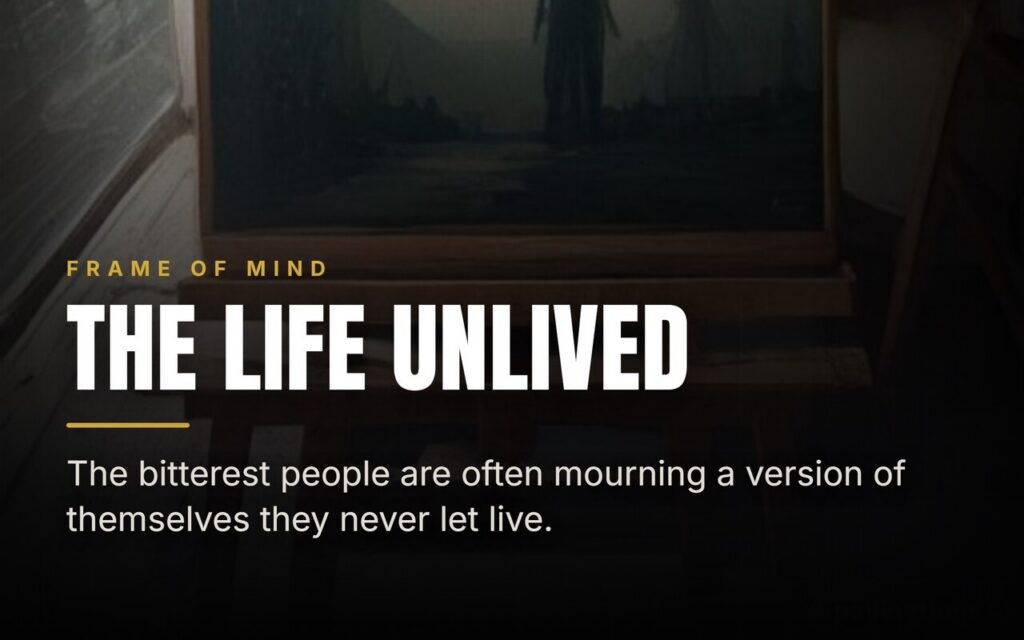
The world is full of people suffering the effects of the lives they never lived. They become bitter, critical, or rigid — not because the world was cruel to them, but because they betrayed their own inner potential. This silent betrayal is the deepest wound of all, because it bleeds meaning.
Jump to section
The Cost of a Buried Talent
A person who buries his talent, suppresses his passion, or avoids risking his emotions, kills a part of his own soul. He keeps living, but he lives half a life — breathing, but never catching fire. This inner frustration turns into harsh defenses. The artist who never painted his painting becomes the harshest mocker of art exhibitions, as if telling himself, “If I’d dared, I wouldn’t have been better than them anyway.” The lover who chose safety over madness mocks romantic stories, because seeing them reminds him of the violent heartbeats and delicious pain he missed out on. The thinker who never risked a big idea accuses every philosopher of naivety, because committing to a belief means confronting the emptiness he himself lives in.
Why Their Mockery Isn’t Innocent
These people become a quiet source of discomfort to others. Their mockery isn’t innocent — it’s an attempt to diminish the value of what they never dared to have. They criticize the brave because they see in them a mirror reflecting their own cowardice. They judge the creative because every act of creation reminds them of what they buried. And in circles of friends, family, or social media, they become the voices of constant doubt, planting suspicion in the hearts of those who still dare to dream.
There’s actual research behind this, not just intuition. Psychologists who study regret consistently find a strange asymmetry: in the moment, people regret their actions, the embarrassing thing they said, the risk that blew up in their face. But when you ask people to look back over decades instead of weeks, the pattern flips. It’s the things they didn’t do that haunt them longest: the person they didn’t tell how they felt, the career they didn’t try, the move they didn’t make. Action regrets fade because the mind can rationalize a mistake as a lesson learned. Inaction regrets don’t fade the same way, because there’s no event to make sense of, only an absence that keeps being available to imagine differently.
None of this means risk is automatically virtuous or that caution is always cowardice. Some people hold back for good reasons: a family depending on their income, a genuine mismatch between talent and ambition, a season of life that legitimately calls for stability over reinvention. The distinction that matters isn’t whether someone took the leap, it’s whether staying was actually examined or simply defaulted into out of fear disguised as prudence. Plenty of quiet, careful lives are the opposite of buried potential; they’re potential correctly assessed and pointed somewhere realistic. The bitterness described here belongs to a narrower group, people who know, privately, that fear did the choosing, and who then need everyone around them to stay small too so the choice never has to be examined.
Temporary Failure vs Permanent Regret
This kind of pain is the most tragic, because it’s optional. No one forces us to betray ourselves; we do it out of fear — of failure, of rejection, of pain, of change. But temporary failure is far more merciful than permanent regret. A life lived halfway leaves an emptiness inside us that screams at night, while a full life — however painful or messy — leaves us with a sense of completeness, even if it ends in loss.
The Daily Practice of Courage
The only remedy is daily courage: to paint the painting despite the fear of criticism, to love despite the possibility of separation, to commit to an idea despite the possibility of being wrong. We aren’t required to succeed — we’re required to try, because a person who takes risks and fails stays alive in his soul, while the one who never risks anything dies slowly while still breathing.
Deep down, every one of us knows which life we were meant to live. The only question left is: will we keep mocking it, or will we finally start living it, even if it’s late?
The cruelest part of this pattern is that it’s self-perpetuating. A person who never tries tends to stay around people who also never tried, because those are the friendships that don’t ask anything uncomfortable of anyone. Get close, even briefly, to someone who is actually building the life they wanted, and the discomfort becomes almost unbearable to sit with quietly. That discomfort is information, not an attack. It’s usually the clearest signal available that the stillness was never peace to begin with, just a slower, quieter way of losing.