Solitude Isn’t Lack — It’s the Highest Form of Freedom
Being alone isn't a lack to escape — it may be the one state where you answer to no one. On the social masks we wear and reclaiming the self in solitude.

Have you ever imagined that your solitary confinement could actually be the only palace of your freedom? Let’s close our eyes for a moment and picture this scene together. You’re at a loud party, or a long work meeting, or even in the middle of a big family gathering. Everyone is talking, laughing, judging. You smile, nod in agreement, choose your words carefully to please this person and avoid angering that one. You’re wearing a heavy social “mask,” playing a role on an endless stage. You feel exhausted, don’t you?
The Sound of the Mask Falling Off
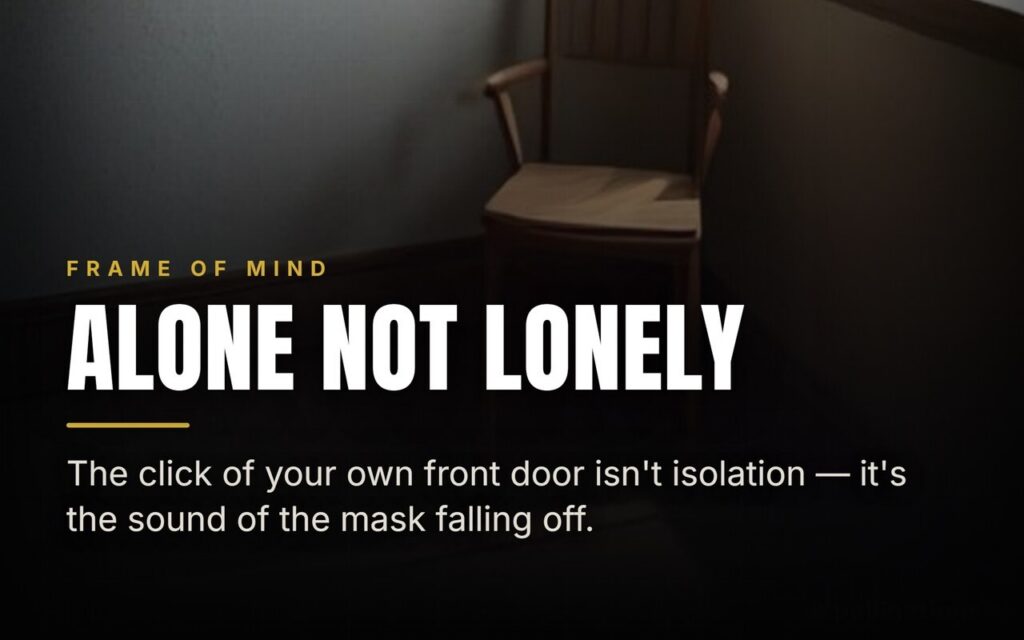
Now imagine the moment you get home. You turn the key in the door, step in, and close the door behind you. “Click.” The sound of the lock isn’t just a metallic click; it’s the sound of the mask falling off. In that moment, silence takes over. Many of us flee from this silence, rushing to turn on the TV or scroll through our phones, afraid of “loneliness.” But what if I told you we’ve been getting the story wrong our whole lives? Solitude isn’t a “lack”… it’s “fullness.” Society has conditioned us to believe that a person alone is sad, rejected, or incomplete. But the truth many overlook is: “Solitude is the one state in which you are 100% your own master.”
Freedom From the Audience
Think about it: freedom from others’ gaze — when you’re alone, no one is watching how you eat, how you sit, or even how you think. There’s no “audience” to perform for. Liberation from expectations — you’re not obligated to be smart, or funny, or polite. You can simply be a “human being” breathing, no additions required. Total authority — you’re the absolute ruler of the kingdom of your own time and thoughts. No bargaining, no concessions, no pleasantries.
A Return to the Self
Solitude, my friend, is the highest form of freedom, because it’s the moment you stop being a “reaction” to other people’s actions, and go back to simply being “you.” It isn’t an escape from the world, but a return to the self. Next time you find yourself alone, don’t feel sorry for yourself. Take a deep breath, look at the space around you, and smile, because you’re now in the presence of the one person who will stay with you until the very end: yourself. Solitude is the vast space where your soul can spread its wings without crashing into the walls of “what people think.” So tell me… do you see sitting alone as a time to rest and recharge, or as an escape and a fear?
Henry David Thoreau built an entire book around this same discovery, though he took it further than a locked apartment door. He spent roughly two years living alone in a cabin he built near Walden Pond, and what he kept circling back to in the account he wrote afterward wasn’t the isolation itself, but what became visible once he’d stripped away the performances and obligations that usually fill a life. Removed from an audience, he found he had to face what was actually his, rather than what he’d absorbed from other people’s expectations of a well-lived life. He wasn’t performing self-sufficiency for spectators, since there was no audience out there to perform for beyond the rare visitor; by his own account, the point was to find out what was actually necessary once every distraction had been stripped away, and to find that out early enough for the answer to still matter. That’s the same trade this essay is describing on a much smaller scale, a locked door instead of a cabin in the woods, but the same exchange: less company, more clarity about what was ever really yours to begin with.
Psychologists who study this territory draw a sharper line than everyday language does. Loneliness is defined less by how many people are around you than by the gap between the connection you want and the connection you actually have, while solitude, specifically the kind a person chooses and can end whenever they like, tends to show up in research as restorative rather than depleting. That distinction matters because it also marks the limit of this whole argument. A person isolated against their will, an elderly widow with no visitors, someone housebound by illness or excluded by circumstance, isn’t experiencing the freedom described here. They’re experiencing the exact deficit solitude is supposed to be different from. The palace only exists when you’re the one holding the key and could walk out the door if you wanted to. Take away the choice, and the same empty room stops being freedom and starts being a cell.
That’s the detail worth sitting with once the glamor of the idea wears off. Solitude isn’t valuable simply because it’s quiet, plenty of quiet rooms are miserable to sit in, it’s valuable because you chose the quiet over the alternative you could have had instead. The measure isn’t whether you’re alone. It’s whether being alone right now is something you’re doing, or something that’s simply being done to you.