The Difference Between Being Good and Being Easy
Psychology has a term for the assertiveness that shows up when a boundary is crossed — and it's not the same thing as becoming a harmful person.

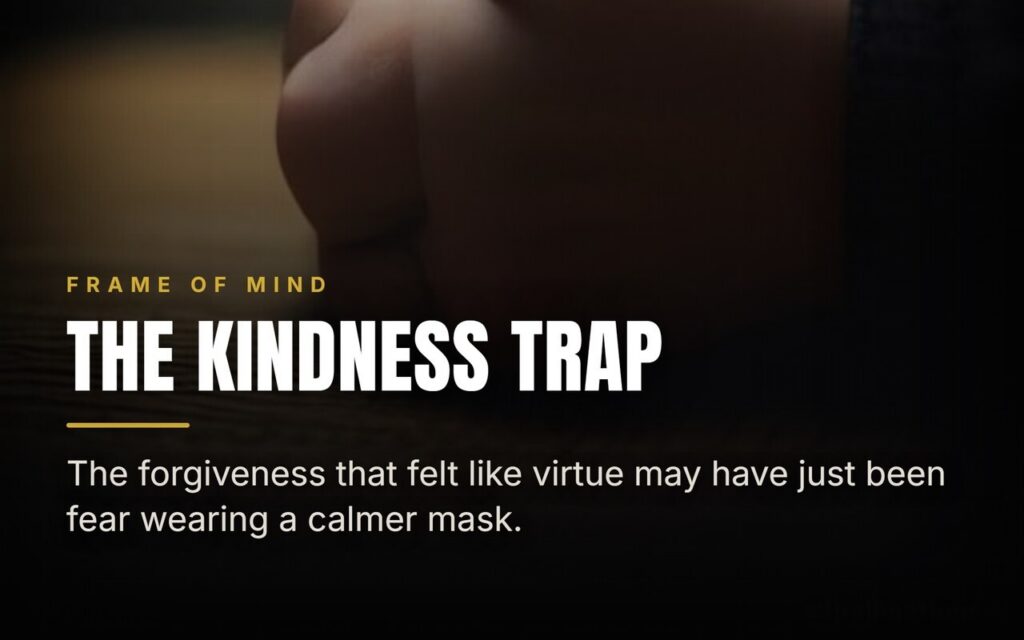
There’s a kind of kindness that can destroy the person who has it without them ever noticing. The person who always forgives. Stays silent. Lets it go. Says “never mind.” Is afraid to upset anyone. Afraid to look harsh. Afraid to say no. And every time someone crosses him, takes something that was rightfully his, or oversteps his boundaries, he tells himself “I’m above responding to this.” Until one day he discovers he was never above responding to it… he was just afraid of it.
Trauma researchers have a name for the reflex that produces this kind of person: the fawn response, alongside the more familiar fight, flight, and freeze. Where fight escalates and flight escapes, fawning tries to make itself indispensable and inoffensive enough that whatever threat is present has no reason to turn on it. It works, which is exactly the problem. A child who learns that staying agreeable is the safest way to survive an unpredictable household grows into an adult whose nervous system still treats every disagreement as a low-grade emergency, long after the actual danger is gone.
And here we have to stop at a slightly uncomfortable idea. Does morality mean staying calm and forgiving no matter what happens? Or are there moments when protecting yourself requires a sharper version of you? The problem is we were taught since childhood that a good person has to be forgiving all the time. Helpful. Understanding. Able to endure. Giving second chances. Avoiding confrontation. That’s beautiful in an ideal world. But real life has people who’ll test your limits the moment they discover there’s no cost to crossing them. Someone who knows you’ll forgive every time might push further. A colleague who knows you’ll cover his mistakes might dump them on you. And a person who knows you’re afraid of conflict might turn your fear of confrontation into a tool in his hand. And here the tolerance that was supposed to preserve your humanity starts working against you.
Protective Aggression
In psychology there’s an idea close to this called protective aggression. This doesn’t mean turning into a harmful person. The idea is that a person has the capacity to use assertiveness, anger, and defensive energy when he senses his boundaries, his safety, or his rights are in danger. Anger, in its natural form, isn’t always a flaw. It can be a signal telling you something has crossed a line. That someone has entered a space that isn’t theirs to enter. That a situation needs a stand. The problem happens when anger takes the wheel and starts hitting anyone in its path. That’s when defense turns into attack, and assertiveness turns into aggression.
Wanting a Victim vs. Wanting Space
And this lets us tell apart two things that look very similar. One person wants to hurt you because he enjoys hurting you. Another says “no” to you for the first time because you kept pushing him until he had to draw a line. The first wants control. The second wants to reclaim control over his own life. The first needs a victim. The second needs space. That’s why the idea of “being a good person” needs revisiting, because there’s a difference between being a good person and being an easy one. A good person can refuse. Can object. Can end a harmful relationship. Can complain. Can ask for what’s his. Can tell someone “you’re wrong.” Can walk out of someone’s life without insulting or humiliating them.
The opposite failure deserves just as much suspicion, though, because plenty of people have learned to dress up plain selfishness in the language of boundaries. Cutting someone off the moment they need something inconvenient, refusing any accountability by calling it “protecting your peace,” treating every request as an intrusion — none of that is protective aggression either. It’s unkindness borrowing a therapy vocabulary to sound principled. The difference isn’t in the words a person uses to describe what they’re doing, it’s in whether the response is proportional to an actual violation or is being used to dodge the ordinary friction that comes with caring about other people, the kind every real relationship eventually asks of us.
So the real test isn’t how sharp someone’s reaction gets, it’s what the reaction is protecting and what it’s willing to cost. A boundary aims at stopping something specific from happening again and is usually willing to name exactly what that something was. Cruelty aims at making another person feel small and rarely bothers to specify why, because specifying it would expose how disproportionate the response actually is. Learning to tell the two apart, in yourself first and then in other people, is most of what separates someone finally done being easy from someone who has simply started being unkind, and it’s a distinction worth checking honestly rather than assuming you already land on the right side of it.