The Quiet Power of the Person Who Talks Least
Sociologist Erving Goffman compared social life to theater. The person who says the least often ends up knowing the most about everyone in the room.

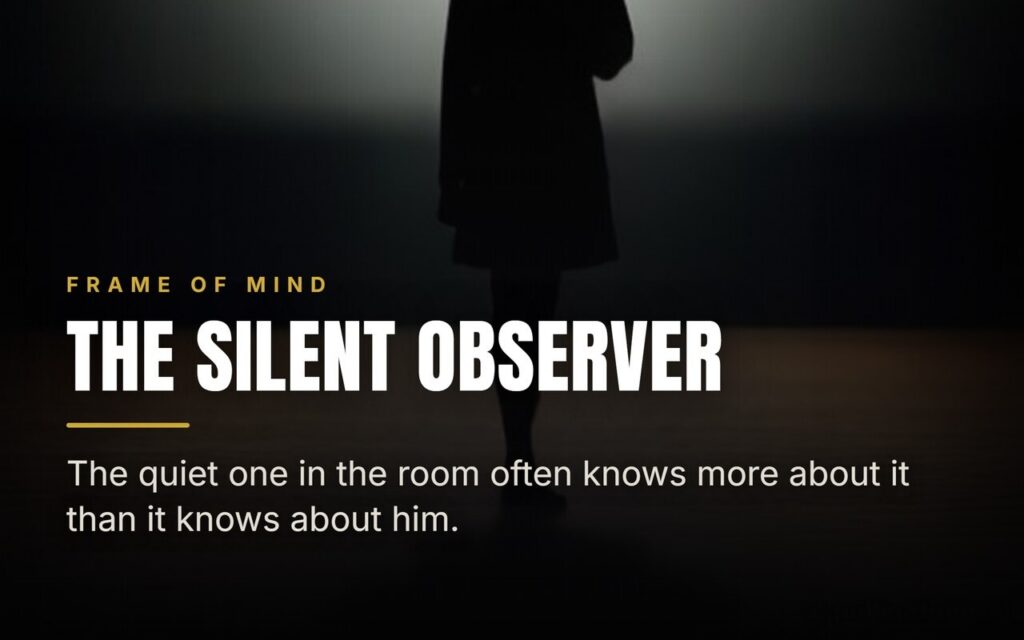
Imagine walking into a room full of people. One of them keeps talking about himself the whole time. Another raises his voice to assert his presence. A third tries to prove he’s the smartest one in the room. Almost everyone wants to be seen. And in a distant corner sits a quiet person. He speaks when he needs to speak. He listens more than he talks. His eyes pick up the small details everyone else ignores. After a short while, you might discover that this person knows more about the room than the room knows about him.
Here begins the idea of the silent observer. Silence in itself isn’t some superpower. Its power comes from the space it leaves for others to reveal themselves. When a person talks about himself, he gives away a lot of information — his opinions, his fears, his ambitions, the things he wants to prove, and the things he’s trying to defend. Meanwhile, someone who keeps a larger part of his thoughts to himself leaves more room for the other person to try to understand him.
Self-Presentation as Theater
Psychology ties this to what’s called self-presentation — the way a person tries to shape the image others have of him. Everyone does this to different degrees. We choose our words, our tone of voice, and the way we present ourselves based on the place and the people around us. Sociologist Erving Goffman described social life as being like a theater — each person presents a particular version of himself depending on the audience and the situation.
And here a simple paradox appears. A person who reveals a lot about himself becomes easier to read. Meanwhile, a person who speaks in a calculated, measured way leaves more room for interpretation. Human beings, by nature, try to reduce the ambiguity around them, so when they don’t get enough information about someone, they start observing them more closely to understand them. And this exact point is what makes silence such an important tool.
Imagine a new meeting at work. One person starts talking immediately. He explains all his ideas. Talks about his achievements. Announces his position on everything. Within minutes, almost everyone knows how he thinks. Meanwhile, there’s someone who listened first. Watched how others spoke. Noticed who influences the decision, and who seeks others’ approval, and who changes their stance when someone more powerful speaks. Then he spoke at the right moment. The second person wasn’t necessarily smarter. But he gathered information before he moved.
Michael Corleone’s Silence
And here we can understand the remarkable transformation that Michael Corleone’s character offers us in The Godfather. At the start of the film, Michael seems distant from his family’s world. Around him are louder, more impulsive figures. Sonny is angry and quick-tempered. Don Vito holds a powerful presence.
Watch how the balance shifts by the restaurant scene, where Michael volunteers to kill Sollozzo and the police captain McCluskey. He barely speaks in the lead-up to it. He listens to the family debate the plan around him, absorbing who trusts whom and who’s afraid, and when he finally commits to doing it himself, the decision lands harder precisely because he hasn’t been narrating his intentions the whole time. By the baptism sequence at the end of the film, intercut with the murders of the other family heads, Michael has become the quietest man in every room he enters, and also, unmistakably, the most dangerous one in it. The film never has him announce that transformation. It just stops needing him to talk as much, and lets the silence show us he no longer has to.
None of this should be romanticized into a rule that silence is always a choice, because plenty of research says otherwise. Studies of workplace meetings, and even of U.S. Supreme Court oral arguments, have repeatedly found that women and more junior people get interrupted far more often than senior men, which means a lot of the silence in any given room isn’t self-possession at all, it’s people being talked over until they stop trying. Confusing the two is a real risk. The quiet colleague who never gets a word in isn’t running the room; he’s been edited out of it. The kind of silence that functions like power has to be available to speak and simply choose not to, a very different position from having the option taken away.
That distinction is what makes Michael’s arc more unsettling than triumphant. His silence works exactly as strategy, right up until the final shot of the film, when the door closes on Kay’s face and shuts her out of the room where decisions get made. The same quiet that won him the family cost him the one person who once knew him before he became this. Power built on saying less can curdle into isolation built on saying nothing at all, and The Godfather doesn’t ask you to admire that ending so much as notice what it actually costs.