Impression Management: Why the Image Wins Over the Truth
People rarely respond to who you really are — they respond to the image you project. A look at first impressions and the skill of impression management.

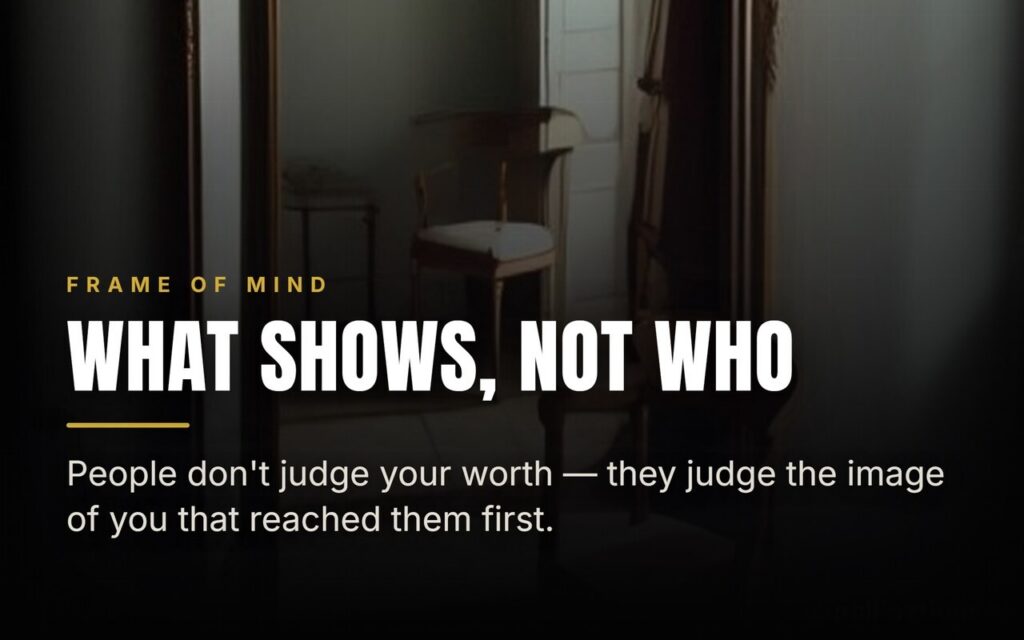
People don’t deal with you based on who you really are — they deal with you based on the image they see of you.
Not what you are, but what shows. That’s exactly why we so often see an infuriating scene: someone less competent than you, less ethical, less experienced, but treated better, taken more seriously, doors opening for him while you’re left standing outside. The question then isn’t “why did this happen?” The bigger question is: is this injustice, or is it just how the system works?
The First Impression
In social psychology there’s a simple concept called the first impression. The human brain is naturally lazy, it likes to judge quickly, and it hates re-evaluating. The first image planted in the mind of the person in front of you usually outlives the truth itself. That’s why a mental image isn’t just some minor detail — it’s the lens through which everything afterward gets seen. If the image says “confident,” any mistake gets read as boldness. If it says “flustered,” any silence gets read as weakness. The truth might be one and the same, but the interpretation changes according to the image.
The Job Interview Test
Let’s look at everyday life. In a job interview, both candidates hold the same degree, roughly the same experience. One walks in calm, dressed simply, speaks with more honesty than necessary, admits his weak points, expecting the other person to “appreciate the honesty.” The other walks in composed, dressed appropriately even if not expensively, knows when to speak and when to stay quiet, presents himself well without lying, but without exposing himself either. Who gets taken seriously? Usually the second one. Not because he’s better, but because he understood the game. And this isn’t deception — it’s a skill called impression management. Meaning you don’t leave your image to chance. You choose what shows and what gets postponed. Honesty isn’t saying everything — honesty is not lying. There’s a big difference.
The Same Story in Love
“Too real” in a world that loves the surface often ends up wronged, not because people are bad, but because the world isn’t built to receive depth on the first encounter. In romantic relationships, the same story repeats. Someone who opens his heart early, exposes all his wounds, and admits every weakness at the very start of the journey, often gets seen as needy, heavy, or unattractive. Meanwhile, someone else, who might be deeper and heavier on the inside, reveals himself one layer at a time, and gets seen as a mystery, someone of value, someone worth discovering. The truth is the same, the timing is different, and the image is what decided. Social media has become the biggest stage for this game.
A curated feed works on the same principle as the job interview, just stretched across years instead of compressed into twenty minutes. Nobody posts the argument, the missed rent payment, or the mundane Tuesday; the algorithm rewards the highlight, and the highlight becomes, for anyone watching from outside, the whole person. The same asymmetry shows up in a salary negotiation or a first client pitch: the person who states a number in a level voice and no apology gets read as simply worth that number, while the one who leads with hedges and caveats trains the room to negotiate down before the conversation about substance has even started. None of this requires lying. It only requires deciding what gets said first.
None of this makes impression management a cynical trick everyone should be playing harder, either. There’s a cost on the other side of the ledger that the interview-room framing tends to leave out: a life spent managing the reveal never actually arrives anywhere, because the timing that worked at the start has to keep working forever, and the gap between the image and the person behind it only grows more exhausting to maintain the longer it goes on. This is part of what impostor syndrome actually is for a lot of people who report it, not a false belief that they’re incompetent, but an accurate sense that the polished version of themselves everyone at work has come to expect was built under a particular kind of pressure and never budgeted for how tiring it would be to keep performing years later. The image did its job. Nobody warned them it would need feeding indefinitely. The people who eventually build real trust with anyone are, at some point, the ones willing to let the second impression catch up with the first, on their own schedule rather than never.
The useful version of this isn’t learning to hide better. It’s learning to sequence honesty instead of dumping it all at once and calling the dump integrity. Say less than everything at the start, not because the rest is shameful, but because trust is something a relationship earns the room for over time. The image and the truth were never really rivals. The image is just the truth, released in an order another person can actually absorb.