The Silent Fight Between Your Mind, Emotion, and Instinct
Most of what feels like a rational decision actually starts as emotion or instinct, and your mind just arrives afterward to write the justification.

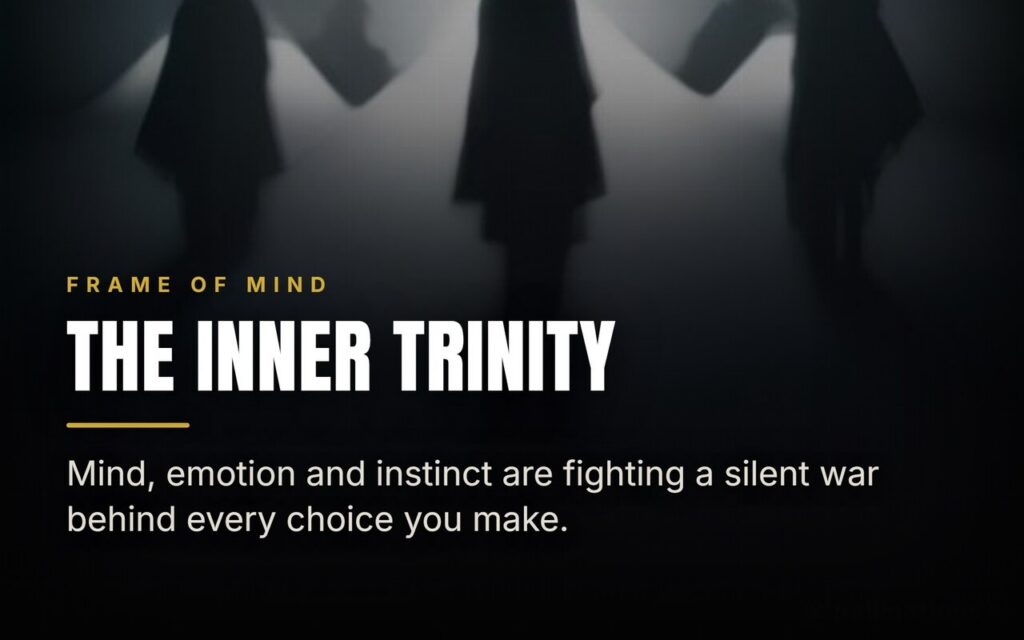
You’re not just one person inside… no, inside you there’s a “holy trinity” running all the time without you noticing. The first is the “mind,” calculating everything in numbers, telling you what’s right and wrong. The second is “emotion,” feeling and impulsive, loving and hating without asking permission. And the third — the most dangerous — is “instinct,” coming from your primal depths, wanting safety, control, pleasure, and survival by any means necessary.
Jump to section
You Don’t Decide With Your Mind — You Convince Yourself You Did
The three of them don’t agree — they never have — and every decision you make is the result of a silent struggle between them. And if you think you’re always rational, let me tell you psychology has proven that most of your decisions actually start from emotion or instinct, and only afterward does your mind come in to justify them neatly. Meaning: you don’t decide with your mind — you convince yourself you decided with your mind. And that’s a terrifying difference.
Quitting a Job, or the Anatomy of a Decision
Let’s simplify it with an everyday example: someone suddenly decides to quit his job. He says, “I thought it through carefully.” The truth? He was suffocated and under pressure, and his emotion exploded, and instinct said “run,” and the mind came afterward and dressed the decision up in a suit of logic and said, “I’m starting a new chapter.” See the trick?
An Old Idea in New Language
Philosophers talked about this trinity a very long time ago, just under different names. In ancient Greek philosophy, for instance, there was a view of man as a struggle between reason, desire, and spirit. And in modern psychology, the idea got broken down further, with the notion that there’s a conscious part and an unconscious part driving you from beneath the table — meaning some decisions you’re convinced are your own choice are actually a stored reaction from long ago, from childhood, from a fear, from an old experience you carry heavy inside you.
When Instinct and Emotion Take the Wheel
Instinct is always faster than the mind — meaning when you’re stressed, or angry, or scared, what kicks in first isn’t thinking, it’s your survival system. Your whole body enters “fight or flight” mode, and in that moment you act in ways you might regret later, saying “I don’t know why I did that.” No, you do know — just after it’s too late.
Now, emotion? It’s more dangerous than you’d imagine, because it wears the disguise of truth. When you love someone, you don’t just love them — you also see them as better than they actually are. Your brain runs a “filter” — it strips away the flaws and magnifies the good qualities. Why? Because emotion wants to continue — it doesn’t want the truth, it wants the feeling. As for the mind — the poor thing — it always arrives late, trying to clean up the mess, but sometimes it becomes a tool of justification rather than judgment — meaning instead of telling you “this is wrong,” it tells you “well, everyone does it,” or “it’s not a big deal this time.”
Neuroscience has actual case evidence for this, not just armchair theorizing. Antonio Damasio studied patients with damage to the ventromedial prefrontal cortex, the brain region that lets emotional signals inform a decision, and what he found upends the tidy story of mind versus feeling. These patients kept normal intelligence and normal logic, and could list pros and cons on command as well as anyone. What they lost was the quiet emotional flinch that tells the rest of us, before we can even explain why, that an option feels wrong. Stripped of that flinch, they didn’t become better decision-makers freed from bias. They became worse ones, stuck for hours over which restaurant to pick, making disastrous financial choices they could argue for perfectly well after the fact. The mind, it turns out, isn’t a neutral referee standing outside the fight. It needs the other two in the room to have anything worth deciding at all.
That complicates the neat picture of a silent war with a villain and a hero. If emotion and instinct were only saboteurs, removing them should have produced clearer thinking, not worse thinking. What Damasio’s patients show instead is closer to a committee missing two of its three members than a mind finally freed from their interference. The fight metaphor holds for the moments when the three pull in different directions, a job you’re desperate to quit, a person you shouldn’t want, but it misses how much of ordinary functioning depends on the three actually agreeing, quietly and most of the time, without you noticing the negotiation at all.
Which suggests the goal was never to help the mind win the argument outright. Daniel Wegner’s research on what he called ironic process theory found that deliberately suppressing a thought, telling yourself firmly not to think about something, tends to make that thought surface more often, not less, because part of the brain has to keep checking for it in order to suppress it. Force the mind to overrule instinct or emotion by sheer willpower and you often get the opposite of what you wanted: the very craving or fear you tried to silence gets louder. The more realistic aim is literacy rather than domination, learning to notice, in the moment, which of the three is actually driving a given choice, since that noticing is the only lever any of them will let you touch.