Herd Psychology: Why the Crowd Makes Us Smaller
Drawing on Gustave Le Bon's The Crowd, on why people who'd never do wrong alone feel safe doing it in a group, and why ignorance so often poses as virtue.

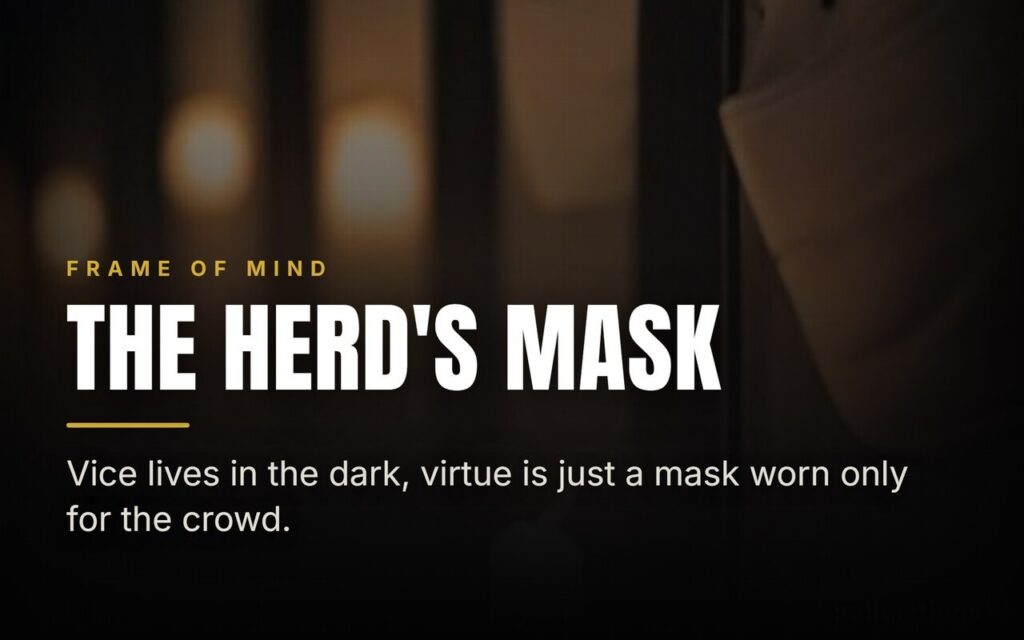
Have you ever wondered why a person feels safe committing collective folly, yet trembles in terror doing the right thing alone? Why does ignorance in our countries seem like a “heritage” to be preserved, and awareness a “betrayal” to be fought? Welcome to a dissection of herd psychology, where reason is switched off, responsibility is dumped onto fate, and virtue is just a mask worn in daylight and removed under cover of darkness.
Gustave Le Bon and the Crowd
When we talk about “herd psychology,” we’re talking about a state of fusion in which an individual’s intelligence dissolves and transforms into the mob’s “rabble,” as the French psychologist Gustave Le Bon explained in his famous book The Crowd. He argued that the moment an individual joins a herd, his intelligence drops instantly, and primal emotions and inherited instincts take over — he becomes a creature stripped of his own will, following the loudest voice rather than quiet logic.
The Hypocrisy of Virtue
This explains the phenomenon of “the hypocrisy of virtue” we live with — many people commit vice in secret, savoring in the dark the very things they publicly condemn, but the moment they step into the light, they turn into judges and executioners, punishing anyone who errs openly — not out of love for virtue, but to prove to the herd that they “belong.” It’s a case of psychological projection — a defense mechanism where a person throws his own ugly flaws onto others so he can feel at ease with his own ugliness, as long as no one is watching. Their standard isn’t conscience — it’s what people say.
A War Against Science
This type of person doesn’t use religion as a path to elevate the soul, but as a catalogue they pick and choose from to suit their own laziness and complacency — they’re skilled at citing verses about sustenance to justify negligence, while completely ignoring the verses commanding reflection, contemplation, and building the earth through knowledge. This is what’s called “confirmation bias” — where your mind searches only for what confirms its preexisting belief and ignores any fact that contradicts it. And from here comes their fierce war against science — science demands effort, thought, doubt, and changing inherited beliefs, while inherited ignorance is comfortable. Science, to them, is an enemy, because it exposes the falseness of the rules their ancestors set — rules they sanctify not because they’re true, but because they’re old. They’d rather live in the warm, dark cave of ignorance than face the cold sun of truth, and that’s why the backward keep producing the backward — not just in ideas, but in people themselves.
This isn’t just a nineteenth-century Frenchman’s hunch. In the 1950s, the psychologist Solomon Asch ran a now-famous set of experiments where participants were asked to judge the length of lines while sitting in a room full of actors instructed to give an obviously wrong answer out loud. A striking share of real participants went along with the wrong answer at least once, not because their eyes had failed them, but because disagreeing with a unanimous room felt like a cost most people weren’t willing to pay. Le Bon was writing about revolutionary mobs; Asch’s data shows the same mechanism working on something as low-stakes as a line on a card.
Le Bon’s theory has also aged awkwardly in places. He was writing partly out of horror at the Paris Commune and a class fear of the masses that later historians have read as more political than scientific, and plenty of research since has complicated his picture of crowds as uniformly foolish. Group behavior can just as easily produce collective courage that no individual in the group would have managed alone: strangers pulling people from wreckage, protest movements that only worked because thousands of separately frightened people stood next to each other. The mechanism Le Bon described, the dissolving of individual judgment into a shared current, isn’t inherently regressive. It just as often depends on which direction the current happens to be running. The same erosion of independent judgment shows up in small, high-status rooms too, not only in street crowds. The psychologist Irving Janis called this groupthink after studying decisions like the Bay of Pigs invasion, where a tight circle of experienced advisors suppressed its own doubts specifically to preserve the group’s sense of unity and confidence. Le Bon was diagnosing mobs in the street; Janis found the identical suppression of private judgment happening around a conference table full of people who, individually, knew better.
That’s the detail the moralizing version of this argument tends to skip. The same psychological trapdoor that lets a crowd turn cruel is the one that lets it turn brave, and the difference isn’t some special resistance the courageous crowd has to herd psychology. It’s what the herd around them happened to be pointed at. Blaming the mechanism itself misses the more useful question, which is what a person has actually built inside themselves before they ever walk into the room: some quiet, private standard that doesn’t wait for a crowd’s permission to hold, and that no amount of collective noise can talk them out of once they’re in it.