The Paradox of Self-Knowledge and Solitude
On Carl Jung's idea of the Persona, and why real self-knowledge often looks like withdrawal, and gets mistaken by everyone around you for depression.

Every life eventually arrives at the same quiet discovery: the person you have spent decades trying to figure out is yourself. Once that work actually begins, something unexpected happens. The closer you get to your own mind, the further you seem to drift from the people around you. Self-knowledge and closeness to others don’t rise together the way we assume they should — past a certain point, one tends to come at the cost of the other, at least for a while.
The shift usually looks alarming from the outside. Someone who used to fill a room and never missed a gathering starts choosing his words more carefully and his evenings more sparingly. He can sit alone for an entire afternoon without the restlessness that used to send him looking for company. To the people who knew the old version of him, this reads as a warning sign. He must be depressed. He must be going through something. He must have lost his faith, or his nerve. It is one of the laziest diagnoses of contemporary life — mistaking a retreat into oneself for an illness, when it might be the first honest thing a person has done in years. Contemplation gets filed under withdrawal; the search for a self gets filed under escape from one.
The Mask We Call a Persona
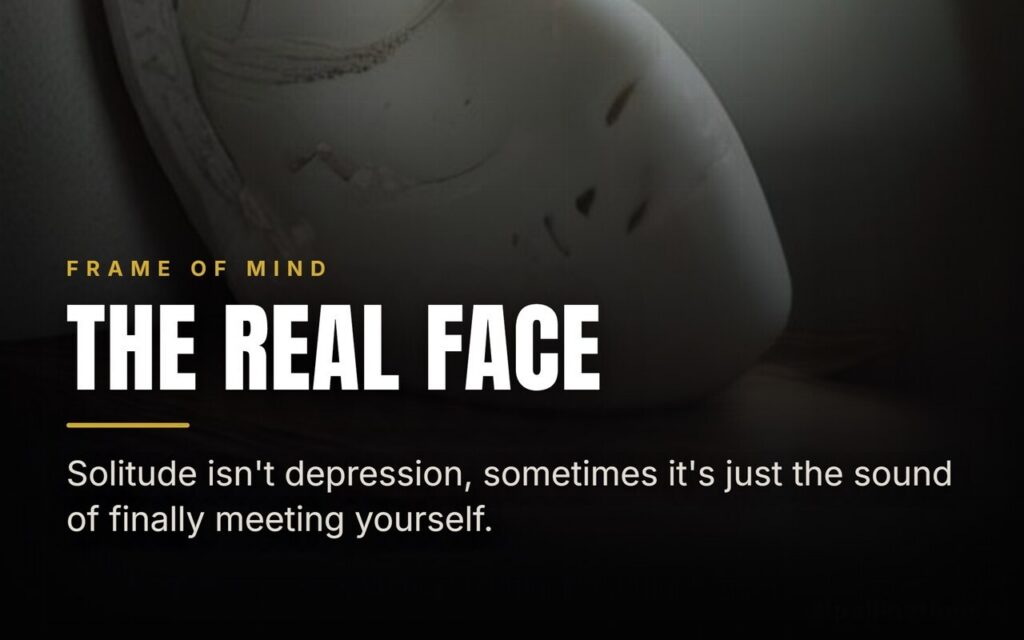
Most people spend the majority of their lives performing a character that other people built for them piece by piece. The family supplied an outline, school added expectations, religion and culture layered on their own requirements, and friends and social feeds finished the job with a running tally of approval. A person can go years genuinely believing he knows himself, when what he actually knows is the edited version assembled around him. Carl Jung had a name for this: the persona, the social mask a person wears to meet the world’s terms. There is nothing sinister about the mask on its own — everyone needs one to function among other people. The trouble starts when a person forgets there was ever a face underneath it, and the habits of a life lived mostly online have only sharpened that forgetting, since the mask is now the thing that gets measured and refined in public while whatever sits behind it goes quietly unattended.
This is why the work of self-knowledge is nothing like the tidy, feel-good version sold in most advice about it. It resembles walking into a storeroom that has been locked for twenty years and finally sorting through what is inside. There are good things in there — old convictions worth keeping, instincts that turn out to be sound. But there are also fears that were buried rather than resolved, grievances quietly filed away, and thoughts a person never let himself finish having. Every door opened inside oneself tends to reveal another room.
Henry David Thoreau ran this experiment on himself two centuries ago and wrote down the results. He left ordinary society for a cabin at Walden Pond not because he hated people, but because he wanted to find out how much of his life was necessity and how much was habit borrowed from everyone else. What he found, by his own account, was less about nature than about noticing: how loud a life gets when it’s never given a quiet room to be examined in. He wasn’t hiding from the world so much as finally getting a clear look at it, and at himself inside it, once the noise dropped away.
None of this should be mistaken for a blanket defense of withdrawal, because the two states really can look identical from the outside and sometimes from the inside too. Clinical depression also produces more time alone and a loss of interest in things that used to matter, and treating every quiet person as a philosopher in training would be its own kind of carelessness. The honest distinction isn’t how much someone withdraws but what fills the silence once they do — whether solitude is being used to think, or simply to disappear. A person doing real inner work usually surfaces with something to show for it: a clearer sense of what he actually wants, maybe a shorter list of people whose opinions still control him. Someone sinking rather than searching tends to come back with nothing at all, not even relief.
Jung had a term for the other half of this process too, beyond the persona: individuation, the slow work of integrating the parts of the self a person has spent years disowning, including the ones the mask was specifically built to hide. That work can’t be rushed by better time management or a single productive weekend alone. It happens, if it happens, on a timeline that has nothing to do with anyone else’s patience for how long a person seems to be “finding themselves.” Which is exactly why it so often gets mistaken for the thing it’s the opposite of.
What looks like withdrawal from the outside is often just a person finally paying attention to a conversation he has been avoiding with himself. The people who worry about him are not wrong to notice the change — they are only wrong about what it means. Solitude chosen on purpose and solitude imposed by despair can look identical from across a room; the difference only shows up over time, in whether the person who returns from it seems more whole or less. Real self-knowledge does not make someone colder toward others. It makes his company a decision rather than a reflex, which is a harder thing to build than the closeness it replaces, but a far more honest one.