The Isolation of Genius: Will Hunting and Alan Turing
Good Will Hunting and The Imitation Game show how sharp minds turn awareness into a shield — protecting them from pain while quietly cutting off closeness.

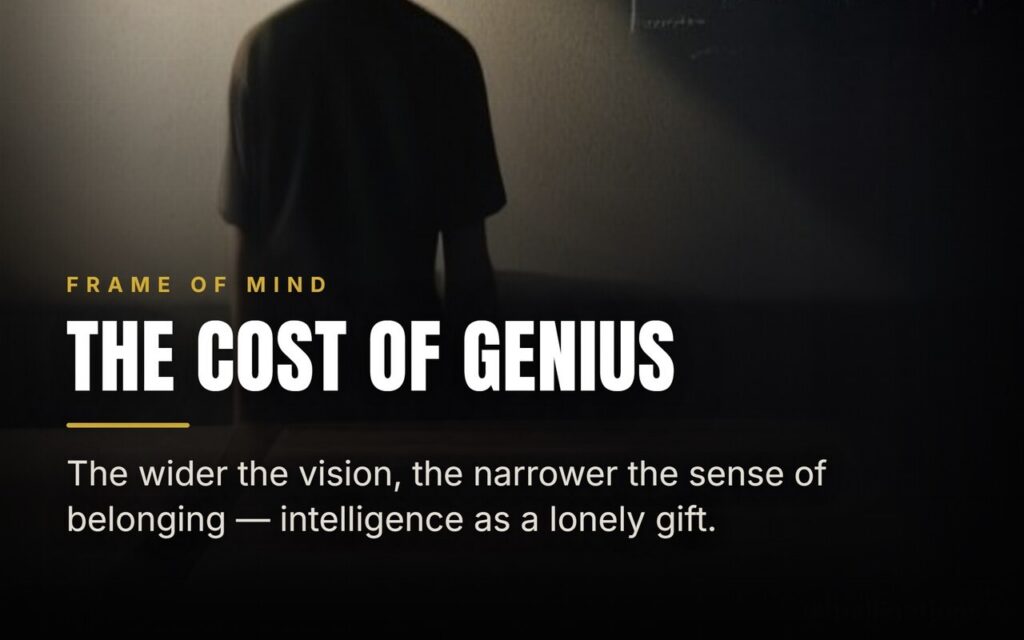
In Good Will Hunting and The Imitation Game, we don’t just see the story of two geniuses; we see an isolation that thickens around two minds working faster than the world’s capacity to keep up with them. Intelligence here isn’t a pure asset. It’s an oversensitivity. A branching awareness. An ability to see possibilities before they take shape. This ability creates distance. The wider the vision, the narrower the sense of belonging. A mind that calculates every possibility becomes less willing to take emotional risks — not because it’s incapable, but because it’s more aware than the heart can bear.
Jump to section
The tax of hyper-awareness
Will Hunting doesn’t fear academic failure. He fears being seen. A childhood full of violence left a complex defensive map inside him. Every new relationship gets dismantled by an inner algorithm: What if he leaves me? What if he discovers I’m fragile? In his famous confession scene in front of the therapist, this algorithm collapses. The intelligence that let him demolish any intellectual opponent couldn’t protect him from his body’s memory.
Alan Turing in The Imitation Game lives a crueler version of isolation. His mathematical genius let him break the Enigma code, but he remained unable to break the code of a society that rejected his difference. His structural intelligence made him lean toward closed systems, toward clear logical language, while the social world runs on an implicit language full of subtle cues and unspoken layers. In the team, he reads equations easily and misreads the room.
Equations as a psychological refuge
When a mind becomes skilled at systems, it tends to escape into them. An equation offers certainty. People don’t. Will uses sarcasm and instant analysis to shut down any attempt at closeness — every conversation turns into a match. Turing uses programming and logic to build a world he can control, a world that doesn’t require emotional intuition. Psychology sometimes calls this pattern “intellectualization,” where pain gets converted back into an analytical problem. Instead of being felt, it’s dissected. Instead of being sensed, it’s explained. This mechanism protects the person temporarily, but it delays healing. Intelligence here works as an advanced shield, but it isolates its owner inside his own fortress.
The isolation of genius: between awareness and belonging
Hyper-awareness means you see people’s contradictions, their weaknesses, sometimes their pettiness. Over time, it becomes hard to simply immerse yourself in things. Will experiences this when love threatens his balance. The relationship with Skylar opens a door that can’t be calculated.
Turing’s isolation didn’t end with the war or with the film’s frame. The historical record outside the movie is harsher than anything dramatized on screen: in 1952 he was prosecuted under British law for homosexual acts, then still criminal, and rather than face prison he accepted a course of hormonal treatment intended to suppress his sex drive as a condition of avoiding jail. He died two years later, in 1954, from cyanide poisoning, ruled a suicide by the inquest at the time, though historians have since debated how settled that conclusion really is. Whatever precisely happened, the plain fact underneath it is damning enough on its own: a mind that helped shorten a world war by cracking a code the Nazis considered unbreakable was, within a decade, destroyed by the same society it had just saved, because that society had no framework for the part of him it could not classify as useful.
Good Will Hunting stages the counter-argument to isolation in one room, across a handful of therapy sessions with Sean Maguire, played by Robin Williams. Maguire doesn’t try to out-argue Will’s intellect, which would be a losing game against someone who has already read every book Maguire could cite back at him. He just keeps repeating, in different forms, that none of what happened to Will as a child was his fault, refusing to let Will intellectualize his way out of hearing it. That refusal is the film’s real thesis: some walls don’t come down through better analysis, only through someone patient enough to sit on the other side of them and not leave. A complication belongs here, though: psychology doesn’t treat every retreat into the mind as pathological. Sublimation, channeling difficult feeling into disciplined, even brilliant work, sits near the healthy end of the defense spectrum in the clinical literature. The line between Turing’s code-breaking as refuge and Turing’s code-breaking as genuine contribution isn’t obvious from the outside, and may not have been obvious from the inside either.
That ambiguity is the more honest ending than either film fully allows. Good Will Hunting resolves with Will driving west toward Skylar, isolation cracked open by love; The Imitation Game closes on tragedy, isolation sealed shut by the exact intolerance the man had just helped defeat. Read together rather than separately, they suggest that hyper-awareness by itself decides nothing about how a life ends. What decides it is whether the world surrounding that mind offers anywhere safe to land the awareness, or only more reasons to keep building the fortress higher.