The Difference Between Being Tired and Being Used Up
Ordinary tiredness passes with rest. Depletion is different — it comes from the people and routines that drain you, and it needs awareness, not more sleep.

If you feel exhausted all the time, the problem is probably not tiredness. Some people sleep eight hours and wake up already flattened. They sit around doing nothing all weekend and still feel wrung out by Monday morning. They try to rest, and rest changes nothing. It isn’t laziness, and it isn’t some personal failure of willpower. Something else is happening, quietly, underneath the surface of an ordinary week, and it doesn’t show up on any test a doctor would run.
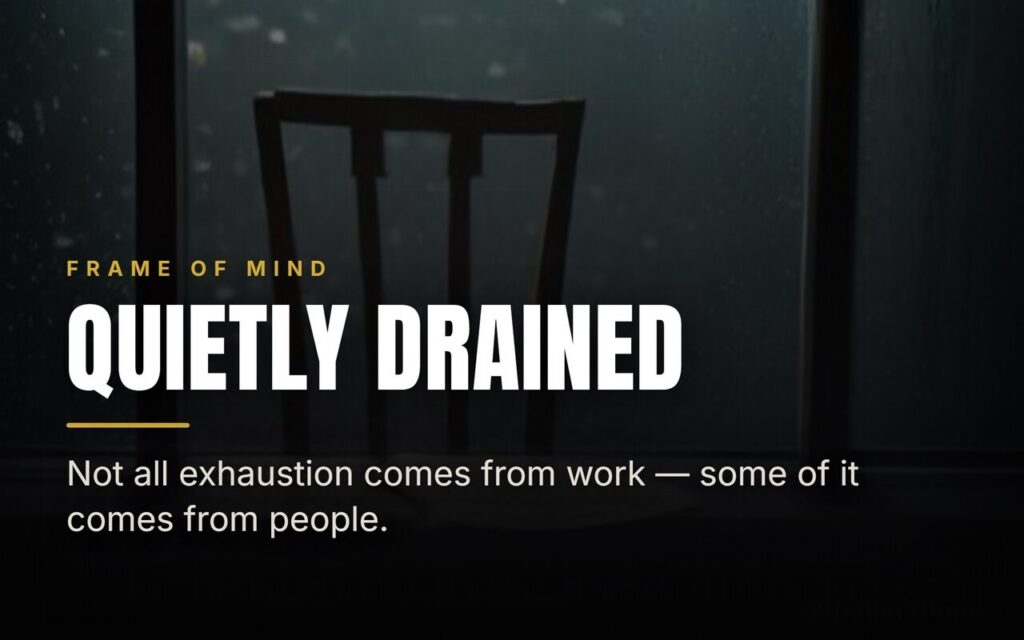
Not all exhaustion comes from work. A good amount of it comes from people, and from the small transactions that make up a day. Conversations that drain you dry and hand nothing back in return. Requests that arrive constantly, as if your time and attention were a public utility anyone could tap into on demand. A habit of overthinking every small exchange until your own mind starts feeding on itself instead of resting. A routine repeated so many times it stopped carrying any purpose a while ago, though nobody officially announced the change. None of this arrives all at once, and none of it looks dramatic enough to name. It just settles into one recognizable feeling: you’re worn out even when, by any honest accounting, you haven’t done anything to earn it.
There’s a real difference between getting tired and getting used up, and the difference matters more than it sounds. Ordinary tiredness passes on its own; depletion just sits there, unmoved by a good night’s sleep. Tiredness has a clear end point. Depletion doesn’t come with one built in. Tiredness responds to rest; depletion needs something closer to awareness — an honest look at where the energy is actually going. And not every form of rest is restful in the first place. Hours spent scrolling from one app to the next can feel like an escape, a small mercy stolen back from the day, but often it’s just a quieter way of spending down what little is left, without the noise that would tip you off.
None of this is solved by trying harder to relax. What it actually asks for is a kind of triage: deciding, plainly, who and what deserves your energy, and cutting back on the things that take without ever giving anything back. Leaving pockets of genuine empty space — no noise, no obligation, no performance of being fine — does more for a person than another early bedtime ever will, because the problem was never a shortage of hours. Once that space is protected instead of filled, the difference is not subtle. It shows up almost immediately, in the small ways a person notices they can finally think a full thought without interruption.
The harder lesson is the one that arrives later, usually by accident: exhaustion isn’t proof of a full schedule. Plenty of people carrying light workloads are just as hollowed out as anyone working two jobs, because the drain was never really about hours logged. It was about how much of themselves they kept handing over, to everyone, without noticing there was a bottom to reach.
Picture the specific mechanics of a Tuesday that produces this without any single crisis attached to it: three unscheduled calls from people who only reach out when they need something, a text thread that requires diplomatic phrasing instead of an honest answer, a meeting that could have been an email but still demanded a performance of attentiveness. None of it would show up on a time-tracking app as demanding. All of it draws from the same reserve, and that reserve doesn’t distinguish between a genuine crisis and a low-grade obligation repeated forty times a week.
The complication worth admitting is that not all depletion is someone else’s doing, and blaming other people entirely lets a person avoid a harder question about their own habits. Plenty of exhaustion is self-manufactured — the refusal to say no, the compulsive need to be seen as reliable, the discomfort with disappointing anyone that quietly costs far more than the disappointment itself ever would have. Other people can only take as much as a person keeps making available to be taken. That’s a less comfortable diagnosis than blaming toxic people, but it’s the one that actually leaves room for a fix.
The test that finally distinguishes the two states is what happens after real time off. A tired person comes back from a week away restored, ready, glad to be useful again. A depleted person comes back from the same week already dreading Monday before it arrives, because the vacation changed the scenery without touching the arrangement that caused the problem. Rest fixes tiredness. It only interrupts depletion, briefly, before the same drain resumes exactly where it left off.
None of this is helped by a culture that treats constant availability as a virtue in itself, rewarding the person who answers at midnight more than the person who protects their own limits. That reward structure teaches exactly the wrong lesson to someone already running on empty, and it keeps the depleted person mistaking the applause for evidence that the arrangement is working.