The Backrooms: Why Empty, Familiar Places Terrify Us
How a 2019 internet forum image became an A24 horror film, and why liminal spaces like empty hallways and airport lounges unsettle us so deeply.

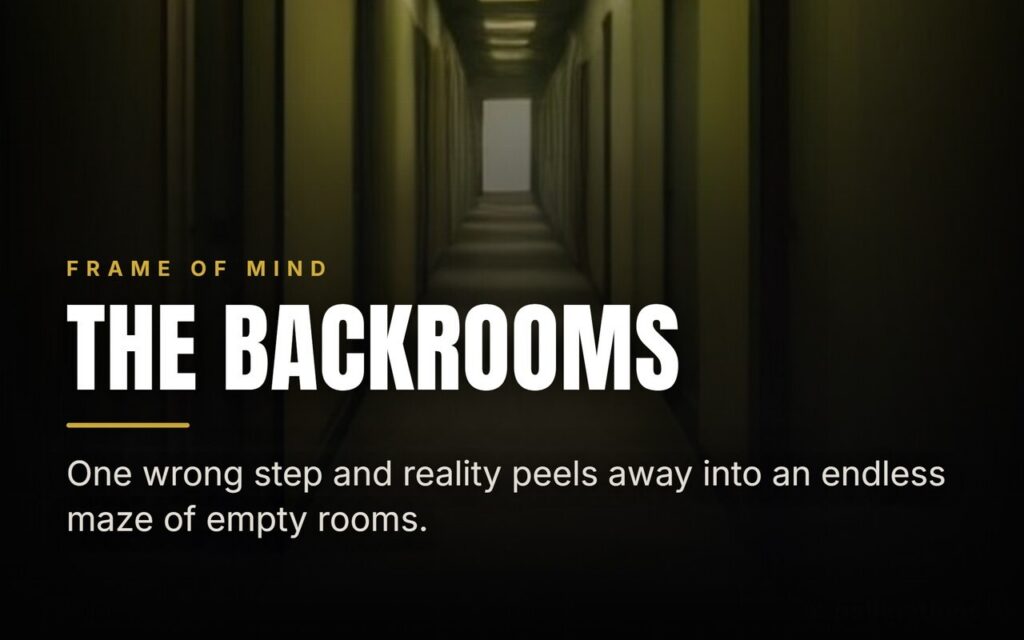
Have you ever imagined falling outside the boundaries of reality?
Imagine walking through a familiar hallway, and suddenly, due to some incomprehensible glitch in the fabric of the universe, your foot slips and you fall through the floor to find yourself somewhere completely different. A place that smells of old, damp carpet, dimly lit by dull yellow light, dominated by the irritating, constant buzz of fluorescent lights.
From Internet Legend to Feature Film
The story began in 2019 with scattered posts on internet forums, featuring a mysterious image of a room with dull yellow walls, old carpet, and annoying fluorescent lighting. Alongside the image was a strange comment talking about “falling outside of reality,” as if the world we live in were just a computer program you could slip out of, finding yourself trapped in the backstage of the universe. The idea remained just a digital legend passed around forums, until a teenager named Kane Parsons, known as Kane Pixels, decided in 2022, at not even sixteen years old, to turn this fear into a visual experience.
He posted a video on YouTube in “found footage” style, a shaky camera in the hand of someone who had suddenly fallen from familiar reality into an endless maze of empty yellow rooms. The video racked up hundreds of millions of views in record time, and the real reason for its overwhelming success is that it didn’t rely on traditional jump-scare monsters, but relied entirely on tapping into psychological and existential fears planted in the subconscious of every modern human. This exceptional success caught the attention of A24 studios and famed horror director James Wan, who teamed up with Kane Parsons himself to bring this phenomenon to cinema screens worldwide, in a film with dimensions that go beyond ordinary horror, becoming rich material for philosophical, psychological, and architectural analysis.
What Liminal Spaces Actually Are
The film’s visual core relies on an architectural and psychological concept known as liminal spaces. What are liminal spaces? They are transitional places designed by humans to pass through from one point to another, not meant to be lingered in or inhabited, like hospital corridors at midnight, empty airport lounges at four in the morning, emergency stairwells, or abandoned parking lots.
Why an Empty, Familiar Room Feels Wrong
Why do these spaces terrify us when we see them on screen? The human mind is evolutionarily wired to search for patterns, meaning, and function.
A hallway is supposed to lead somewhere, a lounge is supposed to hold people, a school is supposed to have voices in it. When a space keeps every visual cue of its intended purpose while stripping out the purpose itself, no chairs arranged for a conversation, no light meant for a human eye to work by, the brain can’t file it under any familiar category. It reads instead as a rule of the world quietly broken, and that specific kind of wrongness, function without inhabitants, design without a designer’s evident hand, triggers a deeper unease than a monster ever could, because a monster is at least a known category of threat. An empty room that looks like it’s still waiting for someone offers nothing to fight and nothing to run from, just an absence with the lights left on.
The word itself has a real history worth knowing, since the internet didn’t invent it. Liminality comes from anthropology, most notably the work of Victor Turner, who used it to describe the threshold stage of a ritual, the part after a person has left their old status behind but before they’ve been granted their new one, neither here nor there, suspended between categories. Online meme culture borrowed the term and applied it to architecture almost by instinct, because an empty airport corridor at 4 a.m. does the same thing to a body that a half-finished ritual does to an identity: it holds you in a state with no clear name, and human beings tend to find namelessness more unsettling than danger they can actually identify.
Some pushback belongs here on how much dread these spaces actually carry outside of a photograph or a horror film’s framing. Most people walk through actual liminal spaces, hotel corridors, parking garages, big-box stores after closing, without feeling anything close to existential vertigo, because context and company usually supply the missing sense of purpose that a lone, cropped photo strips away. The Backrooms aesthetic works less because empty carpeted rooms are inherently horrifying and more because the images that circulate are curated for maximum wrongness, a single figure or no figure at all, a camera angle that removes any exit, lighting pitched exactly between visible and not. That’s not a flaw in the theory so much as a reminder that the fear was always a collaboration between the space and how it’s framed, which is precisely the craft a film adaptation has to reproduce shot by shot instead of getting for free just because the internet already found the image unsettling.



