Shutter Island, The Lighthouse, and the Mind’s Need to Survive
Two very different films, Shutter Island and The Lighthouse, show how the mind builds an alternate reality rather than collapse under guilt or isolation.

Can a person keep on living after the moment they see themselves with no veil at all?
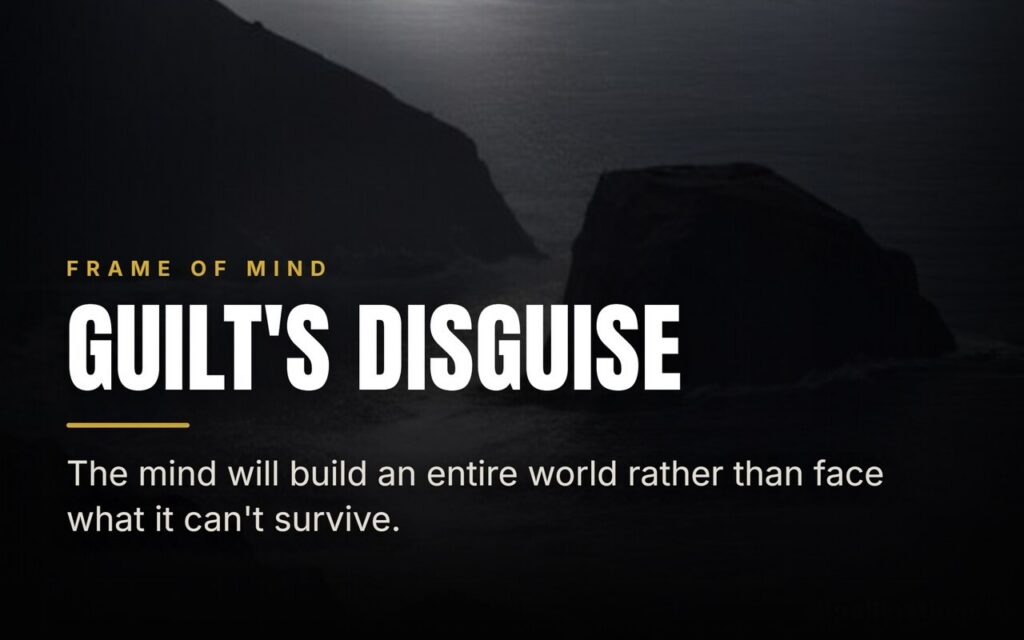
There’s a hidden point within human experience where the outside world begins to recede, while another world inside expands, forming quietly, without announcement, without a conscious decision, as if the mind is rearranging existence anew so it doesn’t collapse under the weight of what it has come to know. A person lives inside an image of themselves, inside a long story that gives them meaning and continuity, and when that story cracks under an event too large to absorb, the real work begins deep down, where memory, emotion, and perception move to redistribute the pain, not with the aim of denial, but with the aim of survival.
Shutter Island: A World Built to Stay Believable
In Shutter Island, an entire world forms around a single need: for the self to remain believable. Every detail within the new experience gives a sense of direction, a clear mission, an external danger, a role that can be played. This construction gives the mind ground to stand on, because guilt, when it stays shapeless, turns into an inner void that swallows everything. In psychology, dissociation appears when the psyche is exposed to trauma beyond its capacity to absorb, so the painful experience is isolated away from the center of consciousness, while the rest of the personality keeps functioning as if the system were still intact.
And yet, the emotional memory stays active, returning in recurring images, in dreams, in sounds, in sensory elements tied to the original moment, as if part of the mind refuses to settle inside the new story. As the moment of full realization draws near, the inner rhythm changes. Details gather, scenes connect, the fog gradually clears, until the person stands before a knowledge that can’t be undone. At this threshold, a silent decision appears: to continue with this awareness and all the permanent weight it carries, or to return to the psychological construction that lets life go on without this burden. Here the imagined world turns into a space of protection, an inner environment that eases the constant pressure imposed by the full realization of guilt.
Shutter Island earns this theory through its structure as much as its story. Teddy Daniels, the U.S. marshal investigating the asylum, turns out to be Andrew Laeddis, a patient there, and the investigation he believes he’s running is a role-play staged by his own doctors to walk him gently toward a truth his mind has rebuilt itself to avoid: that his wife drowned their three children, and that he killed her afterward in his grief. The “case” he spends the film solving was never really a mystery about the island. It was the last layer of a story his own mind built to keep him from being the answer to it.
The Lighthouse: Isolation Erodes the Boundaries of Self
In The Lighthouse, the change begins more slowly and more primitively. Prolonged isolation weakens the boundaries that regulate inner experience, because identity needs the presence of others to stay stable. Over time, the sense of distinction fades, and inner experiences become more intense than the outside world. Repressed images surface, old desires awaken, and memory blends with imagination within a consciousness no longer able to separate them precisely.
Robert Eggers builds this collapse through texture rather than exposition: the cramped, near-square frame, the black-and-white film stock, the foghorn that never stops sounding somewhere underneath the dialogue. Two men are trapped together on a rock with a job that has almost nothing to do all day but wait, and the waiting is what breaks them. The escalation seems to start at a specific, almost throwaway moment: the younger keeper kills a gull against his partner’s explicit warning that the birds carry the souls of drowned sailors, a small act of violence the film treats as the hinge point after which his grip on what’s real starts visibly slipping. Old maritime superstitions about gulls carrying the souls of the dead, and about women luring men to their deaths, stop functioning as folklore and start functioning as explanations, because an unstructured mind reaches for whatever story is closest at hand once the real one stops holding.
Two Films, One Underlying Mechanism
Read side by side, the two films describe the same event from opposite directions. Shutter Island shows a mind building its shelter deliberately, brick by brick, around a wound too specific and too enormous to face directly. The Lighthouse shows a mind losing its shelter gradually, worn down by nothing more dramatic than time, isolation, and the absence of anyone to confirm what is and isn’t real. Neither man is simply insane in the way the word gets used casually. Each is doing the only thing a mind can do when reality stops being survivable as it is: building a version that can be lived inside a little longer.