I Am Hope: Confessions from the Bureau of Deferred Feelings
A personified essay narrated by Hope itself, running the Bureau of Deferred Feelings and filing away every 'maybe this time' we never let ourselves keep.

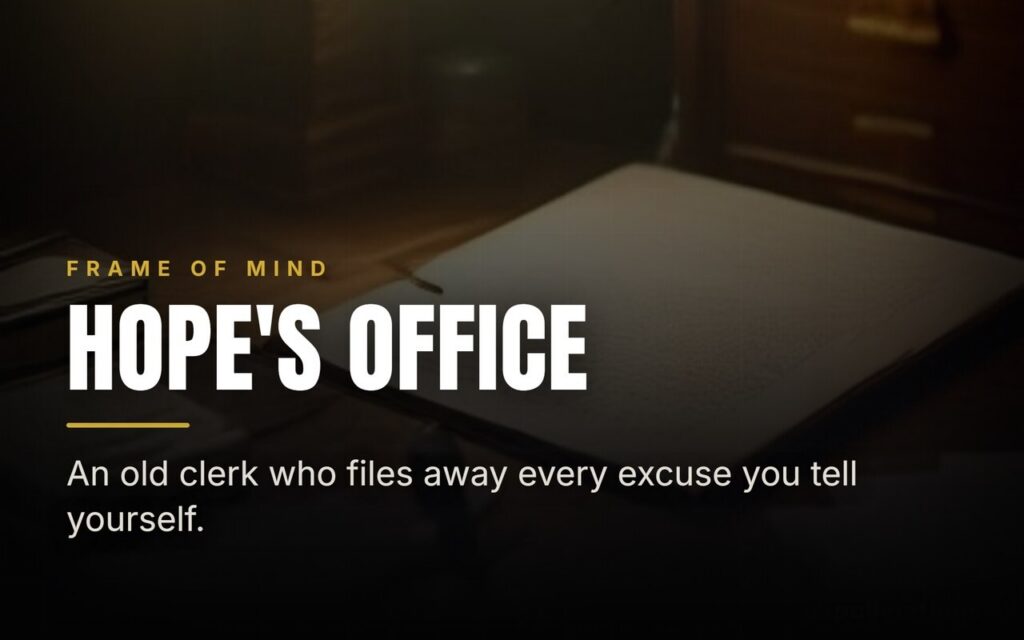
I am Hope. The illegitimate son of Wishful Thinking.
Grandson of a Kindness that never learned to do the math. Cousin of the Softhearted, who signs people’s promises before reading the fine print at the bottom of the page. I’ve worked for years in a strange profession: interpreting things in the best possible light. My office address? “Maybe-It’s-For-The-Best Street. Fourth Floor. Right next to Good Intentions.” And on my door hangs a small sign that reads: “Open even after disappointment.”
The Bureau of Deferred Feelings
I, sir, am an old employee at the Bureau of Deferred Feelings. Every day I receive people who say: “Maybe this time.” So I hand them a number and tell them to wait — even though, deep down, I know some of them are holding a one-way ticket to regret.
What’s Inside the Bag
I carry an old leather bag. Heavier than it should be. Inside it, I keep things people don’t know where else to hide. Letters their writers composed, then deleted before sending. Phone calls that ended with “forget it, it’s fine,” while the person on the other end wished a thousand times someone had asked, “what’s wrong?” It holds appointments that never happened. Apologies that came too late to mean anything. A “missed you” that stalled in the drafts folder. A “I thought you’d remember” wrapped in a tissue so no one would see it.
And in the small pocket, I keep dozens of sentences people say to themselves before sleep: “I’ll call him tomorrow.” “He must have his reasons.” “Maybe I misread it.” “He didn’t mean it.” Of that last one alone, I’ve got enough stock for an entire city.
Sometimes I open the bag and find a small heart left at the bottom. I ask it: “how did you end up here?” And it answers with silence. And I know its owner was the type to say “it’s okay” even while being wronged.
The Drawers
As for my drawers, you can imagine. The first drawer is full of promises whose owners never gave themselves enough time to realize they couldn’t keep them. The second holds the small gestures people blew out of proportion. A cup of coffee. A message at midnight. A passing “how are you.” A laugh at a hard time. I specialize in magnifying these things under a microscope. I give a passing glance meaning. I turn temporary attention into possibility. I place the word “maybe” over everything so the future looks wider than it is.
And in the last drawer — the most dangerous of them all — I keep the people who decided to give a new chance to someone who already broke them once. I set them down gently and tell them: “easy now, folks… when the heart gets used to someone, letting go of them is harder than letting go of an old habit.”
And I have an old enemy named Mr. Completely-Done-With-It. A tidy man. Clean-conscienced. He wears a very precise watch.
He shows up at my office sometimes, uninvited, checking his watch the way other men check a lottery ticket, and he doesn’t yell, doesn’t argue, just states his business plainly: he’s here to collect the accounts I’ve been carrying past their due date. He tells my clients things I never have the stomach to say myself. That the message was read and not answered on purpose. That waiting eight more days will feel exactly like waiting the last eighty. That some doors don’t stay unlocked out of love, only out of someone else’s convenience. I hate him. I also keep his number, because every so often a client of mine needs exactly what he’s selling, and I’m constitutionally incapable of selling it to them myself.
I’ll admit something I don’t put in the annual report. I’ve never been sure whether I’m a public service or a trap with good lighting. Half my clients tell me later that I kept them upright through a season that would have broken them without a reason, however thin, to hold onto. The other half tell me I kept them parked outside a door that had already been locked for months, filing under maybe what should have been filed under over, and that the waiting cost them more than the ending ever would have. Both groups are telling the truth. I don’t get to pick which one a person turns out to be when I hand them their number and tell them to sit down.
So here’s the only honest thing I can post on the door of Maybe-It’s-For-The-Best Street: I will always be open, because closing is Mr. Completely-Done-With-It’s department, not mine. But I’ve started asking my clients one question before I hand them a number now. Not whether they can wait, because anyone can wait. The question is whether they’d still choose to, if I told them plainly that I have no idea how this one ends.