Van Gogh Wasn’t Chasing Beauty, He Was Chasing Honesty
Van Gogh didn't paint to make things pretty. A look at how his inner unrest, his late start, and his use of color turned honesty into his real subject.

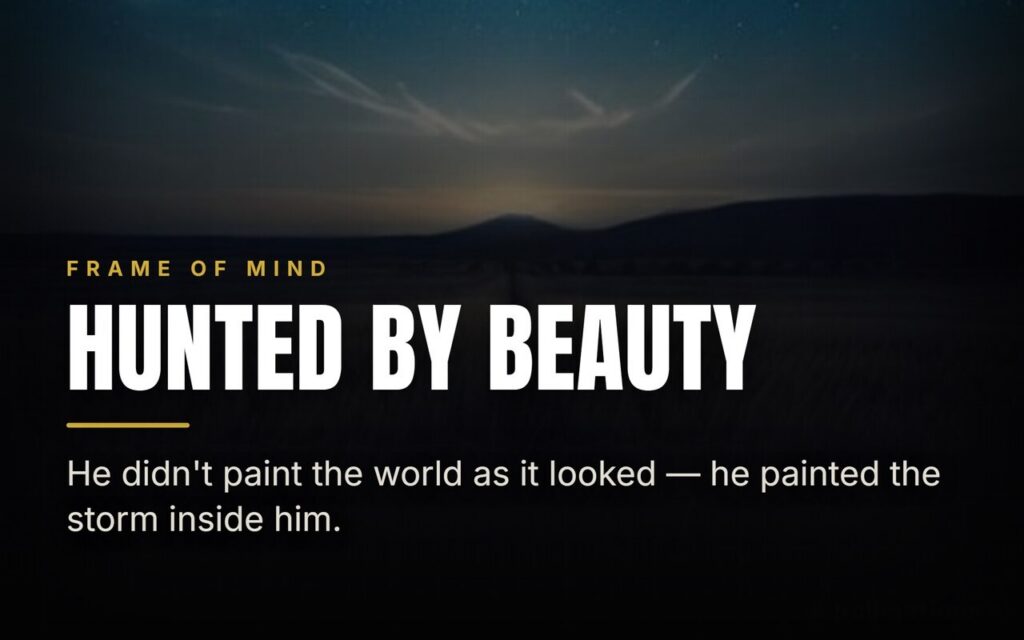
Van Gogh wasn’t searching for beauty; he was hunted by it, the way a person is hunted by the meaning of their life while knowing deep down they may never find it.
Jump to section
That’s why his story doesn’t begin with a painting or a color, but with a deep inner unrest, with a man who saw the world as though it were constantly shaking beneath his feet, a loud world, painful, brighter than it should be, darker than it can bear. This contradiction is the real key to understanding everything he painted afterward. He was a psychological state holding a brush, trying to explain itself, and every painting he left behind isn’t so much a window onto nature as a window onto his mind and heart at a moment of extreme tension. That’s why his paintings seem to move, as if the colors in them never settle, because their creator himself never knew stability.
Painting What Was Felt, Not What Was Correct
Van Gogh was born at a time when art was heading toward discipline, toward academic rules, toward painting as it should be, not as it’s felt. But he went in the exact opposite direction, because he simply couldn’t do otherwise. He saw things differently: fields like waves, the sky like a swirl of thoughts, stars as living beings buzzing with movement. This is what would later appear in paintings like Starry Night, which can’t be read as a calm landscape, but as the mental image of a man standing before the cosmos, trying not to collapse. Here, the sky isn’t painted to be beautiful, but to be honest, and honesty, for Van Gogh, was always violent.
Almost everything we know about how Van Gogh actually thought comes from one source: the roughly six hundred letters he wrote to his brother Theo, an art dealer in Paris who supported him financially for most of his career and never stopped believing in the work even when almost no one else did. Van Gogh sold only a single painting in his lifetime, The Red Vineyard, and died at thirty-seven convinced he’d failed at the one thing he’d given everything to. Theo’s letters weren’t just financial lifelines; they were where Van Gogh worked out, in real time, exactly the ideas this essay is describing — why a wheat field needed to look like it was moving, why a portrait needed the wrong color skin if the right color skin lied about the sitter’s exhaustion.
The Harshness of Life, Without Softening
His artistic path came relatively late, after failed attempts in other fields, including religious preaching, an important detail, because it explains that moral and spiritual streak running through his work. Van Gogh didn’t see art as decoration, but as a way to understand human pain rather than escape it. That’s why he focused so much on peasants, on workers, on tired faces, on people no one bothers to notice, as in The Potato Eaters, where we find no superficial beauty, only the harshness of life as it is, without softening, without prettifying, as if the painter is saying: this is the human being before civilization puts its masks on him.
Color as Feeling
He wasn’t concerned with academic perfection; precise lines or ideal proportions weren’t his main concern. Color was his primary language. To him, color was a feeling toward something: yellow, the color of hope and obsession together; blue, the color of solitude, contemplation, and deep sadness. That’s why his paintings look as if they were written with emotions rather than pigments.
It would be wrong, though, to read his color choices as pure, untrained outpouring. Van Gogh collected Japanese ukiyo-e prints obsessively and copied several directly, borrowing their flat planes of bold, unmixed color; he studied Eugène Delacroix’s writing on complementary colors and Charles Blanc’s color theory closely enough to plan canvases around specific pairings, orange against blue, yellow against violet, well before he lifted a brush. His brief, combustible collaboration with Paul Gauguin in Arles in 1888 pushed him further into deliberate, symbolic use of color rather than direct observation. None of that contradicts the idea that he was chasing honesty over prettiness. It just means the honesty was engineered by someone who’d studied technique hard, not simply felt by someone who hadn’t.
There’s a popular version of his story that treats the suffering itself as the source of the work, as if the breakdowns were producing the paintings. The record doesn’t really support that. His worst episodes — including the crisis in December 1888 that ended with him severing part of his own ear after a fight with Gauguin — left him unable to paint at all for stretches afterward. Some of his most productive periods, including much of his time at the asylum in Saint-Rémy, happened in the calmer months between attacks, not during them. The honesty in the work wasn’t a symptom. It was what he managed to make in spite of the symptoms, in whatever clear space he could find between one collapse and the next.