What Jealousy Is Actually Trying to Tell You
Jealousy can be destructive or motivating, depending on how well you understand it. Freud's take, and the film Amadeus, help explain the difference.

Have you ever felt a pang in your heart when you saw someone else achieve a success you’d dreamed of? Maybe you smiled at them, but inside you held a strange feeling of jealousy, a feeling that confuses the mind and sometimes leads you to think things you wouldn’t normally consider. This jealousy, which seems simple, carries within it a power that controls our behavior, changes how we see the world around us, and might make us prisoners of our feelings if we don’t understand it well.
An Old Emotion With a Purpose
At the heart of every human being lies a complex mix of emotions, and jealousy is one of the oldest emotions described by psychology. Studies indicate it’s a natural part of human nature, acting as an inner trigger that sparks the desire to improve and develop. Sigmund Freud spoke of jealousy as a feeling that can be a creative motivator if controlled, but he also pointed to the danger of it turning into a destructive feeling that takes over decisions. The balance between self-awareness and the desire to excel is crucial, since failing to deal with jealousy leads to both internal and external conflicts.
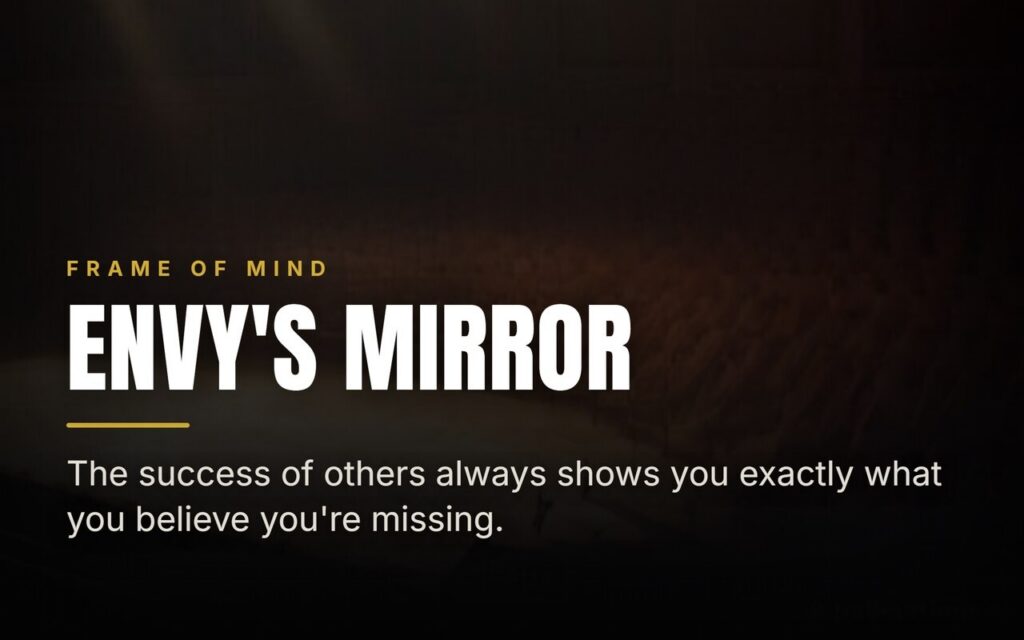
Imagine a moment at work, where your colleague succeeds in a project you’d long dreamed of leading. The situation might seem like a passing event, but inside, thoughts start to circle: why does he get the recognition while I work hard? These natural questions, if left unchecked, turn into negative feelings that affect your productivity and your relationships with colleagues. Jealousy here acts like a mirror, reflecting your own feelings and revealing internal weaknesses, as social psychology research has confirmed that jealousy isn’t just a feeling toward another person, but a feeling toward what you believe you lack. And this point holds huge potential for self-learning and growth, if you understand how to use it to your advantage.
Jealousy on Screen: Amadeus
In cinema and art, we find jealousy portrayed clearly. A film like Amadeus (1984), directed by Milos Forman, portrays the relationship between the composer Mozart and his rival Salieri. Here jealousy turns into a destructive force, planting hatred and leading to psychological manipulation. What makes this film distinct is that it doesn’t portray jealousy only as envy, but as a force capable of shaping a person’s fate and actions, just as in real life, where individuals project their frustrations onto those around them, sometimes without full awareness.
As for natural jealousy, it appears in social relationships in a less harmful way, acting as a motivator for growth and development.
The film’s clearest illustration of that manipulation is its ending: an increasingly ill Mozart dictates the unfinished Requiem to Salieri from his sickbed, and Salieri writes it down not out of belated friendship but so he can later pass off pieces of it as his own after Mozart is dead. It’s jealousy fully metabolized into a strategy, patient enough to wait for a rival’s actual death rather than settling for merely outshining him.
Evolutionary psychologist David Buss has argued that jealousy even splits along fairly consistent lines by sex, with research across dozens of countries finding men reporting more distress at the thought of a partner’s sexual infidelity and women reporting more distress at the thought of emotional infidelity, a partner falling in love with someone else even without physical contact. Buss ties this to different reproductive stakes rather than to different levels of caring, though the pattern isn’t universal and plenty of individuals break from it entirely. Whatever its origin, it’s a reminder that jealousy isn’t one uniform alarm bell. It’s tuned, sometimes very specifically, to what a particular person is most afraid of losing.
The vocabulary is worth separating here, because psychology draws a real distinction between jealousy and envy that everyday language collapses. Jealousy involves the fear of losing something you already possess to a rival, a partner’s attention, a position, a sense of standing. Envy is wanting something someone else has that you never had in the first place. Salieri’s torment in Amadeus is really envy in this stricter sense, since Mozart’s genius was never his to lose, only to want. The distinction matters because the two call for different responses: jealousy often points to something worth protecting or discussing directly, while envy points to a gap between where you are and where you’d like to be, which no amount of vigilance toward a rival will close.
That’s the more actionable version of the film’s warning. Rehearsing a colleague’s success in your head, turning it into evidence of unfairness or personal failure, does nothing but keep you circling the same fixed point. Naming what the feeling is actually about, whether it’s fear of losing ground or a wish that was never yours to lose, is what turns it from something that corrodes into something you can use.