The Difference Between Loving Someone and Needing Them to Exist
Pathological attachment doesn't come from love, but from a fear of nothingness. A look at how 'I'm doing this for you' can mask the need to control.

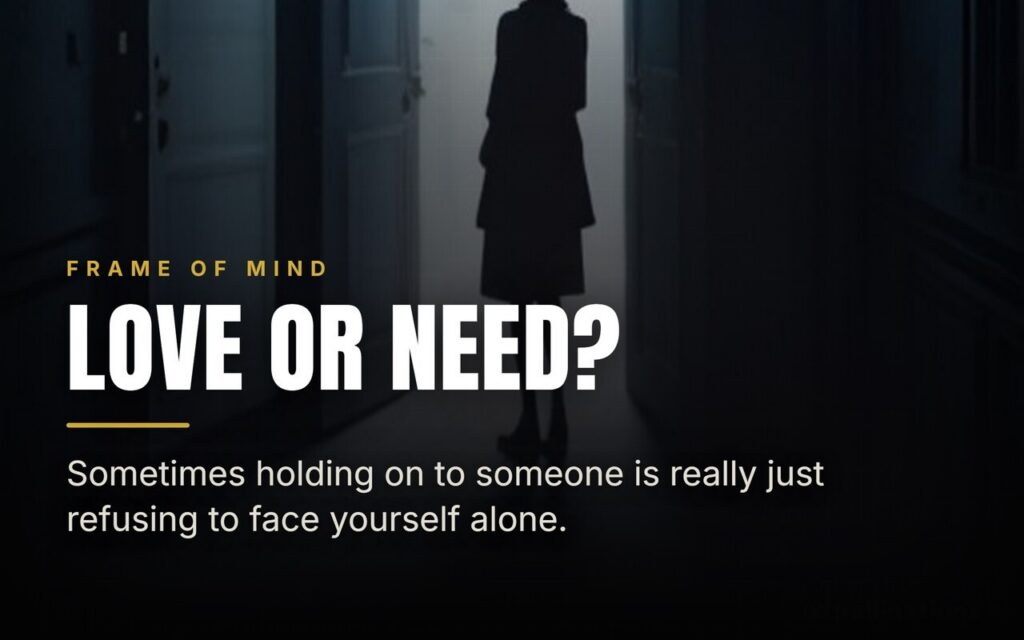
The real tragedy of being attached to someone is discovering that their presence has become the only proof that you still exist.
Pathological attachment isn’t born from love, and doesn’t belong to romance as popular discourse imagines it, but comes from a darker and more complex place: from an inflated awareness of human fragility, and from a mind that can’t bear the idea of nothingness and doesn’t trust the continuity of anything. The person isn’t really seeking the other so much as fleeing from themselves, from their own silence when left alone, from the distance that reveals the emptiness of meaning when there’s no one watching or waiting for us. Here the other stops being a partner in the experience and becomes an existential necessity, a pillar the consciousness leans on so it doesn’t collapse under its own weight.
When Protection Becomes Control
In this kind of attachment, language becomes distorted before intentions do. A phrase like “I’m doing this for you” is said as a fractured psychological truth; the person genuinely believes they’re protecting, because they can’t distinguish between protecting the other and protecting their own inner balance. Protection here becomes a panicked reaction to the possibility of loss, and loss becomes an existential catastrophe, a void that forces the person to face themselves with no mediation. And so every move the other makes is read as a threat, every space they ask for is understood as a prelude to leaving, and every bit of independence is interpreted as coldness. The consciousness never settles, because it’s searching for reassurance, and reassurance doesn’t come from freedom but from control.
What It Looks Like From the Outside
From the outside, the scene looks almost mundanely familiar: excessive attention, close monitoring, endless questions, constant concern, jealousy that seems logically justified. Nothing hints at dysfunction. In fact, this behavior might even look ideal in a culture that glorifies merging and fears distance. But the inside is completely different; the inside is like a locked room where the same thoughts spin endlessly, a stage where loss is rehearsed before it happens, a mind writing breakup scenarios to convince itself it’s prepared, while in reality it’s draining its energy resisting what can’t be prevented. Consciousness becomes a burden rather than a blessing, because its owner sees the fragility of relationships clearly, but doesn’t have the courage to live with it, so tries to erase it by force.
Protection Versus Possession
The difference between protection and the desire to possess shows in the deep motive behind it. Protection implicitly acknowledges the other’s independence and their right to be wrong and to leave, while possession is terrified of that possibility, so it tries to control it, shrink it, besiege it in the name of love.
Simone de Beauvoir devoted an entire chapter of The Second Sex to a version of exactly this dynamic, which she called the woman in love: a person who, finding her own existence unbearable to inhabit alone, transfers the whole project onto a man, making his attention the proof that she’s real. De Beauvoir’s point wasn’t that devotion itself is the problem. It’s that devotion built on escaping your own freedom, rather than choosing another person from a position of already being someone, turns the beloved into a kind of prosthetic self. The relationship stops being between two people and becomes one person borrowing another’s existence to avoid the discomfort of generating their own.
None of this means needing other people is itself the disorder, and it’s worth resisting the instinct to pathologize all attachment as codependency. John Bowlby’s original attachment research treated the need for connection as a basic, healthy feature of being human, not a weakness to outgrow, and therapists working in frameworks like Sue Johnson’s emotionally focused therapy argue explicitly that adults are wired to need each other, and that shaming people for that need usually backfires. The difference isn’t whether you need someone; almost everyone does. The difference is what happens in you when that need goes unmet for an afternoon, whether it produces ordinary longing or a kind of internal emergency that has to be managed by controlling the other person’s movements.
That’s the cleanest test available, in the end, for telling the two apart in practice: whether a partner’s independence gets experienced as their right, or as a threat requiring a response. Healthy interdependence can miss someone badly and still want them to take the trip, see the friends, have the life that doesn’t include you every hour of it. Pathological attachment reads every version of that same absence as evidence of an ending already underway. One version of love can tolerate the other person’s freedom because it isn’t secretly borrowing their presence to stay standing. The other can’t afford to, because if the other person is free to leave, there’s nothing left holding the whole structure up.