Melancholy Isn’t Depression — It’s a Kind of Clarity
Aristotle saw sadness as insight, not illness. Lars von Trier's Melancholia makes the case that clear-eyed sadness can look like calm, not collapse.

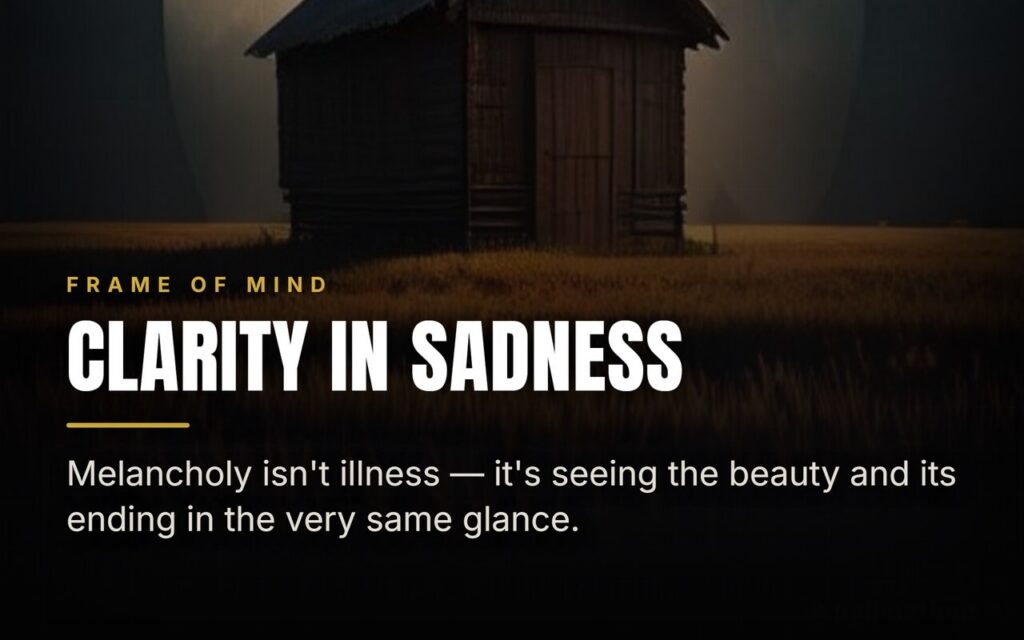
Why do we treat sadness like it’s a flaw? Why, the moment you feel heaviness inside you, do you start searching for anything to escape into… videos, going out, jokes… as if you’re switching off an alarm, even though that signal might not be a danger at all… it might be an invitation.
Jump to section
What the Old Philosophers Called Melancholy
If we go back a bit, we’ll find that the idea of “melancholy” used to be something else entirely… philosophers of old, like Aristotle, believed creative people generally had a tendency toward sadness… not as an illness… but as a state of contemplation… as if the mind, once it settles from the noise, starts seeing things ordinary eyes can’t see… and that’s why classical literature is full of sad characters… but not weak ones. On the contrary — disturbingly deep.
Melancholy Is Not Depression
Here we need to understand the important distinction: depression is an illness… it closes in on you… makes you unable to see meaning in anything… drains you… and needs real treatment and support. Melancholy, though, is a state of awareness… sadness with insight in it… a heightened sensitivity to life… as if you can see the beauty, but you can also see its ending along with it… you see the moment… but feel it slipping away from you.
The Calm of Justine in Melancholia
And that’s exactly what Lars von Trier’s film Melancholia presents… the heroine “Justine” isn’t depressed in the traditional sense… she sees the truth more clearly than everyone else… she sees that the world could end at any moment… she isn’t terrified… on the contrary… she’s calmer than anyone around her… because the people around her are living in the illusion of control… while she sees the fragility.
In the film, as the planet nears destroying the earth… ordinary people fall apart… scream… try to cling to any hope… while Justine… builds a small wooden hut and sits waiting for the end with a strange calm… this scene isn’t just bleak… it’s shocking… it tells you sadness sometimes gives a kind of clarity… a kind of surrender… not defeat… awareness.
And this brings us close to the cinema of Andrei Tarkovsky… the Russian director who believed real art has to be heavy… slow… full of silence… because that silence is the space where you hear yourself… his films never tried to make you comfortable… they made you confront things.
The clearest illustration in the film is its own opening. Before any dialogue, von Trier stages an eight-minute overture in extreme slow motion — Justine in her wedding dress tangled in vines she can’t walk through, birds falling dead out of the sky, a horse collapsing to the ground, and finally the rogue planet drifting into Earth and swallowing it whole, all of it scored to the prelude from Wagner’s Tristan und Isolde. Nothing in that sequence is trying to look hopeful. It’s trying to look inevitable, and it sets the emotional temperature for everything that follows: this is a film that has already shown you the ending before asking you to sit through how the characters arrive at it.
There’s a complication worth being honest about, though. For most of psychiatric history, “melancholia” wasn’t the clear-eyed cousin of depression — it was the very word doctors used for depression, going back to the ancient theory of the four humors and an excess of black bile. The clean split this essay draws between insightful melancholy and clinical illness is a modern, mostly literary distinction, not one the historical record supports on its own. It’s also worth knowing that von Trier has spoken publicly about making the film out of his own depressive episodes, not from some safe philosophical distance above the condition. Melancholia isn’t a healthy person’s tribute to sadness as an idea. It’s closer to a document from inside it, which makes Justine’s calm less a philosophical position the film is arguing for and more a specific, personal way one person’s depression actually presented.
The problem is the world today is trying to “sterilize” sadness… make it something wrong… something that needs to be fixed quickly… motivational posts, rehearsed phrases, constant pressure to stay smiling… and this has created something more dangerous… people now feel guilty when they’re sad… as if they’ve failed some test of happiness. But the truth is simpler and deeper than that… sadness gives you “density” of feeling… it slows the moment down… makes it deeper.
Still, the psychological research gives the essay’s core claim more support than pure literary tradition can. Psychologists Lauren Alloy and Lyn Abramson proposed what they called the depressive realism hypothesis in the early 1980s, after finding that mildly depressed subjects judged their own control over random outcomes more accurately than non-depressed subjects did, who tended to overestimate how much they controlled events going their way. The finding is narrow and contested, and it does not extend to severe depression, which distorts judgment in the opposite direction. But it does suggest that sadness, at a certain pitch, can strip away the small self-flattering distortions most people run on by default. Justine isn’t wrong about the planet. She’s just the only one in the film not motivated to look away from what she already knows.