Black Swan and What Perfection Actually Costs Nina
On Black Swan's Nina, Freud's divided self, and Nietzsche's abyss: how chasing a flawless performance on stage becomes its own kind of quiet collapse.

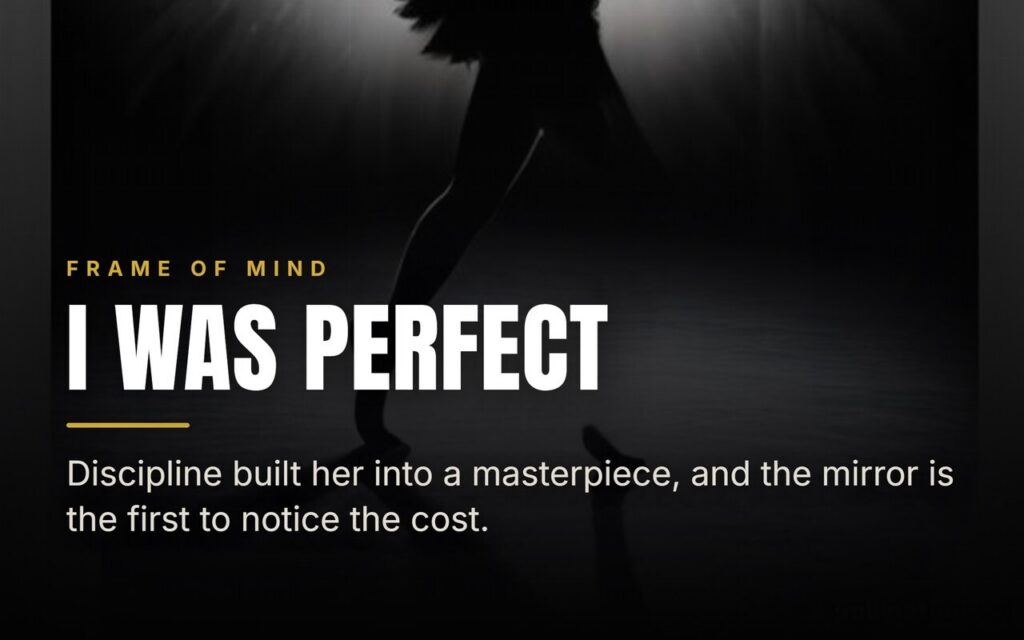
Nina looks as if she was created to be perfect — a disciplined body, calculated movements, a gaze afraid to stray, everything about her running to a strict rule, as if her entire life were one long rehearsal that allows no mistakes. The stage is waiting, the audience is waiting, the role demands a purity untouched by desire, and with every attempt at that discipline, something deeper erodes — something unseen, slowly creeping inside her until it begins reshaping her from within.
Jump to section
Everything that’s suppressed comes back more brutal.
The Mirror Becomes an Adversary
The mirror is no longer a reflecting surface — it becomes an adversary, a reflection lagging half a beat behind, a small movement that doesn’t match, a look carrying a different intention. Here identity begins to slip. The Nina you knew loses her coherence, and another version emerges from the shadow, bolder, freer, closer to chaos. This split brings us close to Sigmund Freud’s ideas, where the disciplined part of the self battles the primal part that refuses restraint. The conflict doesn’t appear all at once — it seeps out in small details, in a tremor, in a look, in a sudden feeling of fear of oneself.
Dance turns into confession, and the body becomes a battlefield.
When the Body Becomes the Battlefield
Every step on stage carries invisible tension, the music rises, and the body begins losing its own nature — feathers appear as a sign, skin changes, sensation intensifies, as if the transformation is really happening, not as a visual trick, but as an expression of an inner collapse surfacing on the body. The perfection she’d been chasing is no longer a pure image — it becomes something predatory, demanding more, pushing her toward limits with no way back.
When you reach the utmost degree of mastery, you discover you’re no longer who you were.
Staring Into the Abyss
This path meets Friedrich Nietzsche’s vision, who believed that when a man stares long enough into the abyss, the abyss begins staring back into him. Nina is no longer performing the role — the role has begun performing her. The line between reality and fantasy dissolves, pain becomes fuel, and fear becomes momentum. Everything moves toward one single moment — the moment of completion, which resembles a fall more than it resembles a triumph.
A masterpiece is born when its creator breaks.
In the final scene, Nina stands on stage, the movement complete, the feeling at its peak, the audience watching a flawless performance — applause, awe, a complete picture. Inside her, something else is happening — a delayed realization that this perfection came at a price. The wound isn’t metaphorical, the pain is real. The ending doesn’t arrive as a shock — it arrives as fulfillment, as if everything that happened had been leading to this exact moment.
I was perfect.
One of the film’s most literal renderings of this collapse is small and physical: a mark on Nina’s shoulder blade that she keeps returning to throughout the story, picking at it, scratching under it, as though something is trying to get out from beneath her own skin. It never gets a clean explanation, and that refusal is deliberate. The wound could be self-inflicted, a habit of anxious picking common enough in real clinical settings, or it could be read as the first physical sign of the transformation the film keeps threatening. The ambiguity does more work than an answer would.
That ambiguity is worth sitting with, because it’s the part of the film easiest to flatten into either pure metaphor or straight body horror. Read purely as psychology, Nina’s transformation is a dissociative episode dramatized for the screen, a mind giving itself hallucinated permission to become someone capable of the role. Read purely as horror, it edges toward a creature story with a ballet score. The film keeps refusing to let either reading fully win, which is its actual craft: every time the story seems ready to confirm that none of this is really happening, it hands you another detail, precise enough that the metaphor stops feeling like metaphor.
What Freud and Nietzsche both offer here isn’t a diagnosis that closes the case, but a way of holding the ambiguity without needing to solve it. The divided self doesn’t require the transformation to be literal to be true, and the abyss staring back doesn’t require Nina to be technically insane rather than technically transformed. The film’s final trick is making the difference stop mattering. By the time she says the perfection was complete, the question of what actually happened to her body has quietly become smaller than the question of what she gave up to hear herself say it, and smaller still than the question of whether she would trade it back if she could.



