Rust Cohle and Hannibal Lecter: Two Kinds of Genius
Comparing True Detective's Rust Cohle and Hannibal Lecter: one sees the universe as meaningless, the other sees it as unfinished art, and neither looks away.

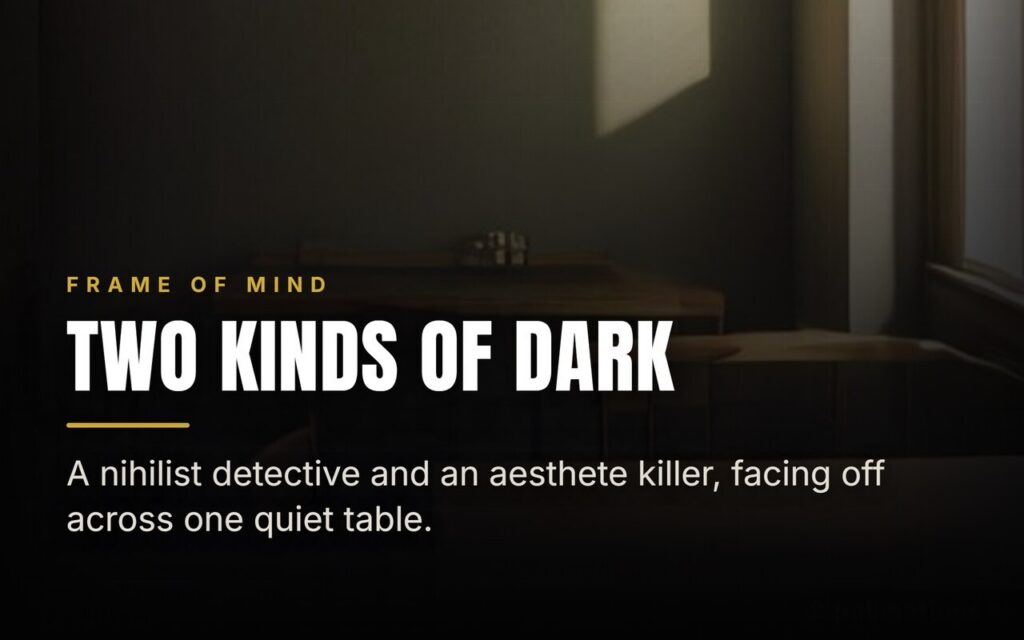
Picture, for a moment, a dark room with a single table, and on either side sit two of the most dangerous minds ever to appear on television — not because their muscles are huge or they’re armed, but because what’s going on inside their skulls is more terrifying than any monster you could ever meet.
Jump to section
On the right sits Rust Cohle from True Detective, the man who sees life as “a biological mistake,” cigarette in his mouth, eyes carrying the look of someone who’s seen hell and came back to tell us about it, coldly. On the left sits Hannibal Lecter from Hannibal, in his impeccably sharp suit, his unnerving calm, his knife glinting beside him as he looks at you like someone evaluating your taste before evaluating your words.
A Clash of Worldviews
The conflict here isn’t who kills whom — the conflict is a clash of worldviews, how each of them sees the world, and that’s what makes this sit-down both terrifying and fascinating at once, because we’re facing two kinds of “cursed genius.”
Rust Cohle: Genius Stripped of Hope
Let’s start with Rust Cohle, the homeless philosopher who believes human consciousness is the biggest prank ever played on a living species. Rust isn’t depressed in the ordinary sense — Rust has reached a stage called “nihilism,” meaning, simply, he sees the universe as meaningless, and that we console ourselves with illusions like love, religion, and society just so we can manage to wake up every morning. When Rust looks at a body dumped in a field, he doesn’t just see a crime — he sees “liberation.” He sees the dead person as lucky, because he’s finally escaped the cycle of pain called life. That’s what makes him a brilliant detective — he isn’t afraid of evil. He sees evil as “the default” and good as the exception. Rust’s genius comes from being stripped of hope, so nothing can break him — he looks a killer in the eye and tells him, “I understand you, because we’re all monsters, you just decided to let yours out.”
Hannibal Lecter: The World as His Canvas
And on the exact opposite side, in the chair across from him, sits Dr. Hannibal Lecter. Where Rust sees the world as a “swamp,” Hannibal sees it as an “operating theater for cosmetic surgery.” Hannibal doesn’t kill because he’s sadistic and bloodthirsty and that’s the end of it — no, Hannibal kills because he sees himself as an artist, and his victims are his clay. To Hannibal, the world is full of ugliness and “rude” people, and his role is to cleanse the world of them and turn them into something beautiful — a fine meal, or a bloody work of art.
The show makes Hannibal’s philosophy literal in ways the metaphor almost undersells. He doesn’t just decide certain people are rude and unworthy, he serves them, plating their organs into elaborate dinners for guests who have no idea what they’re eating, treating a killing as a course that still needs the right wine pairing. Every scene he leaves behind for someone else to discover is staged like a gallery installation, a body folded into wings or dressed as a human tree, because for Hannibal the murder isn’t actually finished until it has been composed.
It’s tempting to call Rust the more honest of the two, since nihilism at least admits nothing matters while Hannibal dresses his cruelty up as art, but that gives Rust more credit than the show ever does. His philosophy is also a kind of armor, convenient enough to explain why he can’t hold a relationship, can’t stay sober, can’t let a closed case rest, and it protects him from ever admitting he still cares how any of it turns out. Hannibal, for all his monstrousness, never lies to himself about wanting things: he wants beauty, deference, and eventually Will Graham’s mind turned toward his own. Rust’s worldview, the one that presents itself as clear-eyed, may actually require more self-deception to maintain than Hannibal’s ever does.
Set the two side by side and the real difference isn’t pessimism versus something else, it’s what each man does after concluding that most of the world is disappointing. Rust responds by disappearing into the work and refusing to expect better. Hannibal responds by remaking the disappointing world in his own image, one dinner at a time. Neither is a reasonable answer to a possibly meaningless universe, but both are more coherent than the comfortable people who never bother asking the question in the first place.
Hannibal, the NBC series, functions as an extended prequel to Thomas Harris’s novels, spending three seasons on the relationship that Red Dragon and The Silence of the Lambs only gesture at afterward, which is part of why the show can afford to make Hannibal seductive rather than simply monstrous. It has the runway to slow-cook the friendship with Will Graham that the books mostly treat as already broken by the time their stories begin, letting the audience watch the trap close in real time instead of hearing about it after the fact.