Viktor Frankl, Schopenhauer, and Why Success Feels Empty
Viktor Frankl's survivors and Schopenhauer's hedonic treadmill point to the same truth: achievement fades fast, and meaning is the only thing that lasts.

“The wider the view becomes… the more the questions outnumber the answers.”
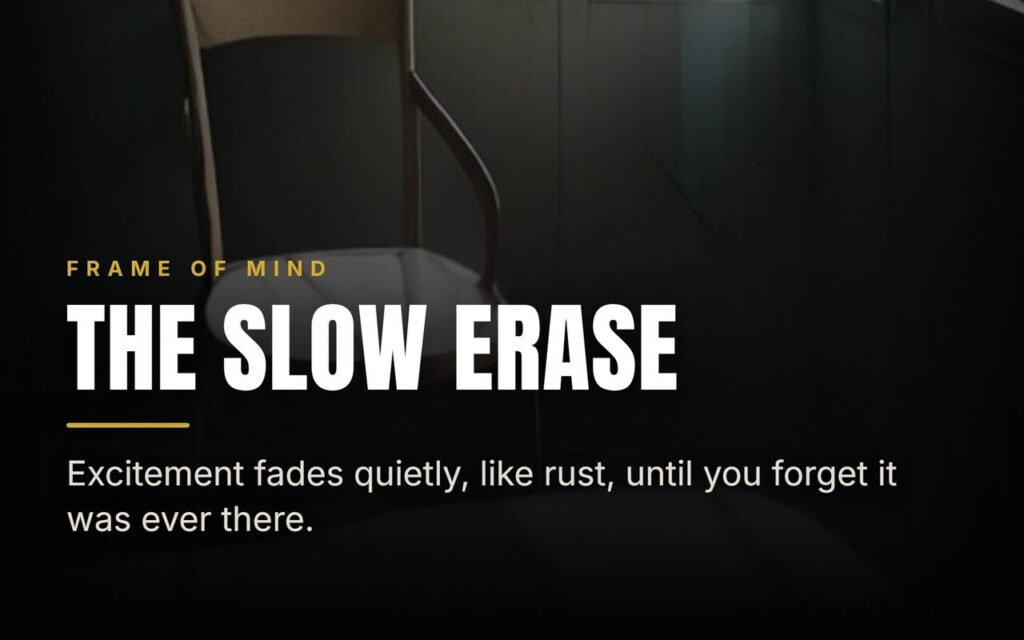
At first no one notices what’s happening. Everything seems normal. You wake up, go to work, pursue your hobby, talk to your friends, chase your goals just like you always have. Then something small happens, barely visible. The things that used to spark excitement inside you become ordinary. The achievements you used to wait for eagerly pass by coldly. The goals that used to keep you going gradually lose their shine. There’s no dramatic collapse, no tragic moment fit for a movie. There’s just a slow erosion, like rust. And after months or years you look at yourself and ask: what happened to all that excitement that used to live in me?
Viktor Frankl and the Search for Meaning
After World War II, an Austrian psychiatrist named Viktor Frankl walked out of the Nazi concentration camps carrying a single question: why were some people able to endure amid the hell while others collapsed? It wasn’t always the physically strongest who survived, and it wasn’t the smartest who could bear the most. What caught his attention was something simpler and deeper at once. Those who had a reason to live for were better able to withstand the pain. From this came his famous idea about meaning. A person can bear exhaustion, deprivation, routine, even suffering, when they feel there’s real value behind what they’re doing. That’s why we find one person working ten hours a day and still full of life, while another collapses after far fewer hours. It’s not always about the number of hours. It’s about whether the heart sees a reason to keep going or not.
Frankl’s own account gives the idea a face rather than a slogan. In the camps he kept mentally rebuilding a manuscript the Gestapo had confiscated before his imprisonment, a book on psychotherapy he’d been drafting for years, revising whole chapters in his head while he stood in roll call or hauled rail track through the snow. He wasn’t fantasizing about rescue. He was rehearsing an unfinished piece of work he intended to return to, and that unfinished task, he later wrote, functioned like a hand pulling him forward through days that offered no other reason to keep walking. The specificity mattered. It wasn’t “survival” in the abstract that kept him oriented — it was one particular book, one particular set of ideas still waiting to be written down.
It’s worth pushing back on the tidiness of the lesson, though. Frankl was describing what he observed in the people who made it out, which means the sample already excludes everyone meaning didn’t save — prisoners with families waiting for them, clear purposes, real reasons to endure, who died anyway of typhus or a guard’s mood or a selection line they had no control over. Meaning may have made suffering bearable to the mind carrying it, but it bought no immunity from the machinery around that mind. Frankl himself was careful never to claim otherwise; the coldest honesty in his book is that meaning changes how a person experiences an ordeal, not whether the ordeal spares them.
Schopenhauer’s Hedonic Treadmill
Nearly two centuries earlier, the German philosopher Arthur Schopenhauer was watching people in a different way. He watched them running after money, status, relationships, and fame, and wondered what would happen once they arrived. Most of us live convinced that happiness is waiting somewhere up ahead. A new job. A bigger house. Marriage. A car. Fame. Success. We run toward it with everything we have. And when we get there, something strange happens. We’re happy for a little while, then the mind settles back into its usual state. In modern psychology this is called “hedonic adaptation,” a phenomenon that makes a person quickly get used to any new gain, no matter how big it is. So the old dream turns into something perfectly ordinary after a short while. Not because the achievement is worthless, but because the brain is wired to always chase the next thing. That’s why so many people feel confused after reaching their goals.
Schopenhauer would have resisted the idea that a purpose fixes the problem, too. His own remedy wasn’t a better goal but a temporary exit from wanting altogether — losing the self for a while in music, in art, in contemplation that asks nothing of the future. For him, chasing meaning through work was still the will doing what the will always does, just wearing a nobler costume. Put the two philosophers side by side, though, and a sharper answer emerges than either offers alone. The treadmill goes flat because pleasure is built to register novelty and then stop registering it — that’s the whole mechanism, and no amount of success outruns it. Meaning doesn’t ride the same circuit. A parent doesn’t get less moved by a child’s life ten years in the way a homeowner gets less moved by the same house, and a nurse who has cared for the dying for decades doesn’t need the job to feel new to still feel it matters. That’s the actual difference between the two men’s diagnoses: one explains why the glow fades, the other explains what doesn’t need a glow to hold.