The Psychology Behind Why Crowds Stop Thinking
Gustave Le Bon and Edward Bernays explained how crowds stop thinking and start following, and how modern advertising still uses their playbook today.

At some point you’re walking through a huge supermarket and you see everyone racing to buy an empty box of cereal — no real advantage to it, just packaging — yet they act as if missing out would be a mistake. It’s tempting to laugh at that. But you probably do something similar every day: scrolling your phone, following the news, or jumping on a trend whose source you don’t even know.
Much of that behavior isn’t random. It follows patterns that psychologists mapped out more than a century ago, in books that are still remarkably accurate about how a group of individuals can turn into something closer to a single, less rational organism.
The Crowd Dissolves the Individual
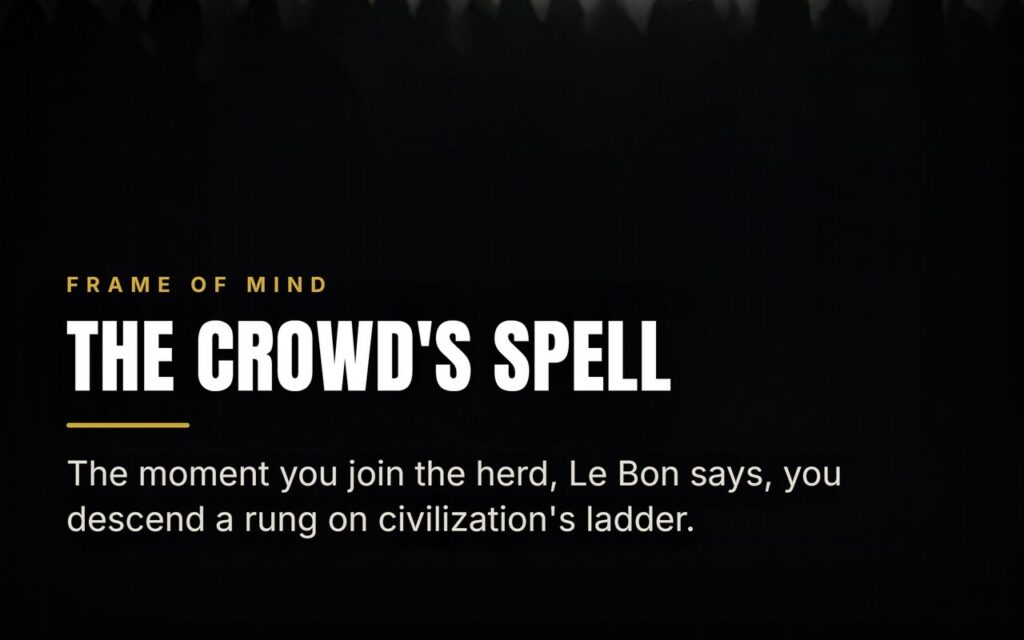
The place to start is the French physician Gustave Le Bon and his book The Crowd: A Study of the Popular Mind. Le Bon wrote a line worth remembering: “The moment an individual joins a crowd, he descends several rungs on the ladder of civilization.” What does that mean? A person alone might be rational, educated, polite. But the moment he joins a crowd — a protest, a stadium, even a Facebook group — something in him dissolves. The conscious, deliberate mind switches off and hands the wheel to something more instinctive and collective.
In that state, a crowd doesn’t reason in logic, it reacts in images and emotion. Look at the comments under any controversial viral post: you’ll find people who are otherwise thoughtful and educated using language that should only come from a mob. In that moment, they aren’t really thinking as individuals — they’re behaving as part of the crowd’s collective mood, which has no single mind, only reflexes.
Selling Feelings, Not Products
If Le Bon explained how crowds think, Edward Bernays — Freud’s nephew — showed how that tendency could be deliberately used. In his book Propaganda, Bernays argued that people don’t really buy products, they buy feelings. His classic example: to get American women smoking in the 1920s, he didn’t argue that tobacco tasted good. He hired fashion models to smoke in a public march and called it the “Torches of Freedom,” linking a habit to the idea of liberation and feminism.
Modern advertising runs on the same logic. Companies rarely sell you a new phone — they sell you the feeling of prestige, of belonging to a certain class. They don’t market a product so much as an identity, and it works precisely because it borrows the same psychological levers Le Bon and Bernays first described.
Solomon Asch’s classic conformity experiments in the 1950s put a number on how far this goes. He found that roughly a third of participants would knowingly give an obviously wrong answer to a simple length-comparison question just to match a room full of actors giving that same wrong answer out loud. Nobody threatened them. Nobody offered a reward. The mere presence of consensus, even a fake one built entirely for the experiment, was enough to override what their own eyes were telling them. Le Bon didn’t have a psychology lab, but he was describing the same pressure a century earlier, just at a larger scale. Bernays would have recognized the mechanism immediately too: manufacture the appearance of a crowd already in motion, real or staged, and individuals will supply their own reasons for joining it after the fact.
None of this means crowds are always reason’s enemy. James Surowiecki’s The Wisdom of Crowds makes close to the opposite case: pool enough independent judgments together, and the average often beats any single expert, which is why prediction markets and crowd-sourced estimates can outperform individual forecasters at guessing everything from election results to the weight of an ox. The difference, in Surowiecki’s account, is independence. A crowd that’s genuinely thinking works because each person is still guessing on their own before the answers get combined. A crowd that’s panicking, rioting, or piling onto a viral post has already lost that independence, which is exactly the condition Le Bon was diagnosing a century before anyone had data to back it up.
The practical test, then, isn’t whether you’re part of a group, since you always are one way or another. It’s whether you formed your view before you saw everyone else’s answer, or copied theirs and mistook the copy for a conclusion you reached on your own.
The GameStop short squeeze in early 2021 showed both dynamics running at once inside the same event. Thousands of retail traders coordinating on Reddit’s WallStreetBets forum genuinely pooled real information about how badly certain hedge funds were exposed, which is the independent-judgment mechanism Surowiecki describes. But the frenzy that followed, driven partly by slogans and momentum rather than fresh analysis, also had the unmistakable shape of Le Bon’s crowd mind: people buying not because they’d done the math themselves, but because everyone around them already seemed to be buying. The same event can start as a crowd thinking and end as a crowd not thinking anymore, sometimes within the same week.