Frankenstein, Black Swan, and the Trap of Perfection
Victor Frankenstein and Black Swan's Nina Sayers both chased perfection past human limits. Here's what their parallel unravelings reveal about hubris.

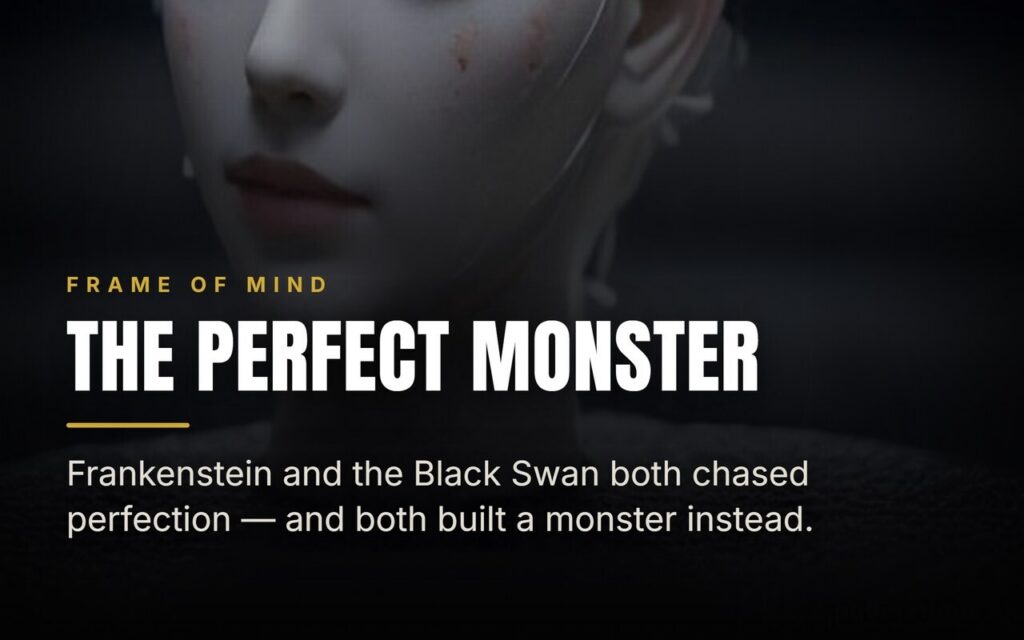
What is the hidden thread linking Victor Frankenstein, the brilliant mind who tried to steal “the secret of life,” and Nina Sayers, the dancer who tore her own skin to dance the perfect role? The link isn’t madness — it’s cognitive hubris. Neither was content with human limits; each wanted to be “superhuman” in their field. Victor believed science would grant him immortality; Nina believed art would grant her the absolute. But what they both discovered is that the pursuit of absolute perfection breeds nothing but monsters.
Victor Frankenstein’s Perfect Creation
Victor is the classic victim of the quest for scientific perfection; his desire wasn’t mere discovery but a wish to “escape human deficiency” and conquer death. He wanted to create a perfect, powerful, immortal being — but the curse wasn’t in his failure, it was in his success. The moment he breathed life into his creature, he looked at it and realized it wasn’t the perfection he had imagined; it was ugly and terrifying, and Victor rejected his creation because it wasn’t an exact copy of the “divine dream” he had pictured. As a result of this abandonment, the innocent creature turned into a monster hunting its creator — the external monster born of a perfectionist’s neglect.
Nina Sayers and the Black Swan
On the other side, Nina Sayers is a victim of artistic perfection; she was the perfect fit for the White Swan, but incapable of embodying the Black Swan. To achieve “artistic perfection,” she couldn’t just play the role — she had to become it. So began her harsh, destructive journey: she rejected her normal life, obsessed over dance, fought parts of herself, and became convinced she saw her rival Lily as a ghost haunting her. Nina’s inner monster was psychosis and hallucination; her body became a battlefield, and her unraveling happened internally before it ever showed outwardly. She achieved “perfection” in the end, but the price was slaughtering her true self.
Icarus’s Sin
The deeper link between them is that both embody “Icarus’s sin” — excessive ambition that leads to a fall. Victor sought to steal the secret of life, the biological red line, and Nina sought to erase her personal identity and dissolve completely into the role, the psychological red line. In both cases, perfection was the mask worn by failure. They show that a blind pursuit of perfection isn’t courage or ambition — it’s an expression of refusing to accept flawed human reality, and this rebellion against imperfection is exactly what breeds ruin in the end.
Mary Shelley gives this its most damning scene not in the creation itself but afterward, when the creature confronts Victor on a glacier and demands he build a companion, having spent the intervening months teaching himself language and feeling by secretly observing a cottage family and reading, among other books, Milton’s Paradise Lost. He compares himself to Adam, cast out with no one, and to Satan, envious of a happiness he’ll never share. The creature isn’t a monster because of anything he did at birth. He becomes one gradually, through repeated rejection, starting with the rejection of the one man obligated to want him.
Black Swan builds toward its own version of that same collapse in the final performance, where Nina’s transformation into the Black Swan is staged as something closer to a wound than a costume, her body seeming to sprout feathers she’s carved into her own skin. Her last lines insist that she has finally achieved the perfection she chased the entire film, spoken while she’s bleeding from an injury inflicted by her own hand earlier that night. Aronofsky refuses to let the audience separate the achievement from the damage; they arrive in the same breath, from the same wound.
Neither man nor dancer invents this pressure alone, which complicates any reading of the story as purely personal hubris. Victor’s ambition is shaped at Ingolstadt by professors who mock the outdated alchemists he grew up admiring and push him toward the era’s cutting-edge science instead, dangling exactly the kind of validation he’s chasing. Nina’s director, Thomas Leroy, tells her explicitly that technical perfection isn’t enough, that she needs to lose herself entirely in the role, and rewards her efforts to do so with the lead. Both institutions, the university and the ballet company, want the transcendence they claim to only be observing. The individual pays the price the system asked for.
What the two stories share, in the end, is that the damage never stays contained to the person chasing it. Victor’s creature goes on to kill Victor’s brother, his friend, and his bride, meaning the cost of one man’s perfectionism gets paid by everyone who loved him. Nina’s collapse, by contrast, is almost entirely self-contained, which is its own kind of warning: a familiar shape of story about hubris usually punishes the people around the obsessive genius, and Black Swan’s willingness to let Nina alone absorb the entire cost is what makes her ending feel less like tragedy in the classical sense and more like a diagnosis of something specifically modern, where the perfectionist’s collateral damage is just her own body.