Arthur Schopenhauer’s Bleak, Honest Case Against Hope
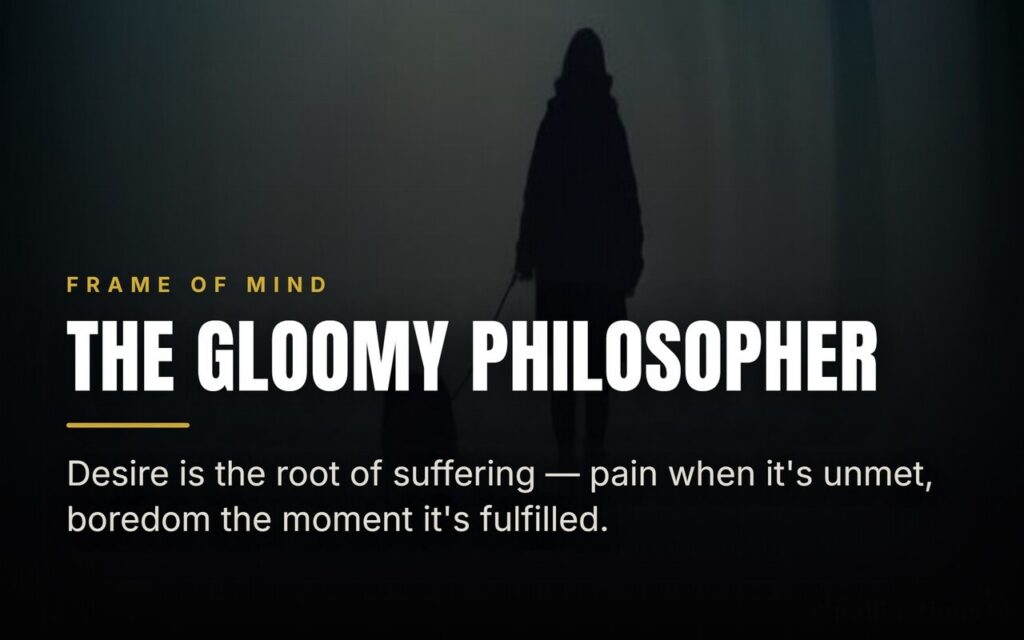
Raised without warmth and ignored by academia, Schopenhauer built a philosophy from one blunt observation: desire is the root of all human suffering.

Why are you upset? Maybe because you think life owes you something… when it never promised you anything to begin with.
If that sentence stung a little, or made you smile with a touch of bitterness, then you’ve stepped into Arthur Schopenhauer’s world — the philosopher who never flattered life, and never lied to man to comfort him, but told the truth exactly as it is: life isn’t some grand tragedy, life is a chain of desires, and behind every desire is pain.
A Childhood Without Warmth
Schopenhauer was born into a wealthy household, but one without warmth. His father was a strict, gloomy merchant who ended up taking his own life, and his mother was a socially successful writer but emotionally distant, more in love with her salons and her guests than with her own son. The child turned out intelligent, sensitive, but carrying a constant sense of being unwanted. From early on he understood that solitude isn’t always a choice… sometimes it’s simply the natural result of being different from those around you.
He traveled Europe as a young man, saw many people, cultures, poverty and wealth, but the one constant thing in front of him was that human beings always want something, and the moment they get it, they grow bored and go looking for something else. This simple observation was the seed of his entire philosophy: desire is the root of suffering.
The Rivalry With Hegel
Schopenhauer entered university thinking he’d compete with the great minds, but was met instead with an academic world full of flattery, self-interest, and heavyweight names like Hegel dominating the scene. And here his most famous complex began. Hegel was the star of his era, speaking in complicated language, and people were dazzled. Schopenhauer saw him as a charlatan selling grand words over nothing. He did something strange — he scheduled his lectures at the exact same time as Hegel’s… and the result? Empty halls. That moment deepened inside him the feeling that the world rewards those who dress up lies, not those who tell the truth.
Schopenhauer spent long years in near-total obscurity. He wrote his greatest work, The World as Will and Representation, and no one cared. He lived alone, in the company of his dogs, disdaining people, mocking them, but deep down understanding them all too well. His life looked simple on the surface, but internally it was a constant battle with depression, loneliness, and a feeling of being unappreciated.
The World as Will and Representation
Schopenhauer’s philosophy starts from one heavy idea: the world you see in front of you isn’t absolute reality — it’s a representation in your mind. What drives the world isn’t reason, or logic, but “the Will” — a blind force inside every living being, making it want to live, possess, and continue, for no logical reason. This Will is never satisfied, and when its desire goes unmet it causes pain, and when it’s fulfilled you feel boredom. Meaning you’re trapped between pain and boredom, and life goes on. That’s why Schopenhauer was gloomy, but not absurdist.
He didn’t leave people simply stranded between those two miserable poles, though. He spent real effort on what he thought might interrupt the cycle, even briefly. Losing yourself in music or art, he argued, was one of the only states in which the Will goes quiet, because contemplating a painting or a symphony asks nothing of your wanting self — for a few minutes you’re not pursuing anything, just perceiving it. He found a deeper version of the same relief in Buddhist and Hindu philosophy, which he was reading seriously at a time when almost no European philosopher gave Eastern thought any weight, and which he credited with describing suffering and its causes more honestly than most of Western thought had managed. By most biographical accounts, he grew fonder of his dogs than of most people he met, and gave at least one of them a name borrowed straight from Hindu philosophy’s term for the universal self — a small, telling detail from a man who found animals easier to trust than the humans dressing up their own wanting as virtue.
His bleakness also produced a real disciple before it produced a rebellion. A young Friedrich Nietzsche read Schopenhauer with something close to devotion and absorbed his diagnosis of suffering as fundamental to existence, before spending the rest of his career trying to answer it differently — not by denying the Will, as Schopenhauer prescribed, but by learning to want your own fate so completely you’d choose to live it again. The two philosophers agree on the diagnosis and split entirely on the prescription, which is as good a demonstration as any that recognizing suffering as basic to life doesn’t force anyone into a single conclusion about what to do with that fact.
Which is maybe the most useful way to read him now, stripped of the caricature of the philosopher who just wanted everyone miserable. Schopenhauer wasn’t trying to talk you out of wanting things. He was trying to stop you from being surprised, every single time, that wanting things hurts. Life never promised you anything — and once that stops sounding like an insult, it starts sounding like the one piece of honest information nobody else was willing to give you.