Absurdism on Screen: Camus, Birdman, and Synecdoche
Camus's absurdism traced through four works — Birdman, Synecdoche New York, Atlanta, and The Banshees of Inisherin — and what each says about meaning.

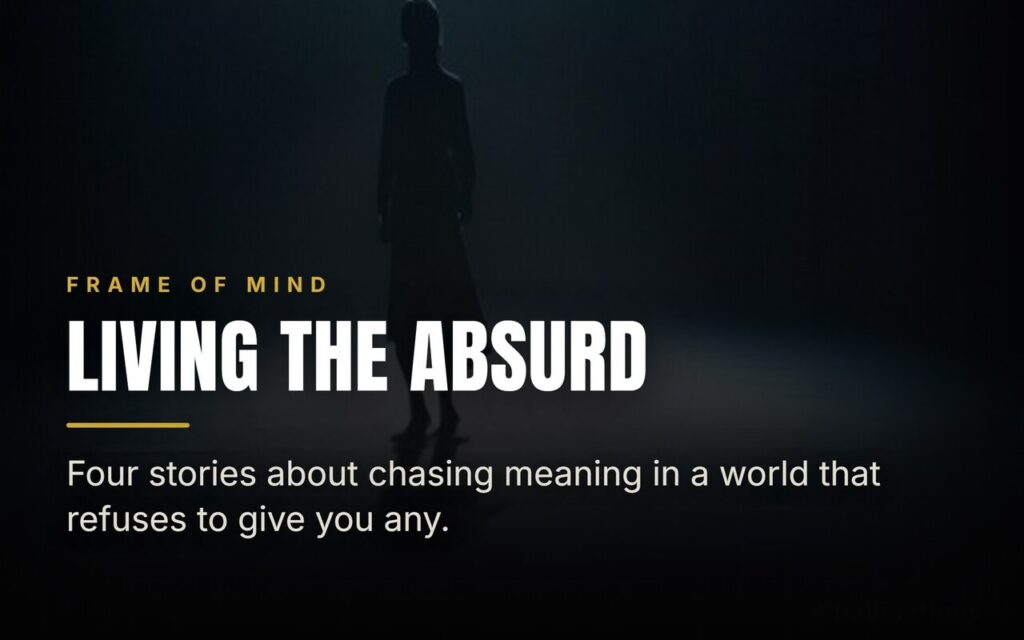
Albert Camus described absurdism as the collision between a person’s innate drive to search for meaning and a silent universe that refuses to answer back. Camus did not propose despair as the response. He proposed revolt: to live fully aware of the absurd, without illusions and without surrender, is itself a kind of victory. Nothing captures that tension better than four very different pieces of screen fiction, each staging the same collision in its own register, comic, cosmic, surreal, and quietly devastating.
Birdman gives it a face and a career. Riggan Thomson, a washed-up star chasing relevance through a Broadway play, spends the film arguing with a voice in his head that mocks every gesture toward significance. His manic grasping for one more shot at meaning is absurd in the full Camusian sense, not silly, but structurally hopeless, since no external validation was ever going to answer the question he’s really asking. The film’s restless, seemingly unbroken camera movement turns his spiral into something closer to a fever than a plot, which is exactly the point: meaning-hunting looks like madness from the outside.
Synecdoche, New York pushes the same idea to a more literal extreme. Charlie Kaufman’s theater director builds a replica of his own life inside a warehouse so vast it eventually needs its own replica, and then a replica of that. The bigger the simulation grows, the less control he has over it, until the map has genuinely become larger and more unmanageable than the territory it was meant to explain. That is Camus’s absurd rendered as architecture: the harder reason works to fully account for existence, the more existence outruns it. Kaufman’s joke is also his tragedy, since no one can think their way out of simply being alive.
Absurdism Without the Cosmic Frame
Atlanta works the same collision at street level, without any of the grandiosity. Its characters chase modest, plausible goals, a record deal, rent money, a functioning life, inside a world whose rules keep revealing themselves as arbitrary, sometimes literally surreal, always indifferent to effort or logic. The show never announces its absurdism the way Birdman or Synecdoche do; it simply lets ordinary ambition run into a wall that was never built to make sense, which may be the more honest version of the absurd, since most people’s collisions with meaninglessness happen exactly like this, in traffic and job interviews rather than in warehouses.
The Banshees of Inisherin approaches from the opposite direction. Here the absurd isn’t imposed by a hostile universe so much as manufactured by a man deciding, on no real evidence, that his remaining time demands a purpose grander than friendship. Colm’s sudden renunciation of Pádraic sets off a string of small, then severe, acts of self-harm and cruelty, and the island’s isolation makes the whole thing feel like a laboratory experiment in what happens when someone insists on meaning where none was required. It is Camus’s absurd turned inward and cruel, revolt curdled into self-destruction.
Taken together, these four works suggest that absurdism is not a single mood but a structure that keeps reappearing wherever ambition meets a world unwilling to cooperate. Camus asked his readers to keep climbing anyway, since the struggle itself is what fills a life. Riggan, Kaufman’s director, the strivers of Atlanta, and the wrecked friendship on Inisherin all keep climbing too. They just don’t all survive the ascent with their sanity, or their friendships, intact.
Camus built his case for revolt around a single image in The Myth of Sisyphus: a man condemned by the gods to push a boulder up a mountain forever, watching it roll back down each time he nears the top. Camus’s famous closing move is to insist that we must imagine Sisyphus happy, not despite the futility of the task but because he has stopped expecting the boulder to stay at the summit and started locating his own meaning in the act of pushing. That’s the move Riggan never quite manages and Colm actively refuses. Riggan wants the boulder to stay up, one great performance to finally silence the voice in his head for good. Colm decides the pushing itself is worthless without a legacy attached to it, which is closer to the opposite of Camus’s answer than a version of it.
It’s fair to push back on filing all four works under one philosopher’s label so neatly. Camus was explicit that revolt has to include a stubborn affirmation of life, and not everything here ends that way. Synecdoche, New York closes on exhaustion more than revolt, its director dying inside a replica he can no longer distinguish from the life it was copying. The Banshees of Inisherin ends in ash and severed fingers, considerably grimmer than anything Camus was recommending to his readers. These four are absurdist in the sense that they all stage the collision Camus described. They’re less unified about endorsing the response he proposed for surviving it.