Whiplash and the Blurry Line Between Greatness and Ruin
Whiplash never really answers whether Andrew's final drum solo is a triumph or a total collapse. A look at ambition, cruelty, and fragile narcissism.

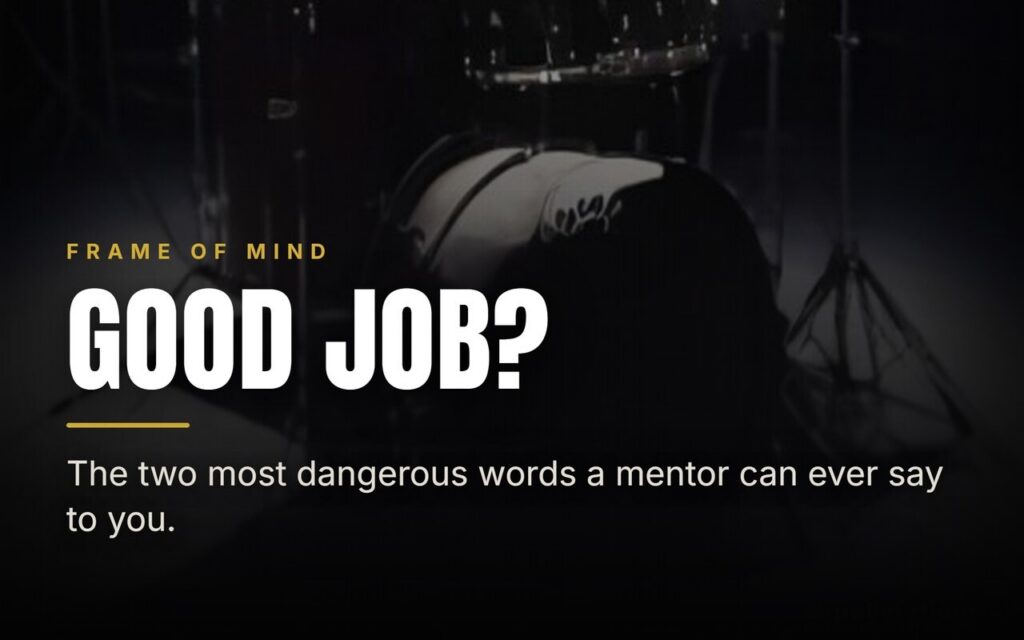
There are no two words in the English language worse than: Good job.
Andrew Neiman, an ordinary young man who wants to become a legend in the world of jazz, is transformed under the influence of his teacher Terence Fletcher into someone obsessed with achieving greatness, even if the price is breaking his spirit, his health, and his relationships with the world. “Success is a sacrifice… and music isn’t notes, music is a battle.” The film digs deep into the idea of “fragile narcissism,” in both Andrew and Fletcher.
Two Kinds of Obsession
Andrew starts as a talented student, but over time develops a lethal conviction: “Either I’m the best, or I don’t deserve to exist.” His obsession becomes a psychological need to prove himself to the world, and even to his father, who sees him as just ordinary. Fletcher, meanwhile, embodies the “sadistic mentor,” who believes that savage cruelty is the only way to forge geniuses. His theory is inspired by the story of Charlie Parker, who became a legend after someone threw a cymbal at him for messing up while playing. Fletcher believes genius isn’t born, it’s forged with fire and pressure, even if it means breaking his students psychologically and physically. “Ordinary people stay ordinary because they never realized that greatness only comes to those who fight for it.”
The Cost of Chasing Perfection
Andrew moves through a complicated psychological journey between perfectionism — every mistake makes him see himself as a total failure. He holds an idealized image of “the genius,” and the closer he tries to get to it, the further away he feels. An addiction to cruelty follows: after being humiliated and pressured, he starts to believe that psychological and physical violence is the only way to succeed. Even after Fletcher destroys him, he still craves proving himself to him. Isolation and emotional detachment set in over time — Andrew starts pulling away from everyone he loves, he leaves his girlfriend, grows distant from his family, and even loses the ability to enjoy music itself. “If you’re not willing to bleed for your dream, don’t expect to reach it.”
Triumph or Final Fall?
The final drum-solo scene is one of the greatest endings in cinema history. In the moment Fletcher tries to destroy Andrew for good, the exact opposite happens. Andrew doesn’t just refuse to give up — he seizes the moment for himself, proving he’s not just a student… he’s an equal, maybe even better. But the real question is: is this a moment of triumph? Or a final fall? Has Andrew truly become “great,” or is he just another shadow of Fletcher — someone who sacrificed everything to prove he deserved it?
Well before the finale, the film plants a quieter warning sign, in the scene where Andrew breaks up with his girlfriend Nicole. He doesn’t have an argument with her or a change of heart in the moment; he arrives with a script already worked out, calmly explaining that she’ll eventually resent his ambition and that ending things now is more efficient for both of them. It’s delivered with the same flat control he’ll later bring to a drum solo. Andrew isn’t cruel by accident in that scene. He’s rehearsed the cruelty, the same way he rehearses everything else he’s decided is necessary.
Whatever triumph the ending offers gets complicated by a single reaction shot the film keeps returning to: Andrew’s father, watching from the crowd, wearing an expression closer to dread than pride while his son pushes himself to the edge in real time on stage. Jim Neiman isn’t reading the solo as a victory. He’s watching what looks, from the outside, like a young man having some kind of breakdown in front of an audience that’s applauding it. Chazelle didn’t need to include those cutaways. Their presence in the finished film is a deliberate refusal to let the audience feel only exhilaration during the one scene built to make them feel exactly that.
The setup for that final scene matters as much as the scene itself. Fletcher orchestrates the humiliation on purpose, cueing a piece the band never rehearsed with Andrew in front of an audience of industry names specifically to destroy him, payback for Andrew reporting Fletcher’s abuse of a previous student to the school. That’s not a teacher pushing a student past his limits for the student’s own good. It’s a grown man using a live performance to settle a score, and Andrew’s response, walking back on stage uninvited and turning the ambush into the best playing of his life, only reads as triumphant if you ignore that the entire scenario was manufactured as an act of revenge.
Chazelle has talked about drawing the story partly from his own time as a student drummer under a similarly punishing teacher, which may be why the film never fully resolves the question it keeps asking. It doesn’t need Andrew to be purely broken or purely vindicated, because both readings can be true of the same nine minutes of music. He plays something genuinely extraordinary, better than anything he’d managed before Fletcher, and he does it by finally becoming the kind of person who’d wreck a rental car and still show up to the gig. The film’s real achievement is refusing to tell you which of those two facts matters more.