V for Vendetta and the Idea Bullets Can’t Kill
V for Vendetta argues that tyranny isn't only about controlling bodies. It's about controlling which ideas people are even allowed to think in the first place.

The story begins at that moment when a person sits inside a closed room… knowing that what’s happening around him is wrong… feeling angry… watching oppression before his own eyes… and then falling silent. Because he’s learned that silence is safer. And this is exactly where the world of V for Vendetta begins.
In a city that looks calm from the outside… a whole system hides behind security, law, and public order. The streets are controlled… the screens speak in the name of truth… and fear works silently inside every home. A tyrant doesn’t always need to put a gun to your head. Sometimes it’s enough to make you believe the gun is everywhere.
A man becomes an idea
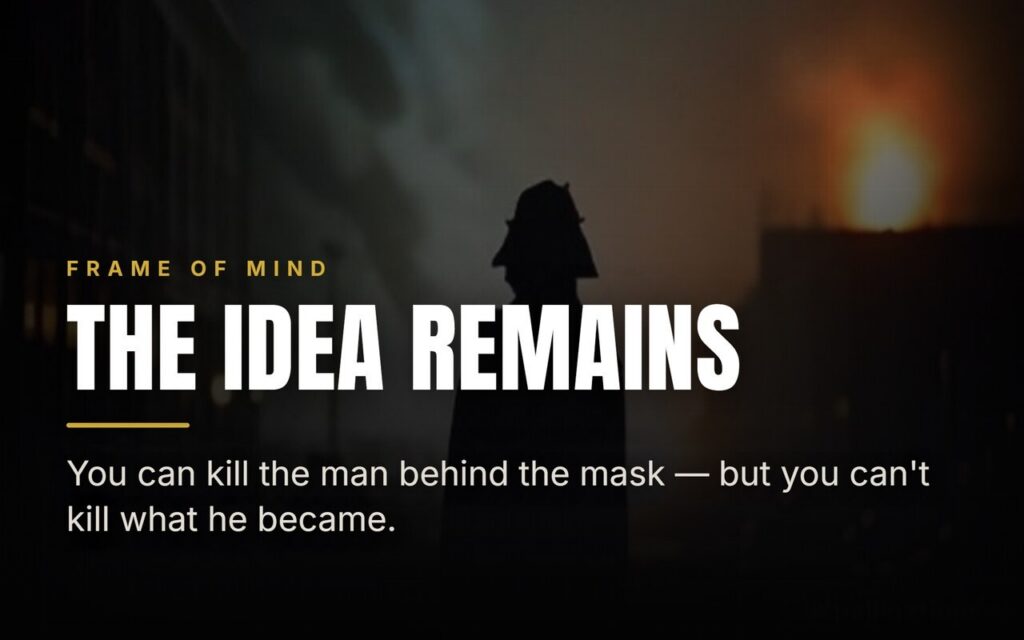
Then a man appears wearing a mask. We don’t know his real face. We don’t know his full name. We barely know where the man under the mask ends and the idea he carries begins. And this is one of the film’s cleverest paradoxes. The more V hides his face… the more present he becomes. Because the authorities can kill the man… can torture him… can erase his name from the records… but they face a much bigger problem when the man turns into an idea.
Do ideas need bodies to live?
And here the film approaches a very old philosophical question… do ideas need bodies to live? Nietzsche believed man doesn’t only live by the values he’s inherited. There’s always a hidden struggle over who has the right to define good and evil… strength and weakness… truth and lies. And whoever has the power to impose these definitions can shape the world around them. This is what makes tyranny more dangerous than just a tyrannical ruler. It doesn’t just want control over your body… it wants to reach the place where your ideas are formed. To tell you what to fear… and what to hate… and who to trust… and to spy on those around you under the pretext of safety… and to consider that normal.
Orwell’s warning, wearing a mask
And here V becomes more than just a man seeking revenge. He’s trying to break the rule that makes people believe reality is a fate that can’t be changed. Literature knew this idea long before cinema did. In George Orwell’s 1984… power wasn’t just watching people. It was trying to control language itself. Because a person who can’t own the words he uses to describe injustice finds it hard to even think about it. And in V’s world… we see the same idea wearing a mask and walking through the streets. Power fears words. It fears books. It fears music. It fears memory. And more than all of that… it fears the person who remembers he was once capable of choosing. That’s why Evey mattered as much as V himself. Because V knows what he wants.
The film makes this concrete with the sequence built around Valerie’s letter, the handwritten testimony smuggled cell to cell in the prison where Evey is later held. It has nothing to do with grand ideology and everything to do with one woman’s insistence on naming what happened to her — who she loved, what was taken from her, why she still refused to apologize for either. That scrap of paper does more to convert Evey than any speech V could have staged, because it proves the state can imprison a body and still fail to reach the part of a person that decides what her own life meant.
A fair complication worth sitting with: the film asks us to cheer a man who blows up a government building and calls it liberation, and that’s a much harder thing to endorse outside the tidy logic of a screenplay. Real insurgent violence rarely resolves as cleanly as it does under a Guy Fawkes mask, and the film’s comic-book source material knows this better than its adaptation lets on — Alan Moore has been openly uneasy with how thoroughly the story’s anarchism got smoothed into something closer to conventional heroism once it reached the screen. The movie wants revolution without asking too hard what comes after the fireworks.
Whatever discomfort that leaves, the central claim survives it. Regimes that police thought eventually run into the same wall: you can burn a man’s house, seize his archive, put a bullet in him at close range, and still not touch the part of him that already decided to think differently. That’s the whole argument wearing a mask and a cape. Ideas outlast the bodies that first carried them, which is exactly why every regime that has ever tried to kill one has had to settle, eventually, for just killing the person instead.
The mask itself does one more piece of quiet work worth naming. By the film’s end, ordinary citizens put on identical Guy Fawkes masks and walk toward Parliament together, and the image only works because the mask had already stopped belonging to one man. Anyone can wear it, which means the idea was never actually his property to lose. That’s the last twist on the film’s central argument: an idea only becomes unkillable once enough people are willing to carry it as their own.



