Tyler Durden and the Self We Invent to Survive
Long before Tyler Durden, Dostoevsky wrote a man who couldn't stand himself and split in two. Fight Club just gave that old idea a modern shape.

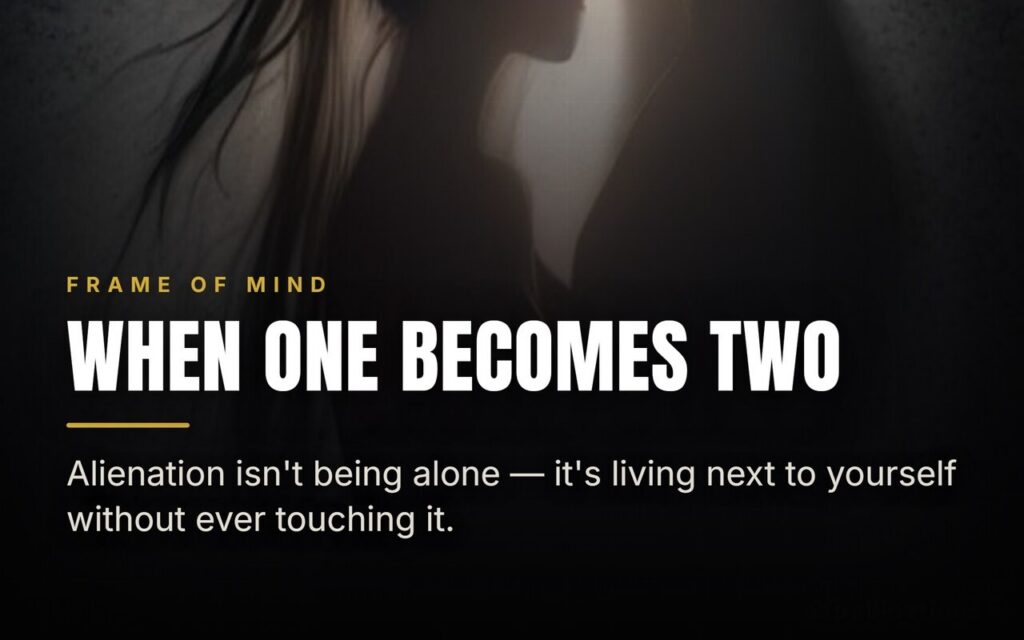
There’s a moment in every person’s life when he looks in the mirror and doesn’t see his own face… but another version of himself, bolder, darker, and more honest. A version that doesn’t submit, doesn’t fear, and doesn’t belong to this world that was carefully built to give us a false sense of identity. And here the story begins — when one becomes two, when alienation turns into rebellion, and the mask turns into a creature living alongside us… and maybe inside us the whole time.
“When the world fails to define you… you try to create yourself from scratch.”
Fight Club is a journey into an identity crisis that widens until it swallows the self. The narrator lives his life as a featureless employee, buying furniture to manufacture meaning, filling his emptiness with things he doesn’t need, playing the role of the modern man as he’s supposed to be: polite, productive, subdued. This alienation reminds us of Dostoevsky’s protagonist in The Double, a man who collapses under the weight of daily details that suffocate him until his “double” appears, doing what he doesn’t dare do himself. Both live in a world that reproduces human beings the way it produces goods, a world that separates a person from himself… and makes him search for a substitute, a shadow, a second version to carry the burden of existence for him.
Tyler Durden as a Principle
“The hero we invent is a tacit admission that we can no longer stand ourselves.”
Tyler Durden isn’t just a fictional character within the film — he’s a principle: the raw desire for liberation from every law. He’s the force that provokes a man to break out of his cage. Every scene between the narrator and Tyler feels like an internal dialogue between a person and his own weakness, between the one who lives by society’s rules and the other who wants to burn them all. Here dual identity appears as an existential battle: not between good and evil, but between “me as the world wants me” and “me as I want to be.” And this second face — extreme, violent — isn’t strange… it’s logical in a world that severs a person from his true will. So when Tyler appears, he doesn’t seem like an intruder; he seems like an unveiling of what was hidden inside all along.
Alienation Is Living Next to Yourself
“Alienation isn’t being alone… it’s living next to yourself without ever touching it.”
The identity crisis the film presents isn’t just psychological — it’s existential. Modern man owns almost everything except himself. He owns a house, coffee, brand-name clothes, but doesn’t know what he’s living for. He works a stable job but feels hollow. He takes part in a society he doesn’t understand and doesn’t belong to. This condition, which Dostoevsky explained in his own way, Fincher amplifies and turns into a full rebellion.
The phone call does the real work here. Marla calls the narrator’s apartment looking for Tyler, and for the first time we hear both sides of a conversation the narrator has been having with himself the entire film, staged as if two separate men occupied two separate bodies. Fincher doesn’t reveal the twist through a monologue explaining it. He reveals it by making us recount, silently, every scene where Tyler was supposedly in a room, and realizing no one else in the film ever addressed the two of them separately. The horror isn’t the revelation. It’s how obvious it was the entire time, and how willingly we agreed not to notice.
The film has a genuine, documented failure mode: a real chunk of its audience walked out treating Tyler Durden as an aspirational figure rather than a warning, adopting the anti-consumerist sloganeering at face value rather than as the diagnosis Palahniuk and Fincher intended. That reaction isn’t a misreading invented by critics after the fact; both the novelist and the director have had to publicly address it for years since the film’s release. A story about a man so alienated he invents a second self to survive got received, by a meaningful slice of its audience, as a lifestyle guide. That says something uncomfortable about how thin the line is between depicting a seduction and performing one.
What that misreading obscures is the actual ending, which isn’t a triumph. The narrator shoots himself to kill Tyler, not to become him, and the film closes with buildings collapsing outside the window while he holds Marla’s hand, having just watched his own invention detonate the future he built. That’s not a man who won his war with himself. It’s a man who survived it by force, standing in the wreckage of a plan he no longer controls, next to the one person he never fully explained himself to. Dostoevsky’s clerk in The Double doesn’t get even that much; his ending is committal, not rubble and a held hand. Fight Club at least leaves its narrator a choice about who to be next. That’s a thinner victory than the film’s cult reputation usually allows for.