The Teacher Who Chose Distance Over Closeness
A quiet substitute teacher who avoids closeness raises a hard question about attachment, distance, and whether keeping people away is really survival.

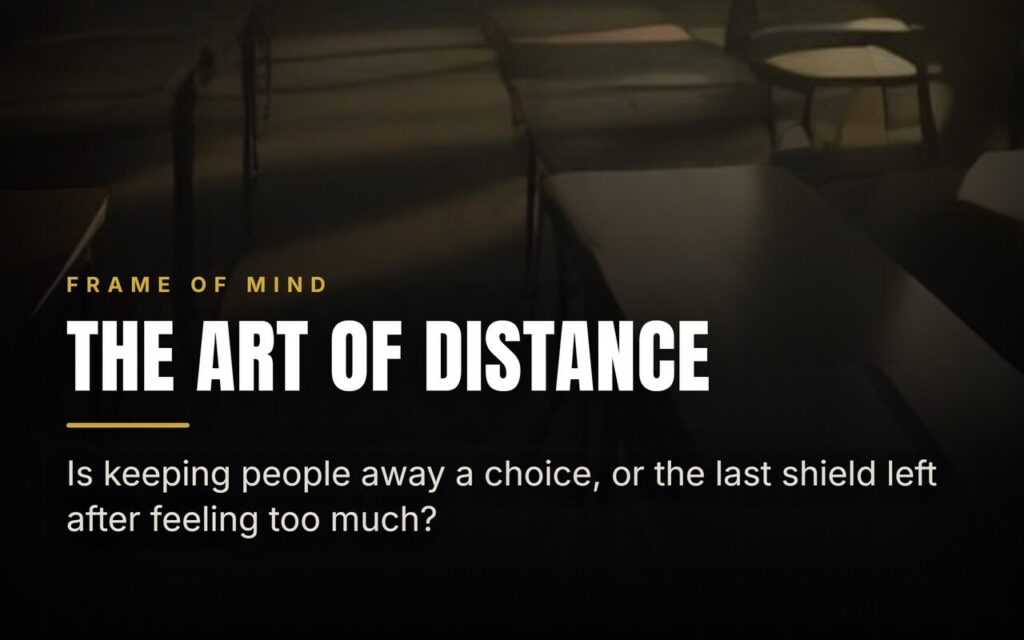
He walks into the classroom, doesn’t raise his voice, doesn’t try to be a hero. He just stands there, looking at the faces, as if he sees something no one else can see. There’s no explosion here, no giant mystery, no elaborate revenge plot. The battle is eerily quiet, unfolding inside a person who has calmly decided to put distance between himself and everything, because he tried closeness once too often.
Jump to section
The protagonist is so transparent it makes you suspicious of him: a substitute teacher who enters his students’ lives and then leaves without a trace, as if he doesn’t want to be remembered. And here the question creeps in quietly: is distance a choice, or a survival mechanism?
Distance as a Survival Mechanism
The psychiatrist John Bowlby, the father of attachment theory, believed a person is shaped emotionally by his earliest relationships, and if those relationships were unstable or painful, the mind starts building something like an invisible shield. It protects you from harm, but at the same time stops you from feeling. Put another way: you don’t go cold because you don’t feel — you go cold because you once felt too much, at a time when you shouldn’t have had to feel at all.
A System That Has Lost Faith in Itself
The film moves slowly, through scenes that look ordinary: a classroom, a silent student, another one angry, an exhausted school administration. But underneath this calm, something is eroding. The system itself seems to have lost faith in its own purpose. The thinker Erich Fromm believed modern societies produce individuals disconnected from themselves, because they’re treated as functions, not as human beings. The school in the film is a transit station for exhausted souls. The teachers save themselves, and the students learn one lesson in silence: no one here will stay for you.
And here the protagonist doesn’t seem as different as you thought at first. He isn’t the exception, he’s the most honest version of everyone else. But the film doesn’t leave you with this comfortable reading, because it starts revealing a deeper, more unsettling layer: the detachment in the protagonist is an ongoing decision. He knows how to get close, but chooses not to. He knows there are people who need him, but he keeps the same distance, as if closeness itself is a danger to be avoided.
Survival that costs you everything isn’t survival.
The Question the Film Won’t Answer
With every character he meets — a student trying to be seen, a girl searching for shelter, a system slowly collapsing — you feel the film pushing you toward one question, with no ready answer: is it better to suffer because you got close, or to live in a false peace because you never got close at all?
Bowlby’s framework isn’t just a single mechanism, it comes with categories, and the protagonist reads like a textbook case of what later researchers called avoidant attachment: a person who deactivates the need for closeness rather than expressing it, who has learned that wanting comfort out loud gets punished or ignored, so he stops signaling the want at all. It looks like calm from the outside. From the inside, avoidant attachment is not the absence of need, it is need that has gone underground because showing it once cost too much.
But the film is careful not to let this read as a victimless strategy. Every student who reaches toward him, the one trying to be seen, the girl looking for somewhere safe to land, absorbs the cost of a defense mechanism that was built to protect someone else entirely. That is the harder version of the question the film is asking: distance may keep the protagonist intact, but it doesn’t keep intact the people who need him to be something other than intact. Self-preservation and care for others turn out to be values that don’t automatically point in the same direction, and the film refuses to pretend otherwise.
Erich Fromm wrote about this exact trade years before attachment theory had its current vocabulary, describing how people faced with more freedom and more responsibility than they can bear will often choose a kind of controlled withdrawal over the risk of real connection, calling it, in the title of his best-known book, an escape from freedom. The protagonist isn’t fleeing a tyrant or an institution. He’s fleeing the specific freedom to be hurt again, and the film’s refusal to resolve that trade-off, to tell you plainly whether he chose correctly, is the most honest thing about it. An underfunded school with an exhausted staff was never going to hand out clean answers, and a film that pretended otherwise would have been lying about the one thing it actually gets right. What lingers after the credits isn’t a verdict on the man but a question about the institution around him: a system this depleted produces exactly this kind of careful, self-protective distance in the people who staff it, and calling that a personal failing lets the system off far too easily.