Thanos’s Philosophy Has a Hole He Never Sees
Thanos framed the Snap as the only rational solution, but his logic has a hole he never questions, and that gap is what makes him truly dangerous.

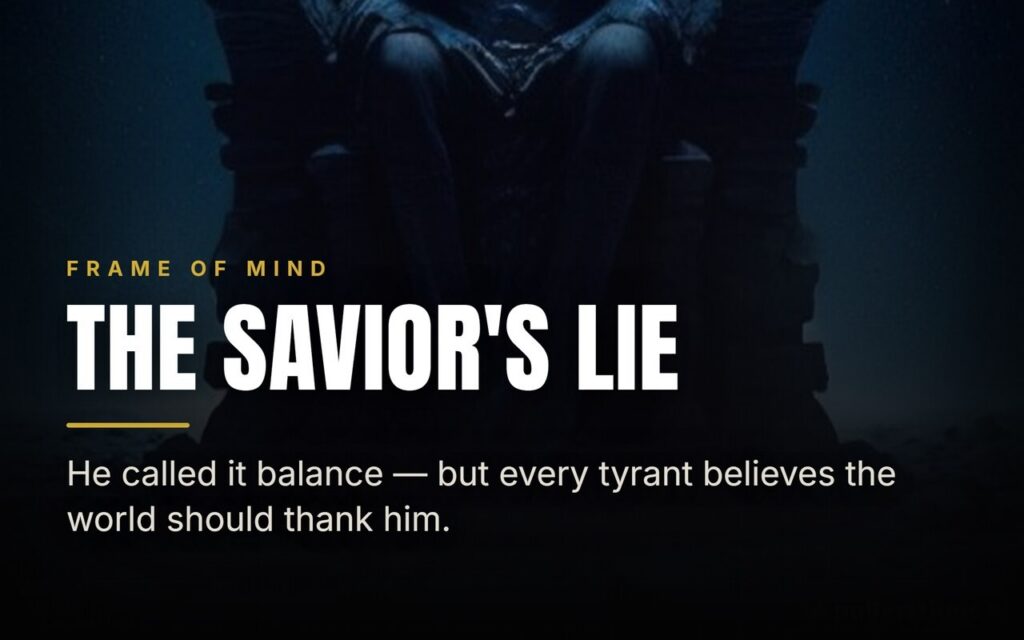
Thanos built his entire worldview on a premise that sounds almost reasonable stated quickly: resources are finite, populations keep growing, and left unchecked that imbalance ends in famine, war, and the collapse of whatever civilization tries to contain it. His solution was to erase half of all life so the remaining half could live without want. The premise has just enough truth in it, scarcity is real, growth strains systems, to make the leap that follows feel, to him, like arithmetic rather than atrocity, which is exactly what makes the argument worth taking apart rather than simply dismissing as villainy dressed up in a lecture.
The obvious question keeps returning: why not simply use the same near-omnipotent power to increase the resources instead of erasing the people who need them? That question exposes the actual hole in his philosophy. Thanos never seriously interrogates whether the problem is the number of beings at all, as opposed to how resources are distributed, hoarded, or wasted by the systems governing them. He treats population as the variable to solve for because it’s the one his plan can act on directly, not because he has ruled out every alternative. A being capable of rewriting reality with the Infinity Stones chose the bloodiest available fix, and never once asks whether that says more about his temperament than about the math.
The Contradiction at the Center
That’s where the deeper contradiction in his character surfaces. Thanos considers himself the realist in the room, the one figure willing to see past sentiment and act on cold necessity, yet his entire plan rests on an unexamined assumption dressed up as inevitability. It’s worth granting him the strongest version of his own argument: suppose the catastrophe really was unavoidable, and only a massive sacrifice could prevent something worse. Even then, two incompatible ideas sit in open conflict. Does saving the greater number justify sacrificing the rest by force, without consent? Or does each individual life carry a weight that forbids treating it as a variable in someone else’s equation, no matter how dire the math looks from above?
Thanos answers that question once, privately, and then acts as though it were never in doubt. That certainty is what turns him from a tragic figure into a genuinely dangerous one. Anyone who grants themselves the authority to decide who gets to keep existing tends to start from an argument about saving the world and end somewhere closer to expecting the world’s gratitude for having been spared. Thanos never experiences himself as an executioner working through the discomfort of what he’s done. He experiences himself as a savior, quietly wounded that the universe hasn’t thanked him for it.
That is the real philosophical failure underneath the Snap, not the willingness to cause suffering, which plenty of tragic figures share, but the total absence of doubt afterward. A person who kills and struggles with it remains within reach of tragedy. A person who kills and feels chosen for it has already stopped asking the only question that might have saved him from becoming the villain of his own story.
The clearest evidence that the philosophy was never really about balance comes later, in Endgame, after the heroes undo the Snap. Facing a version of himself from an earlier point in the timeline, this Thanos abandons the whole pretense of restoring equilibrium and settles on a new goal instead: erase the universe entirely and rebuild it from nothing, grateful this time, with no memory of what was lost to argue back. That’s not a man correcting an imperfect solution. That’s a man revealing that the actual constant in his plan was never the math, it was his own certainty that he alone should decide what gets to exist.
The films themselves quietly rewrote his motive to make the argument land better on screen. In the comics his character is drawn from, Thanos’s obsession isn’t ecological balance at all, it’s a doomed infatuation with the literal embodiment of Death, and the mass killing is a courtship gesture meant to impress her. The films replaced that with a tidier, more debatable premise about scarcity, because a cosmic love story doesn’t hold up as a philosophical argument audiences might briefly entertain. Knowing that softens the case, a little, for taking his logic seriously in the first place: even his own writers needed to give him a better argument than the one that originally motivated him.
Either way, the tell is the same. A villain who needs his motive upgraded to sound reasonable was never actually reasoning from the problem outward. He was reasoning from the conclusion he already wanted, and back-filling the argument that would let him feel justified reaching it, which is the same move every real atrocity in human history has needed somebody to make first.