Sentimental Value and the House That Wouldn’t Let Go
Joachim Trier's Sentimental Value turns an old house in Oslo into a character in its own right, unearthing a family's unspoken grief and resentment.

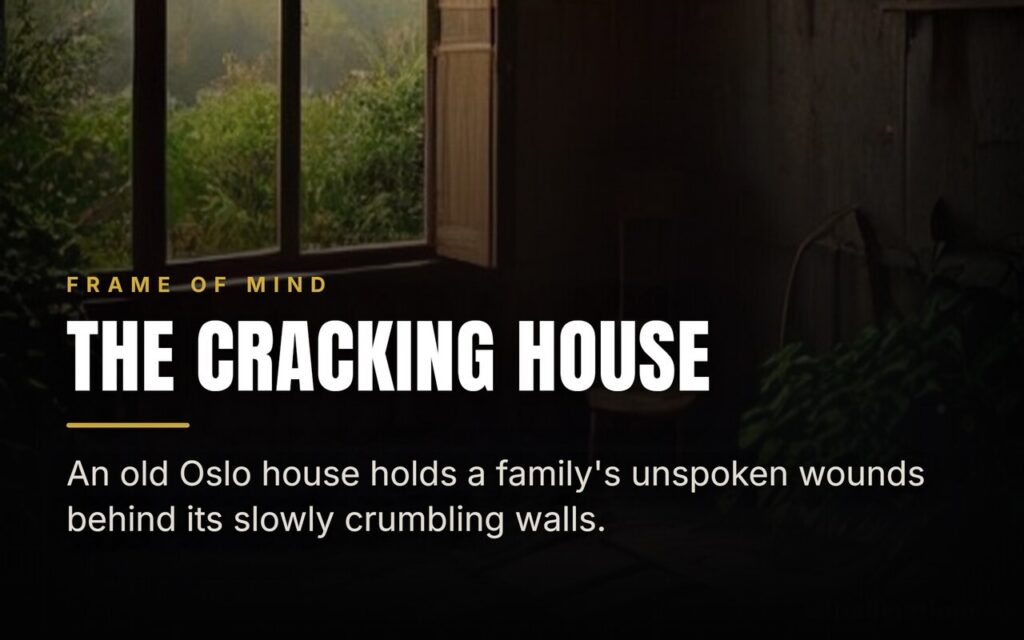
In an age drowning in ready-made emotional jargon — “trauma,” “safe boundaries,” “toxicity” — this film comes along to shatter those rigid molds, returning instead to a more primal, more honest language: the language of cracking walls, of glances lingering between doorways, of art stepping in where words fail. Norwegian director Joachim Trier rediscovers the family as an old house whose walls are slowly crumbling, each crack hiding a secret left unspoken. Crowned with the Academy Award for Best International Feature and the Grand Prix at Cannes, the film is a poetic meditation on how we build fortresses of memory around things that hold nothing but sentimental value, while real relationships crumble under the weight of silence.
None of this is new territory for Trier, even if the house is a new vehicle for it. His so-called Oslo trilogy — “Reprise,” “Oslo, August 31st,” and “The Worst Person in the World” — spent nearly two decades circling the same questions: what people owe the ones they love, and how art becomes both a way of reaching someone and a way of avoiding them entirely. He wrote all three, and this film, with his longtime collaborator Eskil Vogt, a partnership stable enough that critics now talk about a shared sensibility rather than crediting either man alone. What’s different here isn’t the questions. It’s the decision to let a building ask them instead of a person.
A House That Breathes
From the very first shots, the red house in Oslo becomes a central character in its own right. A vessel that breathes, holding onto the late mother’s screams, the director father’s whispers, the buried laughter of childhood. The camera loves the walls the way one flips through an old photo album, every corner narrating a chapter of the Borg family’s story — a family that chose art as an escape from love, and love as a trap they can’t escape. Trier, who shot the film on 35mm, gives every frame a visual warmth that conceals a bitter emotional cold. This contrast is the film’s very core: a visual beauty wrapped around a harsh story, golden light flooding rooms haunted by the ghosts of the past. The house doesn’t just serve as the stage for events — it becomes a mirror reflecting the fragmentation of those who live in it.
Nora’s Exposure, Agnes’s Quiet Strength
It’s a device other filmmakers have reached for before, worth asking why it works here rather than curdling into a gimmick. A house standing in for a family’s unspoken history is old enough to be a minor tradition of its own — a way of externalizing what characters won’t say to each other by giving it walls, staircases, a roof that leaks in the same place it always has. The risk with that device is sentimentality, a house doing the emotional work a script hasn’t earned. Trier avoids it mostly by refusing the metaphor any warmth on its own terms: the house doesn’t comfort anyone in this film, it just keeps recording what happens inside it, indifferent to whether the family ever resolves anything.
Renate Reinsve delivers a performance that goes beyond acting into something raw and lived-in. Nora, a stage actress who suffers from stage fright, finds on the boards what she can’t find in her own life: an organized space for chaos. Her face, which critics described as “impossible to look away from,” carries in every line a history of repressed pain. The opening scene, where she collapses before going on stage, drops us straight into the contradiction lived by a woman practicing one of the most exposing professions while dreading being truly seen. By contrast, Inga Ibsdotter Lilleaas delivers a devastatingly quiet performance. Agnes, the calm historian who seems “the most stable one,” gradually becomes the family’s emotional backbone, the pillar that silently bears the weight while everyone else is absorbed in their own drama. The scene where Nora asks her, “Why didn’t our childhood destroy us?” and Agnes answers with devastating simplicity, “Because I had you,” is a moment where cinema captures the essence of human relationships — love that goes unseen, sacrifice that goes unmentioned.
What the film keeps circling, under the house and the performances both, is a fairly unglamorous question: whether making art about your family is a way of finally understanding them or just the last, most sophisticated way of keeping them at a safe distance. The father’s career depends on turning his children’s pain into material. Nora’s career depends on turning her own exposure into a performance she can control, unlike the exposure she can’t. The exchange between the sisters near the film’s end works precisely because it doesn’t explain itself any further than the line itself — the film trusts that everything that’s come before has already done the work of making a few plain words land like a small earthquake. The film doesn’t resolve which use of art, the father’s or the daughter’s, is healthier. It just keeps setting them next to each other until the difference stops looking obvious.



