Dahmer and the Psychology Behind a Manufactured Monster
How Netflix's Dahmer traces a killer's need for possession back to childhood objectification and abandonment, and a justice system that looked away.

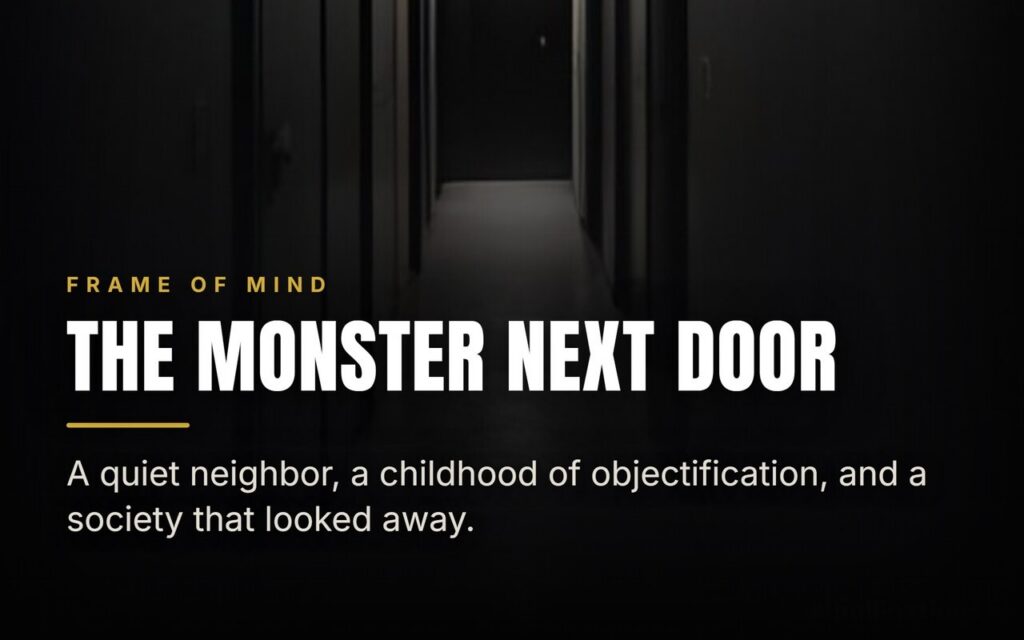
Have you ever caught a bad smell in your building’s hallway and dismissed it as “spoiled meat”? What if I told you your quiet neighbor, the one who wears glasses and seems shy, is hiding a whole world of hell behind his door? From the very first episodes, the show poses the eternal philosophical dilemma: is evil born with us, or is it the product of bad upbringing?
Jump to section
A Childhood Built on Objectification
We see young “Jeffrey,” isolated, strange, his mother suffering from psychological disorders and taking heavy medication during her pregnancy. But worse still is his father, who taught him “dissecting dead animals” as a kind of scientific hobby. Here we see the first lesson in psychology: “objectification.” Jeffrey learned from a young age to treat bodies as “objects” that could be opened up and explored, not as living beings. His father, unintentionally, handed him the “catalog” he would later use in his crimes. It’s a toxic mix of disturbed brain chemistry and an ice-cold home environment.
Possession Disguised as Intimacy
You might think a serial killer kills because he hates his victims… but in Dahmer’s case, it’s stranger and far more complex. Jeffrey’s character clearly demonstrates what psychology calls “abandonment issues.” Jeffrey suffered from a killing loneliness and a genuine terror of being left behind. His mother left him, his father left him, everyone left. So his sick philosophy became: “if I kill you, you can never leave. You’ll be mine forever.” He didn’t want death for his victims so much as he wanted “total possession.” He wanted to turn them into obedient dolls with no will to leave. This explains his attempts to turn them into something like “zombies” (through skull drilling). He wasn’t looking for a partner — he was looking for “property” that doesn’t talk and doesn’t leave.
The Blindness of the System
The show cleverly points its finger of blame at society and the police as well. Here we see the concept of “unconscious bias,” or institutional racism. How was Jeffrey able to kill 17 young men, mostly Black and from minority backgrounds, in his own apartment, while the police stood at his door and did nothing? The scene that truly rips your heart apart is the one with the 14-year-old boy who fled from Jeffrey, bleeding — and instead of the police rescuing him, they handed him back themselves to “the monster,” because Jeffrey (the calm white man) coolly convinced them it was just a “minor domestic dispute.” The show’s message is that the monster wasn’t some criminal genius — society was the one that was blind.
The show isn’t inventing this pattern out of nothing. Accounts of Dahmer’s early life describe a household where an isolated boy’s fascination with the bones and carcasses of dead animals wasn’t treated as a warning sign so much as an odd private hobby, and a father who introduced dissection as something closer to a shared project than an intervention. None of that explains seventeen murders on its own, and to its credit the show never claims it does. What it stages instead is the specific vocabulary a troubled mind was handed before anyone thought to take it away: an early, working idea that a body can be something you open up and study rather than someone you have to reckon with.
The series drew real backlash after it aired, and not from people defending Dahmer. Several relatives of his victims said publicly that no one from the production ever contacted them before dramatizing their family members’ deaths for a global audience. Rita Isbell, whose brother Errol Lindsey was one of Dahmer’s victims, wrote afterward that watching an actress recreate her own courtroom statement, delivered decades earlier at his sentencing, felt like being made to relive the worst day of her life without ever being asked or warned first. It’s a genuine complication for a show built around the argument that society looked away from these victims for too long: making that argument compellingly still meant putting real grieving families through something several of them experienced as its own kind of violation.
What the show gets right, more than any single theory of causation, is its refusal to settle on one clean answer. Disturbed brain chemistry alone doesn’t explain seventeen deaths. A cold, strange household alone doesn’t either. Institutional racism explains how he wasn’t stopped long before he was, not why he started in the first place. The series’ most uncomfortable achievement is making all three explanations sit next to each other without letting any single one absolve the others.
That tension isn’t unique to this show. True crime as a genre keeps facing the same question: does dramatizing real suffering in this much detail serve public understanding, or does it just repackage someone else’s worst day as entertainment with a bigger budget? Netflix drew a separate wave of criticism after the series briefly appeared under an LGBTQ-content tag on the platform, a labeling choice widely read as mistaking a story about a predator who targeted young gay and Black men for a story representing that community, one Netflix removed after the backlash. It’s a smaller controversy than the one involving victims’ families, but it points at the same underlying risk: a true story about real, specific harm can get flattened by whatever categorization or marketing logic makes it easiest to surface to an audience.