The Hypervigilance of a Heart That’s Been Burned
An essay on chronic hypervigilance after being hurt, on tasting bitterness before the cup reaches you, and the cost of expecting betrayal everywhere.

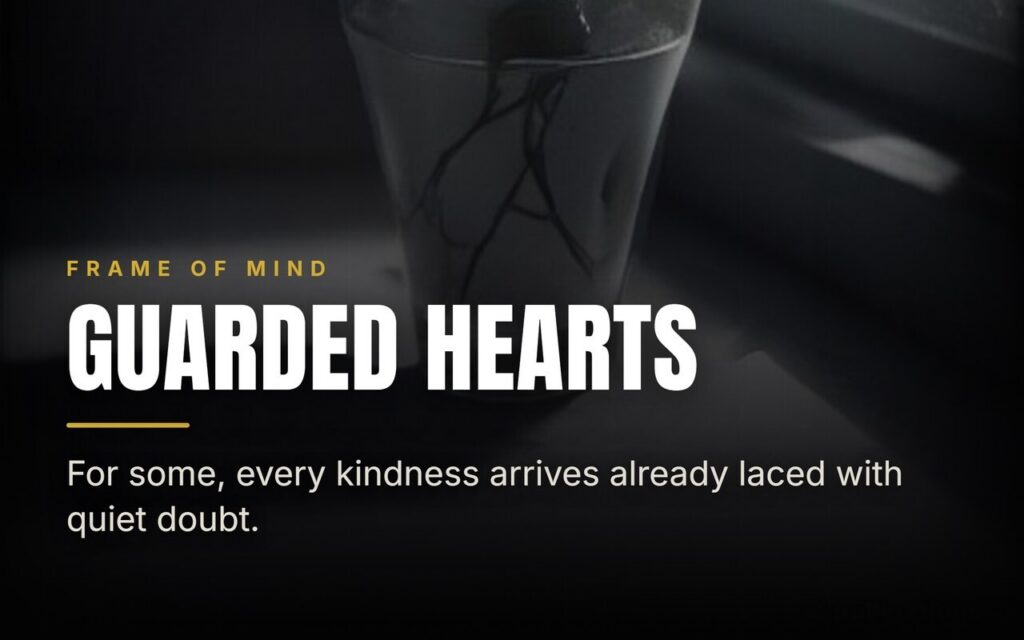
Those condemned to a kind of silent curse live somewhere everything that gets close to them turns into a hidden poison, seeping slowly through the veins before anyone notices the wound was there at all. The laugh they hear hides a blade inside it. The extended hand holds a trick folded into its palm. The rose someone hands them smells of thorns before it smells like anything else. They taste bitterness in the sweetest cups, feel pain arrive before the event that’s supposed to cause it, and read betrayal into the loveliest smiles, because the loveliest smiles are exactly the ones that hurt them the first time. Every surprise strikes like lightning, as if the body had been built for permanent defense and never once for welcome.
This isn’t paranoia in the clinical sense, and it isn’t a character flaw either. It’s a nervous system that learned its lesson too well the first time and never got the memo that the lesson was supposed to expire. Hypervigilance doesn’t ask permission before it activates; it just runs the old calculation on new information, treating a raised voice, a delayed reply, or an unreadable expression as data points in a pattern that already has a conclusion attached. The tragedy isn’t that the alarm goes off. It’s that it goes off constantly, indiscriminately, even in rooms that were never actually dangerous, because the nervous system doesn’t distinguish between the person who hurt you and the person standing in front of you now.
Every new experience becomes a form of prolonged suffering under those conditions, because trust, for a person carrying this, is a distant memory rather than a working assumption, and safety is something they’ve read about rather than lived inside. They move through a world seen through cracked glass, where every source of light carries a shadow larger than itself, and every patch of warmth hides a cold current running just beneath it. Nobody chooses this. It isn’t a philosophy adopted after careful thought; it’s a reflex installed by circumstance, and it gets carried into rooms and relationships that had nothing to do with whatever installed it in the first place.
What makes it exhausting rather than simply sad is the constant forecasting. A person living this way watches the world from a slight distance, smelling danger before it arrives, anticipating an ending before the story has even properly started, which means they rarely get to just be present for the middle of anything. Behind their eyes are stories nobody asked to hear, wounds that stopped bleeding without ever actually closing, doors shut long before there was a real reason to shut them. They live, but taste mostly caution; they breathe, but the exhale rarely feels complete.
The way out isn’t a slogan about learning to trust again, because that instruction assumes trust is a switch rather than a rebuilt structure. It’s slower than that. It starts with recognizing the alarm for what it is — evidence of a past danger, not a reliable forecast of a present one — and it grows only through small, repeated proof that not every hand extended is holding something behind its back. That proof has to accumulate the same way the original wound did: one instance at a time, unglamorously, with no guarantee the nervous system will believe it on the first several tries. Nobody heals a reflex by being told to. They heal it by living long enough inside rooms that don’t confirm the old fear, until the body, slowly and without asking permission this time either, starts to stand down.
Clinicians who work with trauma have a specific vocabulary for what’s happening physiologically here, and it isn’t metaphorical. The nervous system framework known as polyvagal theory describes a body that has learned to default into threat-detection mode, keeping something like an internal alarm system running continuously in the background, scanning tone of voice and facial expression for danger long after the actual danger has passed. What looks from the outside like distrust or overreaction is, underneath, a body doing exactly what it was trained to do by an earlier environment that actually required it. The alarm isn’t broken. It’s just still responding to a building that burned down years ago.
That distinction matters because it reframes something that looks purely like a liability. In an environment that was genuinely unsafe, this same vigilance was the accurate read, not the distorted one — noticing the shift in someone’s voice before the blow landed, or reading a delayed reply as a real warning sign because it had been one before, kept a person prepared for what was actually coming. The tragedy isn’t that the trait exists. It’s that it doesn’t come with an expiration date automatically attached, so it keeps running its old, once-necessary calculations in rooms that no longer require them, at a cost the person paying it rarely chose and often can’t see clearly from inside it.
The slow work of loosening it tends to look almost embarrassingly undramatic in practice — not a single breakthrough conversation, but hundreds of small moments where a raised voice turns out not to be followed by a blow, where a delayed reply turns out not to mean betrayal, logged one at a time until the body’s internal sense of danger finally has enough contradicting evidence to update. Therapists who work somatically with trauma describe this as retraining a body, not correcting a belief, because the fear was never purely a thought to argue with in the first place. It was a lesson written into muscle and breath, and it comes out the same slow way it went in.