Every Batman Actor Reflects the Era That Made Him
From wartime propaganda to Nolan's philosophical trilogy, each actor who has played Batman has mirrored the fears and hopes of his own decade on screen.

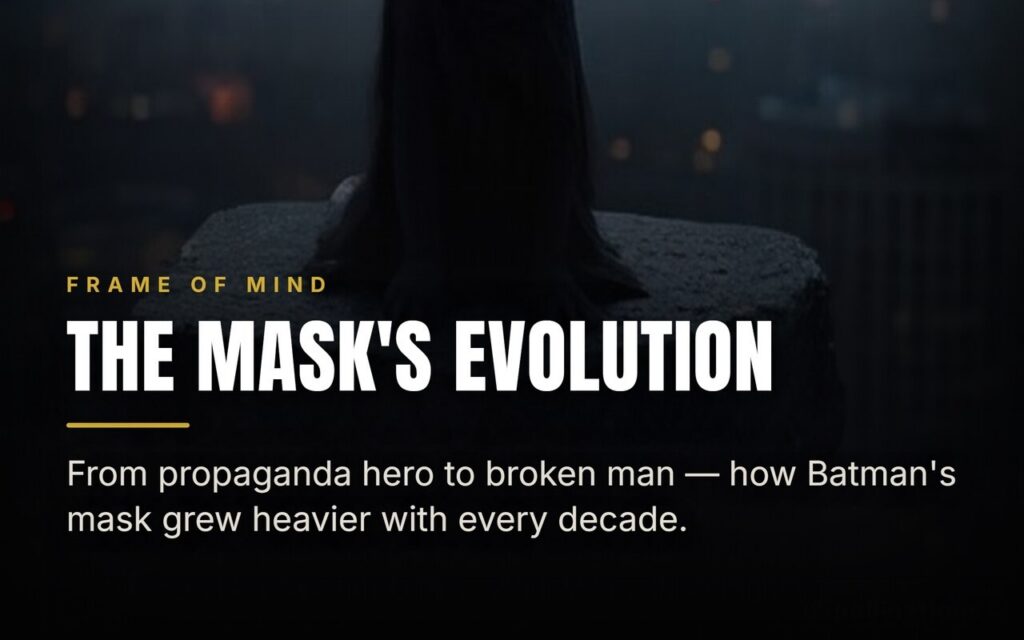
Over the decades, cinema has taken us on a journey from the classic hero to the psychologically shattered man, from the masked spy to the fragile human waging his inner war before facing the chaos of the city. Here are the most notable actors to portray the Dark Knight on screen, and how each reflected the spirit of his era.
Jump to section
From Propaganda to Camp
Lewis Wilson (1943) gave a performance rooted in classic crime cinema at the height of World War II; an ordinary man fighting corruption as a direct piece of propaganda. Robert Lowery (1949) brought a formal maturity within a limited production, where psychological depth gave way to light adventure and Batman appeared as a “local legend” protecting the streets of Gotham. Adam West (1966–1968) used bright colors and a subtle irony reflecting society’s desire at the time to escape the gloom of the Cold War and strip heroism of its solemnity.
The Wound Beneath the Mask
Michael Keaton (1989–1992) marked a pivotal shift with Tim Burton: Batman embodied as an open wound, a silent figure carrying an eternal ache that makes the mask far heavier than the head that wears it. Val Kilmer (1995) brought a faster visual spectacle and a style gleaming under neon lights, a character torn between the pain of the past and the duty of the present, without ever reaching deeper philosophical territory. George Clooney (1997) embodied the fall into Hollywood commercialism, the icon reduced to a shallow visual product, which is why Clooney later apologized for the whole experience.
A Philosophical Turn
Christian Bale (2005–2012), in Nolan’s iconic trilogy, offered a philosophical study of will, presenting a man who turns himself into an eternal symbol, fulfilling the Nietzschean dimension of heroism: falling in order to recreate the self anew. Ben Affleck (2016–2023) played the broken old warrior, a fighter who has lost faith in justice and now sees it as a burden, a dark, realistic embodiment of an existential question: does the fight still mean anything once the passion has died? Robert Pattinson (2022) delivered the scream of a lost generation, a young version obsessed with revenge who gradually realizes that justice lies in understanding and saving, shaping a hero out of the void itself.
The Voice That Needed No Face
Kevin Conroy (1992–2022) remains the eternal voice: he gave the character its true soul through animation and video games without ever appearing in the flesh, proving that the tone of sorrow behind the mask is enough to build a legend. Batman has evolved across generations to become a mirror reflecting our own psychological and social shifts; the darker the world grows, the heavier the mask becomes, and the sadder its voice.
The clearest single scene for what Bale’s version was doing might be the interrogation room in The Dark Knight, where Batman beats on the Joker for information and gets nothing back but laughter, because the Joker has already worked out that Batman’s one unbreakable rule, no killing, is also his only real vulnerability. Nolan stages the whole philosophical argument of the trilogy inside that one room: a man who built himself into a symbol of order discovering that a symbol can be out-thought by something that doesn’t want order at all. It’s the moment Bale’s Batman stops being simply strong and starts being cornered, which is exactly the register Nolan’s whole run operates in.
Affleck’s older, harder incarnation didn’t come out of nowhere either. It leaned openly on Frank Miller’s 1986 comic The Dark Knight Returns, which had already reimagined Batman decades earlier as a retired, brutalized veteran dragged back into a war he no longer fully believes in. That lineage complicates any tidy claim that each actor simply invented his era’s Batman from scratch; often the comics got there first, and the films are catching up to an idea Miller or other writers had already put on the page years before. It’s also worth admitting that fans and critics have never agreed on which version deserves the crown, and the character seems built to resist a single definitive take in a way Superman or Spider-Man mostly haven’t. Every generation gets to relitigate the argument from zero.
That argument keeps happening because the mask genuinely is a mirror and not a costume. A country coming out of a world war wanted a plain man beating plain corruption. A culture anxious about a nuclear standoff wanted a hero who could laugh at himself. A post-9/11 audience wanted someone willing to lie, surveil, and take the blame so the city didn’t have to look at its own compromises. Batman never changes his mission. Every actor who’s worn the cowl has just been handed a slightly different question to answer with it, and that’s really the only consistency the character has ever needed.