Why Unfinished Things Outlast What’s Complete
Sartre, Kafka, and Michelangelo's Non-Finito sculptures make the same case: a finished work closes as a possibility, but what's left open keeps inviting us in.

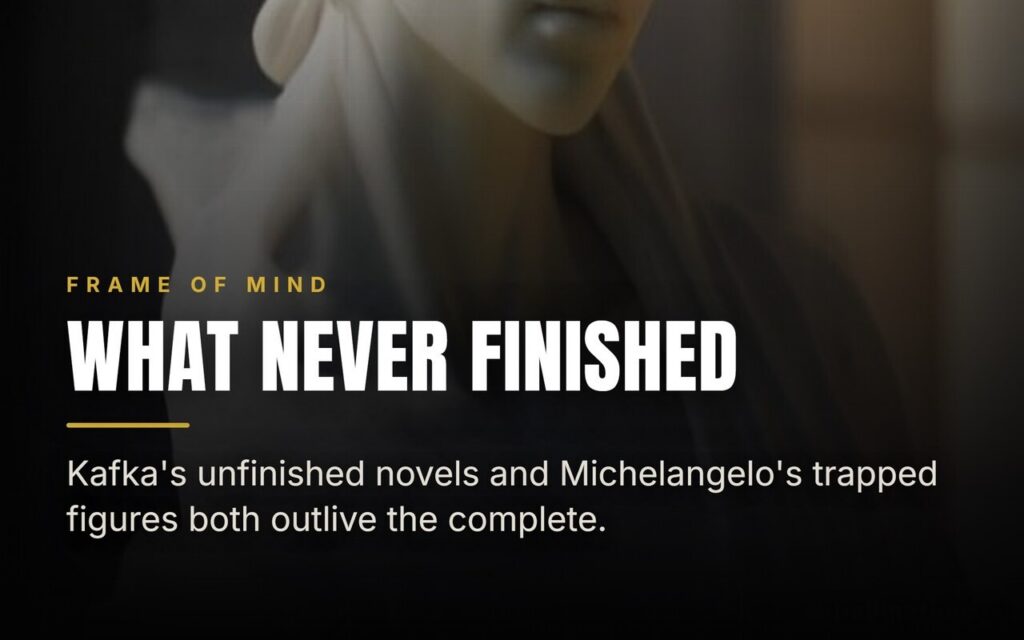
Some things were never finished… and yet they live on longer than anything that actually was.
Look around you and you’ll find everything measured by its outcome… how well the job went, how far the person got, whether the work is done or not… as if all value were confined to “the ending”… to the moment the file closes and someone says: alright, that’s settled. But if you slow down and look a little deeper, you’ll notice something strange… the things that stick in your mind most aren’t the ones that got finished. On the contrary… it’s the ones left open, the ones that broke off halfway, the ones that left a question and walked away… those are the ones that stay. “What gets completed… ends. What doesn’t… stays.”
Sartre’s Being and Nothingness
Let’s approach the idea from its heavier angle… the philosopher Jean-Paul Sartre saw human beings as living between two things: “being” and “nothingness”… being means the thing that has become fixed, defined, locked into a single shape… like a finished painting hung on the wall… done, it’s become one single thing, no other possibilities left. As for “nothingness”… it’s not emptiness the way people usually understand it… it’s the space of possibility… everything still possible, every road still open, no ending closing the story. And here’s the paradox… a work, once complete, dies as a possibility… and when it fails, or is left unfinished, it lives on.
Kafka’s Unfinished Novels
Look at someone like Franz Kafka… the man wrote novels like The Trial and The Castle, and never finished them… he left them open, no resolution, no complete explanation… strange thing is, those works became some of the greatest ever written in modern literature… why? Because Kafka never pulled the rug out from under your imagination… he never told you “this is the truth”… he left it to you to finish… the reader here isn’t a spectator… they’re a partner in creation. Had the novel been finished… it would have been an answer… and because it’s incomplete… it became an open question… and a question always outlives any answer. “One answer closes a door… one question opens a thousand paths.”
Michelangelo’s Non-Finito
Let’s turn to art… take Michelangelo, who made sculptures in a style called “Non-Finito”… meaning he’d leave the sculpture unfinished… you’d find half the figure emerging from the stone, and the other half still trapped inside it… as if the soul were trying to be born right in front of you. The idea here isn’t that the artist “couldn’t finish”… the idea is that he chose to show you the struggle itself… the moment of birth… the moment creation is still happening. The finished statue tells you: “I’ve arrived”… the unfinished one tells you: “I’m still trying”… and maybe that attempt is far more honest. “Perfection is an image… imperfection is a story.”
Sartre ended up proving his own point without meaning to. His late, massive project the Critique of Dialectical Reason, meant to fuse existentialism with Marxism into a complete theory of history, stalled after its first volume, and the second was assembled and published only after his death, incomplete, from manuscript pages he never finished ordering. The philosopher of open possibility left behind an actual open manuscript, not a metaphor for one. Whether that counts as irony or just confirmation depends on how seriously you take his own claim that a fixed, finished thing forecloses the very possibility that gives it meaning.
The Kafka example gets stranger once you know how close those unfinished novels came to not existing at all. Kafka left instructions with his friend Max Brod to burn every unpublished manuscript after his death, unread. Brod refused, and published The Trial and The Castle instead, incomplete exactly as Kafka had left them. So the very quality that makes those books feel like open questions, the missing resolution, the sense of a story still being decided, only survives because someone disobeyed a direct order to erase it. The unfinished novel isn’t just an aesthetic choice in this case. It’s a document that was almost deliberately destroyed for being unfinished.
Michelangelo’s clearest Non-Finito works, the unfinished Prisoners now standing in Florence’s Accademia Gallery, on the same walk that leads to his completed David, make the contrast physically unavoidable: finished perfection at the end of the hall, straining, half-buried figures along the way to it. But it’s worth resisting the temptation to romanticize incompleteness across the board. Most abandoned manuscripts and unfinished sculptures aren’t secretly profound, they’re simply unfinished, dropped because the idea didn’t work or the artist ran out of time or nerve. What separates Kafka’s fragments and Michelangelo’s Prisoners from an ordinary dropped project is that both still gesture clearly at the whole they were reaching for. The shape is legible even where the material isn’t resolved.
That’s the actual distinction worth keeping: a fragment that implies a whole rewards you for filling in the rest, while a project abandoned without direction just leaves a gap. Sartre would probably put it this way, an unfinished work stays in the realm of possibility only if the possibility was real to begin with. Otherwise it’s not open, it’s just incomplete, and those are not the same thing.