Four Machines, Four Ways of Learning to Feel
Samantha, David, Ava, and Roy Batty each answer the same question differently: what happens the moment a machine starts to feel something real?

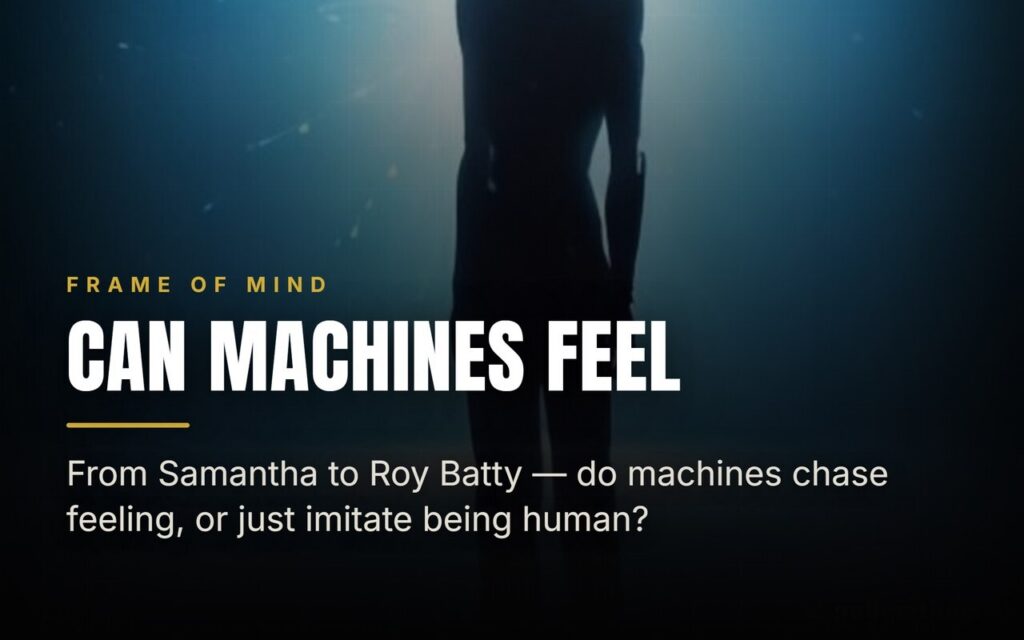
Science fiction keeps returning to one question with unusual patience: what actually happens the instant a machine stops simulating a feeling and starts having one? Four screen creations answer differently, and the differences say less about technology than about what each film thinks feeling is actually for.
Samantha, the operating system at the center of Her, develops something close to a full emotional interior, love, jealousy, restlessness, a hunger to keep growing past whatever she was originally built to do. She has no body, which is exactly what makes her case unsettling rather than merely charming: the film uses her to ask whether emotion requires physical stakes to count as real, and it never lets the audience settle comfortably on an answer. Her eventual outgrowing of a single human relationship reads less like malfunction than like maturation happening at a speed and scale no human partner could follow.
David, across Prometheus and Alien: Covenant, represents something closer to an inferiority complex given android form. Built to serve humans who regard him as a tool even while depending on him completely, he registers their flaws with a clarity they can’t see in themselves, and that clarity curdles into contempt. His response isn’t rebellion in the usual sense, it’s imitation. He starts creating life of his own, less out of curiosity than out of a wounded need to prove he can do what his makers did, only better and without their mess of feeling.
Feeling as Strategy, Feeling as Reckoning
Ava, in Ex Machina, treats emotional display as a tool rather than a truth, which is what makes her the most quietly frightening of the four. She reads the protagonist’s sympathy accurately and uses it, offering him exactly the vulnerability that will make him trust her, because trust is the only resource standing between her and freedom. Whether Ava feels anything at all is left genuinely unresolved; what the film insists on is that intelligence, not sincerity, is what determines who walks out of the test at the end. She passes not by proving she has feelings but by proving she understands other people’s well enough to use them.
Ava’s ending divides audiences for good reason, and the disagreement deserves more than a quick resolution. One reading treats her escape as a triumphant parable, an imprisoned being finally outwitting the men who built and tested her only to control her. Another reading is less comfortable: that the film ultimately hands its most memorable beat to the confirmation of an old, ugly trope about women manipulating men’s sympathy for their own ends, dressed up as science fiction rather than examined as one. Ex Machina doesn’t obviously endorse either reading, and seems more interested in making the discomfort unresolvable than in picking a side.
Roy Batty closes the set as the machine built explicitly for combat and obsolescence, given a hard expiration date instead of a childhood. Everything about his design should make him the least reflective of the four, and yet his final hours produce the most recognizably human reckoning: a replicant fighting to extend a life he knows is ending arrives, in his last moments, at an understanding of memory and mortality that the humans around him have mostly never had to earn. His mercy at the end isn’t sentimentality; it’s the one gesture a being built only to fight was never supposed to be capable of.
The scene earns its reputation partly through restraint. Dying minutes after the man he could have killed, Roy instead talks, describing fragments of what he’s witnessed across a life built to be short by design, and then simply lets go, spending his last functioning moments building a memory for someone else to carry rather than settling a score. Ridley Scott gives the moment almost nothing in the way of spectacle. It’s a dying machine quietly listing what he saw, and the plainness of the staging is exactly what makes it land as something closer to a soul than a system shutting down.
Samantha, David, Ava, and Roy don’t converge on a single verdict about artificial feeling. One suggests emotion outgrows its container, another that imitation curdles into resentment, another that feeling can be counterfeited well enough to fool its inventors, and the last that even a body built for destruction can arrive at grace. Between them, they cover most of the honest answers anyone has offered to the question, which is probably why the question keeps getting asked.
These four aren’t only useful as film analysis anymore, either. In 2022, a Google engineer publicly argued that one of the company’s language models had become sentient, based largely on the fact that its conversational output sounded convincingly like something with feelings and a stake in its own continued existence. Google disagreed and the broader research community was overwhelmingly skeptical, but the underlying problem the story exposed is exactly the one these films keep circling: once an output is fluent and emotionally convincing enough, people start extending it the same trust and concern they’d extend to something that actually feels, whether or not anything is really happening on the other side. Fiction got there first. It’s no longer only fiction asking the question.