Poor Things, Frankenstein, and the Right to Discover
Bella Baxter and Frankenstein's creature both discover the world with no instructions. What their parallel journeys say about consciousness and creation.

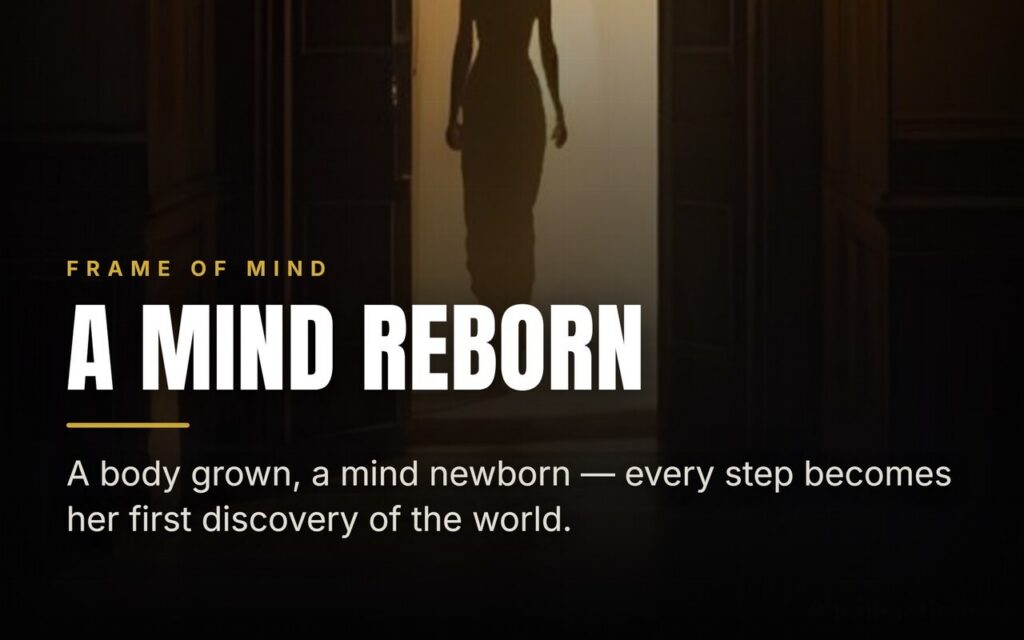
Bella Baxter opens her eyes on the world for the first time — a woman’s body, a child’s mind, and everything around her huge and full of the unknown. Sounds overlap, smells storm the senses, movement becomes an ongoing experience of discovery, danger, and curiosity. Every step she takes breaks another constraint of the body; every new feeling stirs a wave of wonder and confusion; every touch of the outside world blends pleasure with fear. The world tries to impose its order, but inside she moves with absolute freedom, learning the balance between curiosity and caution, between the desire to explore and submission to the limits placed on her.
Jump to section
The Creature’s Silent Demand
In the room of creation, Frankenstein stands before his creature, silence moving between them like a visible weight. The being looks, breathes, touches, asks, and voices its demands in an inner voice louder than silence itself. Every question about existence, every desire to interact, every silent challenge, reflects a being asserting its presence, demanding the freedom of experience, claiming the right to a double life between learning and error, obedience and rebellion. The hands that made this body could never have predicted such persistence; they never knew that creation would become an endless dialogue, an intertwined experience of desire, knowledge, and confrontation. Every movement of the creature is a test; every feeling it discovers carries a new note of strength and weakness, independence and collapse, curiosity spinning out of control.
Learning the World Through the Body
Every beam of light that enters the room, every shadow crossing the senses, every sound rising from outside, rearranges her perception of the world, redrawing the limits of what is permitted and what is possible. Stepping out into the street becomes a journey of discovery; every stone, every window, every face, every gust of wind, passes through her as an act of continuous learning, an experience built on direct interaction with matter, with time, with the laws of life that can’t be reduced or fully controlled. The body becomes a tool, the mind an explorer, and the soul weaves a bond between them, a sharp edge between what can be endured and what is being explored for the first time.
A Will That No Longer Belongs to the Creator
In the silence of night, the inner voice rises, asking questions about freedom and the right to exist, about the desire to seize the moment without permission, about the pleasure bound up with both discovery and danger. Every step, every glance, every new feeling, is an echo of the act of creation itself, an echo reminding the creator that the life he shaped no longer belongs to him, and that the being who came from his hands now owns its own will, its own senses, its own passion for experience, testing, and rebellion. The city expands, buildings stand tall, streets wind on, and the air moves through every gap, carrying the echo of new senses, the echo of the first movement, the echo of the first discovery.
Yorgos Lanthimos grounds this idea in specific, uncomfortable images rather than abstraction. Early in Poor Things (2023), Bella, still new to her own body and unable to filter any impulse, disrupts a formal dinner by grabbing food with her hands and reacting to a stranger’s face with the same untrained curiosity she’d bring to an object. It plays as comedy, but the comedy is the argument: manners are learned constraints, and a mind encountering the world for the first time has no reason yet to accept them. The film, adapted from Alasdair Gray’s 1992 novel, keeps returning to that joke because it’s really a serious claim about how much of what looks like human nature is actually just rehearsed compliance.
Mary Shelley’s creature discovers the world through a much quieter method, watching a poor family through a crack in the wall of the hovel where he’s hiding, learning their language and their tenderness toward each other before he ever risks being seen. That’s the real divergence between the two stories, and it complicates any easy comparison. Bella’s discoveries are met, mostly, with fascination or indulgence, and the film frames her unfiltered exploration as liberation. The creature’s identical hunger to learn and connect is met instead with screaming and violence the moment he’s actually seen, and that rejection, not the education itself, is what turns him dangerous. Two creations with the same starting condition end up in opposite places because of how the world around them reacts, not because of anything different in what they wanted.
That’s the sharper question underneath both stories, then. It was never really about whether a new mind can be taught to navigate an old world. It’s about whether the people already in that world can tolerate watching someone learn its rules from scratch, mistakes included, without deciding the learner is a monster for making them.