Se7en and the Quiet, Organized Face of Evil
Se7en doesn't need chaos to terrify — its killer is methodical, its detectives fractured, and its ending offers no comfort, only the proof that evil can plan.

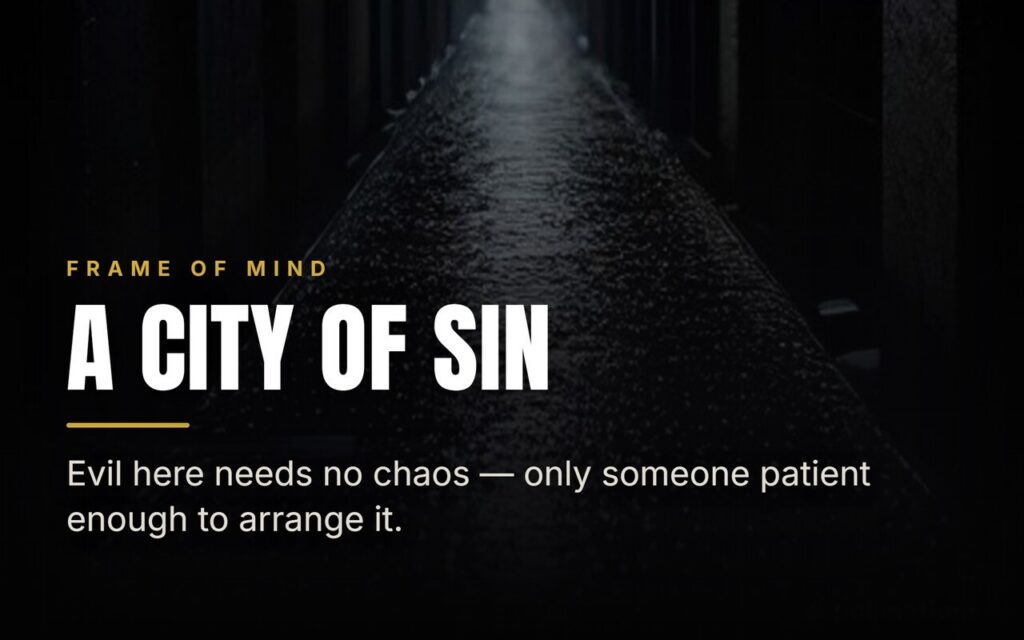
The world here moves inside a state of constant suffocation — a city drowning in repetition, in violence, in habituation, where values have lost their meaning through repeated use with no real belief propping them up anymore. The detectives don’t represent justice as some absolute force standing outside the rot; each one carries a different, half-formed vision of what the world should look like, and that vision erodes a little further with every step deeper into the case.
What separates this film from a standard manhunt is that the killer doesn’t appear as chaos at all. His presence reflects a rigid system built on his own reading of the world, a reading that treats the flaw in human behavior not as something to fix, but as something to expose in public, in sequence, on a schedule. Every crime works like a mirror rather than an invention — it replays a form of human failure that already exists all around us, just magnified past the point where anyone can pretend not to see it. The escalation doesn’t depend on surprise; it depends on the slow, sinking realization that what’s unfolding isn’t a series of separate murders but one idea, executed with the patience of a man who has already planned the ending.
That patience is the film’s real subject. Most stories about violence ask you to fear the loss of control — the snap, the outburst, the thing that can’t be predicted. This one asks you to fear the opposite: a mind so controlled that horror becomes procedure, complete with its own internal logic and its own sense of moral bookkeeping. As the investigation drags forward, the line between right and wrong stops being a line at all. Actions start reading as arguments, each one built to prove a point rather than commit a crime, and the detectives are left prosecuting a case against a man who has already decided what the verdict should be.
The climax doesn’t arrive with the final act of violence; it arrives with the recognition that everything before it was constructed to lead to one specific moment — a moment where a person is tested against himself instead of confronted with someone else’s crime. The conflict stops being external. It becomes an argument between what a person believes he stands for and what he can actually survive once that belief is put under real pressure, with no script and no time to think it through. There’s no room left for the comfortable distance of watching a bad man get caught.
The film doesn’t hand you a resolution, and it isn’t interested in the relief a resolution usually provides. What it leaves behind instead is the sense that certain ideas don’t set out to win an argument — they set out to prove that they’re possible, that someone could actually go through with them from beginning to end without flinching. That’s the note the story ends on, and it’s colder than any twist: evil, in this telling, doesn’t need chaos to take shape. It only needs someone patient enough, organized enough, and certain enough of his own reasoning to arrange it, one carefully chosen tableau at a time.
The desert delivery near the end works because it refuses the shape the genre trains you to expect. There’s no confrontation to win, no trap to spring; the case simply arrives, already finished, in a box the killer has been driving toward completion for the entire length of the film. Nothing about that scene depends on surprise. Everything about it depends on the sinking, delayed recognition that the last sin on the list was never going to be committed by the killer at all. It was reserved, from the start, for someone else’s hand to complete.
It’s a design so total that it asks a lot of the audience’s patience with coincidence. For the plan to work, the killer has to predict not just where his pursuers will be but exactly how a specific, grieving man will react to a specific piece of news delivered at a specific moment, a level of foresight that edges toward the implausible even by the generous standards thrillers usually get. The film gets away with it because it has spent two hours building the killer as someone whose whole identity is patience and preparation, so the improbability reads as one more data point about him rather than a plot hole demanding forgiveness.
What the ending actually proves isn’t that evil can plan, exactly, since planning alone describes half the killers in the genre. It’s that evil can plan for a version of goodness, can bet correctly that decency, tested hard enough, will do exactly what decency is supposed to do and destroy itself in the process. That’s a colder proposition than a killer outsmarting detectives. It’s a killer outsmarting virtue itself, and walking in already certain the bet would pay off.