Why We Feel Like We Won When Our Favorite Player Does
Football is a mirror for something bigger than sport — belonging, identity, and why some fans feel closer to a global star than their own national team.

Is it normal for a person to feel happy when their national team loses? Or are we facing a much bigger crisis than just a football match? In every major tournament, the same scene repeats itself: someone sitting among friends, and the moment their national team scores, you notice they’re upset, and if the team loses, they end up smiling — yet if their favorite player loses even a friendly match, they’ll sulk for days as if they’d lost something deeply personal. This scene makes a lot of people say: “These people have no loyalty to their country.” And others reply: “That’s just the freedom to support who you want.” But the truth runs deeper than either side, because football was never just 22 players chasing a ball… football has always been a mirror exposing what’s hidden inside society, and drawing out feelings people themselves may not know how to explain.
Jump to section
The Need to Belong
Before we ask who people support… maybe we should first ask: what are people actually searching for? A human being has a very basic need called “belonging.” Each of us needs to feel part of a group, a story, a success bigger than ourselves. The problem starts when a person feels their surrounding environment isn’t giving them that feeling. When they feel there are no nearby achievements to be proud of, or that daily reality is full of disappointments, they start looking for belonging somewhere else.
Agency Psychology
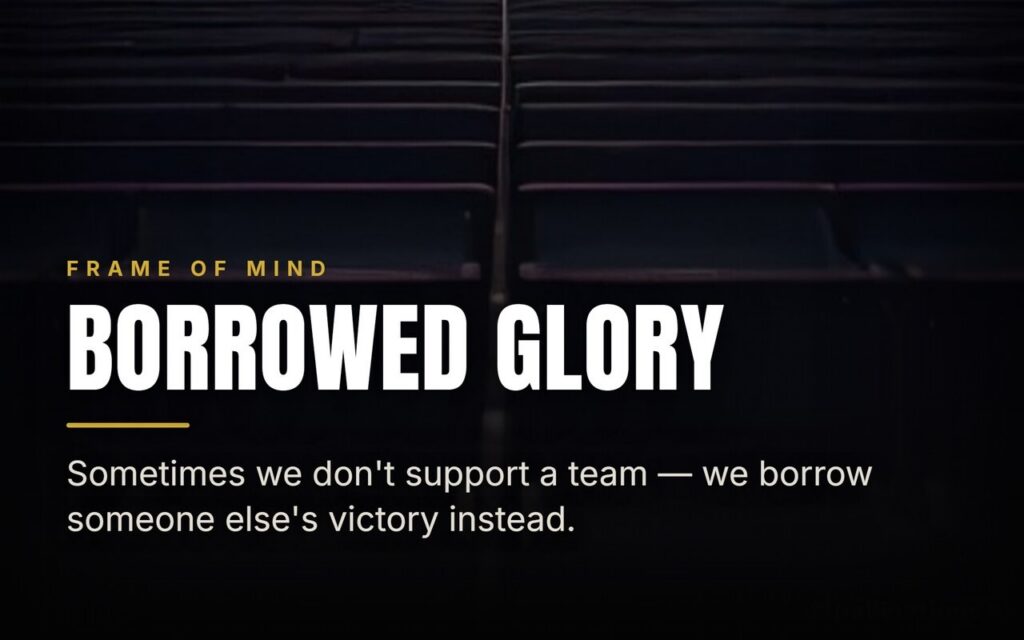
Here comes a concept in psychology called “agency psychology.” Put very simply: instead of achieving success myself, or feeling proud of the achievements of those around me, I adopt someone else’s success and consider it my own. When the player wins, I feel like I won, and when he loses, it’s as if I lost. This isn’t an illness, and it doesn’t mean every fan thinks this way, but it’s a plausible psychological explanation for some cases, especially when supporting a team becomes part of a person’s identity. And that explains why a lot of people know more about the details of a global player’s life than the history of their own local club, and can recite his goals down to the minute, yet can’t name half the players on their own national team — because the relationship here has stepped outside the frame of sport and into the construction of personal identity.
Borrowed Heroes
A person sometimes chooses the hero they wish they could be… even if they’ve never met him. When we talk about Messi or Ronaldo, we’re not talking about just two football players. We’re talking about two global symbols, each one representing an entire story. One person sees in Messi the story of the child who defied illness and became a legend, and another sees in Ronaldo the model of a man who built himself through work and discipline.
This dynamic shows up most nakedly at a World Cup, where a fan’s own national team can be eliminated in the group stage and their mood barely dips, only to spend the rest of the tournament living and dying with a foreign superstar who has no connection to their country at all. Nobody finds this strange anymore, which says something about how thoroughly the “borrowed hero” model has replaced older, more local forms of sports loyalty. The player doesn’t need to share your passport. He only needs to be carrying, publicly and under pressure, the specific story you privately want to believe about yourself.
There’s an obvious pushback worth taking seriously here: maybe this isn’t identity substitution at all, just an appreciation of excellence for its own sake, the same reason people admire a chess grandmaster or a violinist without needing any personal stake in the outcome. That explanation covers plenty of casual admiration, but it doesn’t explain the specific physical toll fans describe, the sleepless night after a loss, the days-long low after an early exit, reactions that look a lot more like grief than aesthetic appreciation. Pure appreciation doesn’t usually cost you sleep. Borrowed identity does, because losing isn’t just watching skill fail, it’s watching a piece of your own story fail by proxy.
Which suggests the healthiest version of fandom probably sits somewhere between the two extremes: caring enough to feel the game, not so much that a stranger’s Tuesday night performance gets to set the terms of your own self-worth. The player goes home to his actual life either way, trophy or no trophy. The fan is the one left to explain, the next morning, why a game he didn’t play in feels like something that happened to him personally.
Social psychologist Robert Cialdini gave this exact behavior a name after noticing college students were far more likely to wear their school’s colors the Monday after a football win than after a loss: basking in reflected glory. His research also found something less flattering, that fans tend to describe a win as “we won” but a loss as “they lost,” distancing themselves grammatically the moment the reflected glory turns into reflected failure. The same quiet grammar shift shows up around a favorite player: his victories become collective, his defeats become his alone, which is a fairly convenient arrangement for whoever’s doing the borrowing.