History Is Written by Whoever Wins: Carthage to Tesla
From Carthage to Native history to Nikola Tesla, the loser rarely tells their own story — the winner writes it, and future generations believe it.

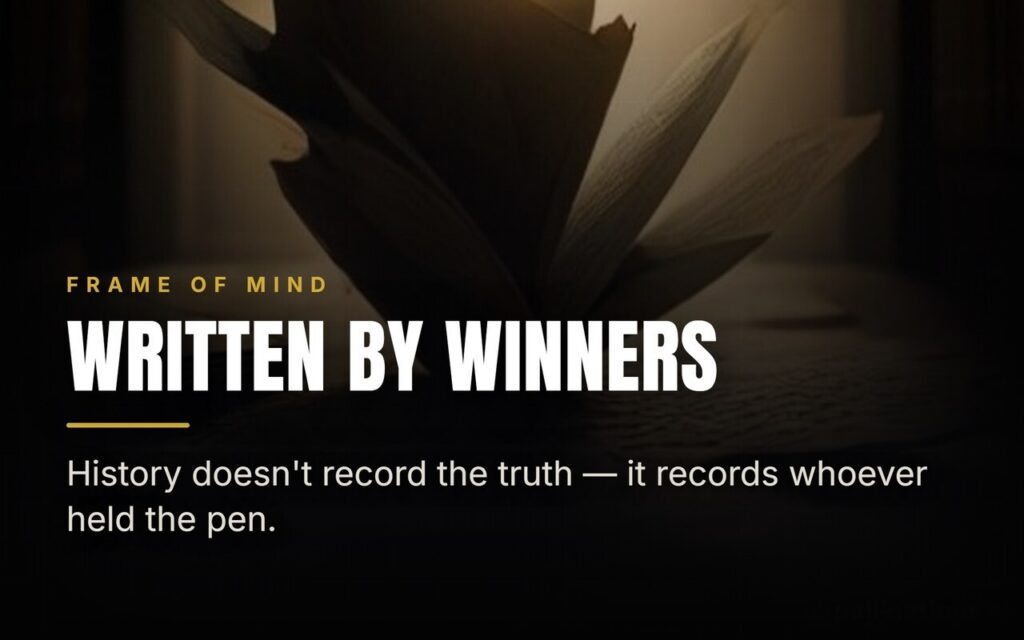
There’s a man standing in the middle of a battlefield, his body covered in wounds, trying to tell his story… but no one hears his voice. The one who won is the one holding the pen, and he writes that the one who lost is a “monster” or “backward” who deserved what happened to him. It’s a mechanical law running in our brains like clockwork: history doesn’t record the truth, it records the winner’s version.
Jump to section
Carthage: Erased by the Victor
Now imagine what happens when the loss is enormous. Not just a defeat in a war, no… total erasure. The winner burns the books, renames the places, and plants a distorted image in the minds of future generations about the one who lost. And that’s exactly what happened to Carthage, long ago. Hannibal, the brilliant commander who came within a hair’s breadth of entering Rome and redrawing the map of the world, led his armies across the Alps in a military miracle. But once the tide turned, everything we know about Carthage’s civilization, rich in trade, art, and intellect, comes to us from Roman historians — their enemies. They’re the ones who said the Carthaginians were savages who sacrificed their own children. Imagine the horror of dying while your enemy is the one telling your story to future generations, turning you from a hero into a monster.
The Same Pattern on Screen
This idea didn’t stop at ancient history. Look at how it carried over onto cinema screens and modern consciousness. Native Americans, the original owners of the land in America, were subjected to systematic extermination. But Hollywood, the dream-making machine, spent decades in Western films turning the victim into the monster. The white man became the “heroic discoverer” protecting his family, and Native Americans became “savages screaming and killing for no reason.” Martin Scorsese in Killers of the Flower Moon, and Kevin Costner in Dances with Wolves, started to pull back that curtain a little. But for many years, the official narrative made the one defending his home a “terrorist,” and the invader a “civilized conqueror.” Psychologically, this creates an “inversion of justice” — a person loses their sympathy for the weak because the image painted in their mind is distorted. It’s like someone stealing your house, then telling the neighbors that you were the one stealing from them.
Tesla, Edison, and the Same Law of Money
And this same law operated in the world of science and money. Nikola Tesla, the Serbian genius who dreamed of free electrical power for all humanity, stood up against Thomas Edison, the businessman backed by financial empires like J.P. Morgan. Tesla worked with purity, Edison used propaganda and money.
The contest between them, remembered now as the War of Currents, was fought less on engineering merit than on public perception. Edison’s direct current had a real technical limitation, it couldn’t travel far without massive power loss, while Tesla’s alternating current, licensed to George Westinghouse, could be stepped up to high voltage with a transformer for long-distance transmission and stepped back down safely near the outlet, letting it move electricity efficiently across whole cities in a way nothing in Edison’s system could match. Rather than conceding the engineering argument, Edison’s side ran a fear campaign, staging public demonstrations that electrocuted animals with alternating current to brand it as the deadlier technology, and pushing for the newly invented electric chair to run on AC specifically so that executions would carry Westinghouse’s name in the newspapers. Tesla had the better technology. For years, Edison had the better story, and the better story is what the public actually bought.
Alternating current eventually won the argument on its own merits, since it’s the standard that still powers the electrical grid today, but the win came too late to rescue Tesla’s reputation in his own lifetime. He died in 1943 in a New York hotel room, largely out of the public eye, having spent his later years chasing ideas, wireless power transmission chief among them, that the financial backers of his era had no interest in funding. Edison, by contrast, became American folklore’s default image of the inventor, the man synonymous with the light bulb in schoolbooks for generations, even though the underlying current running through the modern world is the one he spent a career trying to discredit.
Carthage, the American West, and the War of Currents aren’t really three separate stories about villains getting lucky. They’re the same mechanism recurring at different scales: whoever controls the printing press, the film reel, or the newspaper wire gets to decide which side of the story becomes the default one, and defaults are stubborn things, repeated in textbooks and movies long after the original propaganda has been forgotten as propaganda. The uncomfortable part isn’t that history lies. It’s that most of what any of us believe about the distant past arrived through exactly one side’s account, and there’s rarely a Hannibal left standing to argue back.