The Comfortable Lies We Tell Ourselves to Feel Okay
Peace of mind isn't always proof you're fine — sometimes it's proof you've stopped looking at what hurts you. On denial, self-deception, and quiet drift.

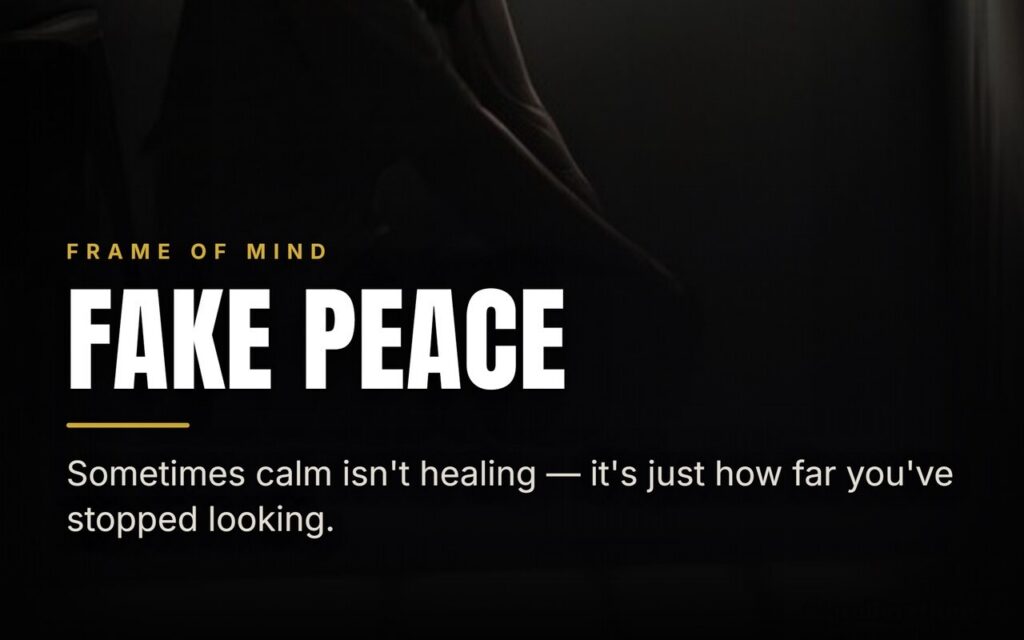
“Peace of mind isn’t proof that you’re okay… sometimes it’s proof that you’ve stopped looking at what hurts you.”
At some point, a person doesn’t choose to lie… they just choose not to look too closely. They turn down their inner voice a little, put off an uncomfortable question, pass over an obvious detail as if it never happened. And every time they do that, a thin layer forms between them and the truth — a layer you can’t see or touch, that just makes them feel comfortable. A deceptive comfort, like sitting in a house that’s slowly cracking apart. The walls are still standing, the roof is still overhead, everything looks normal, except for that faint sound you decide to ignore every single day.
“I’m Fine” Is Not a Description
“I’m fine” isn’t a sentence said to describe reality — it’s said to end the conversation. Because the truth costs more than we can bear. The truth means decisions, means confrontation, means tearing down something you’ve grown used to even if it’s hurting you. So the mind chooses a cleverer path… it doesn’t deny reality, it just reinterprets it. It turns neglect into “circumstances,” coldness into “just their personality,” failure into “bad timing.” And so, it doesn’t lie to you… it tells you a version you can bear.
Over time, you stop seeing the contradiction. You live inside it. You adapt to it. It becomes part of how you define yourself. The relationship that drains you turns into “stability,” the job that empties you out becomes “security,” the life that doesn’t feel like yours becomes “fate.” Not because you’re weak… because you’re tired of resisting. Because confrontation is no longer heroism, it’s just extra weight on top of everything you’re already carrying.
When Calm Becomes Sedation
This is where the illusion turns from a choice into a way of life. You don’t need to convince yourself of it every day… it runs automatically. It deletes what bothers you, softens what hurts you, rearranges the picture so it stays livable. In return, it gives you a strange calm… a calm that doesn’t resemble peace, but resembles sedation. No screaming, no questions, no confusion… just extended stillness, as if you’d walked out of a battle that could have changed you.
The harsh irony is that this very calm is the most dangerous part of it, because it stops you from doubting. It stops you from pausing. It makes you keep going… in the same place, in the same version, with the same story you know deep down is no longer true. You don’t collapse, you don’t fall, you don’t lose anything obviously… you just drift away from yourself, gradually, without noise, without a single defining moment you could point to.
“Some truths don’t destroy your life… they free you from it.”
The question no one wants to ask: how many times have you felt something was wrong… then convinced yourself it was normal? And how many times did you choose peace of mind… only because the truth would have forced you to change?
A common shape this takes: a person notices, once, that a partner never asks how their day went, and instead of naming it, quietly reclassifies the omission as “he’s just not a talker.” Eighteen months later, the same person can list a dozen more omissions from memory without effort, each one absorbed and relabeled the same way, filed under personality instead of pattern. No single conversation ever happened where they consciously decided to stop noticing. The noticing itself just got quieter, one reclassification at a time, until the silence around it started to feel like the natural condition of the relationship rather than something that had been built.
None of this makes self-deception a moral failing, and framing it that way misses what the mechanism is actually for. Denial buys time. It lets a nervous system absorb a threat in installments instead of all at once, which is sometimes the only way a person gets through a period they genuinely cannot afford to fall apart during — a new baby, a health crisis, a job that has to be survived for another six months before anything can change. The problem was never that the mind protects itself. The problem is what happens when the protection outlives the emergency it was built for and quietly becomes the default setting.
The way out isn’t a single dramatic reckoning, however satisfying that would be to imagine. It’s smaller and less cinematic: noticing the exact moment a reclassification happens, catching the word “fine” before it closes the door on a question that deserved a real answer. That small delay, repeated enough times, is the only thing that reopens the gap between the story a person is telling themselves and the life they’re actually living inside.