The Truman Show, Black Mirror, and Living Inside a Copy
From The Truman Show to Black Mirror to Her, four films ask the same question: if a feeling is real to you, does it matter that its source was manufactured?

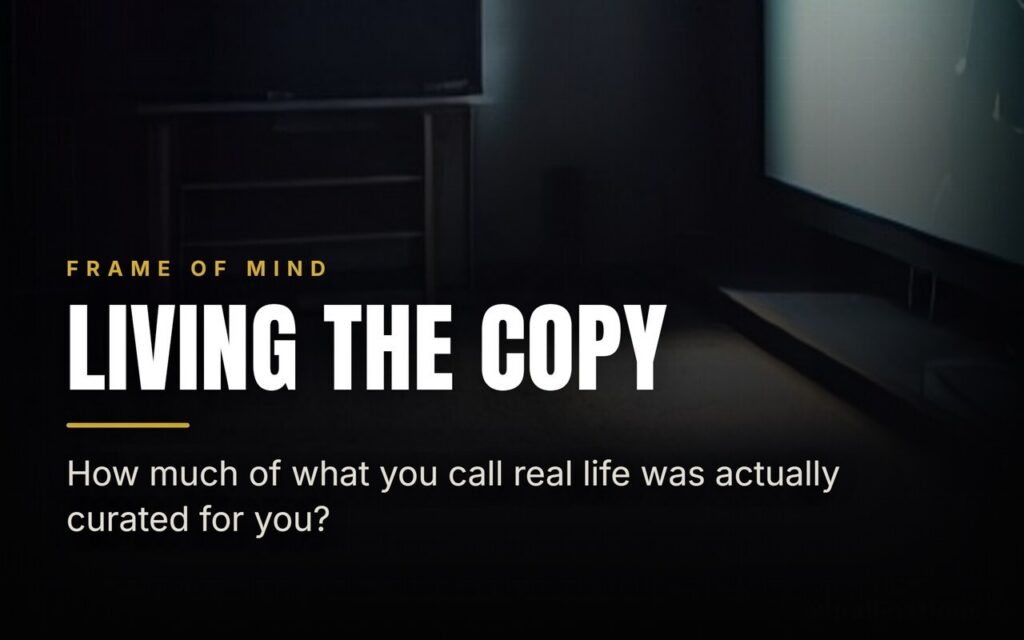
You don’t see reality as it is… you see the version that was made for you. Imagine waking up every morning and opening your phone. News curated for you. People pushed to the front of your screen. Images telling you what life is supposed to look like. Products convincing you of what you’re missing. Opinions repeated in front of you until you start to think of them as your own. After a while… it becomes hard to tell where your own choice ends and where the thing chosen for you begins.
Jump to section
This is the idea behind the concept of simulation in modern philosophy. When the image becomes more present than the original… it gradually turns into a reality of its own. A person doesn’t deal with the world directly all the time. Much of what they know about it passes through images, screens, and narratives made by others.
The Truman Show and Black Mirror
The Truman Show presented the idea brilliantly. Truman lives inside an entire city built around him. His wife isn’t his wife. His friends are actors. His daily life is a TV show watched by millions. And yet… his feelings are real. That’s where the film’s power lies. The lie wasn’t in Truman’s feeling… it was in the world that feeling was placed inside of.
In Black Mirror: Nosedive, the issue becomes something closer to our own lives. People rate each other with numbers. Social standing is tied to a person’s image. A single word at the wrong moment can affect your future. So everyone starts performing the best possible version of themselves. The result? A society full of smiles… and very little honesty.
Her and Dark City
Her goes to an even more sensitive place. Theodore falls in love with an operating system. The relationship has no traditional body, no physical presence. Yet he feels jealousy, longing, intimacy, heartbreak. And here the film puts its finger on a deeply complex question: if the feeling is real to you… does it matter that its source is virtual?
Dark City flips the table entirely. Memories can be changed. Characters can be reshaped. The city itself keeps shifting. And with every change, the question of identity grows more terrifying. If your memory can be edited… how can you be sure the person you call “me” is really you?
The philosopher most responsible for this whole vocabulary is Jean Baudrillard, whose work on simulation argued that a copy can eventually replace what it copied so completely that the original stops mattering, or stops being accessible at all. The Matrix borrowed directly from him, going so far as to put his book Simulacra and Simulation on screen as a prop, hollowed out to hide computer disks inside it. The irony, which Baudrillard himself was reportedly unhappy about, is that the film turns his argument into a rescue story, a hero who escapes the simulation into a more real reality outside it. His actual point was bleaker and harder to package into an action movie: once simulation goes deep enough, there’s no clean floor left underneath it to wake up onto.
The Lighter Version We Live Every Day
We live a lighter version of this idea every day. Algorithms decide what appears in front of us. Platforms reward a certain kind of behavior. Curated images make other people’s lives look complete. Ads create desires, then convince us they were inside us all along.
None of this makes mediation itself the villain, and it makes sense to resist the urge to treat every algorithm or screen as automatically corrosive. Letters, novels, photographs, and television all mediated experience long before anyone carried a phone, and people built real relationships and real selves through all of it. What changed with modern platforms isn’t the presence of mediation, it’s the fact that the mediator now has a measurable financial interest in shaping what you see, refined in real time by exactly how you reacted the last time. The Truman Show’s producers wanted ratings. A modern feed wants your attention for its own sake, and it’s very good at getting it, which is a more total kind of authorship than even Christof managed with an entire fabricated city built from scratch for one unknowing star.
Truman gets a door leading out of the studio. Even Nosedive’s protagonist eventually crashes out of the rating system entirely, landing somewhere that at least feels unmanufactured. Real life doesn’t offer an equivalent exit. There’s no door at the edge of a news feed and no wall to find at the end of an algorithm, because the algorithm isn’t a set built around one person. It’s a shared environment everyone stands inside together, adjusting itself in real time to whichever version of each of us keeps scrolling the longest, with no producer to blame once the credits should have rolled.