The Cat Strategy: Why Distance Creates Attraction
Cats never chase attention, and that's exactly why we want theirs. A look at Cialdini's scarcity principle and why selective openness builds real attraction.

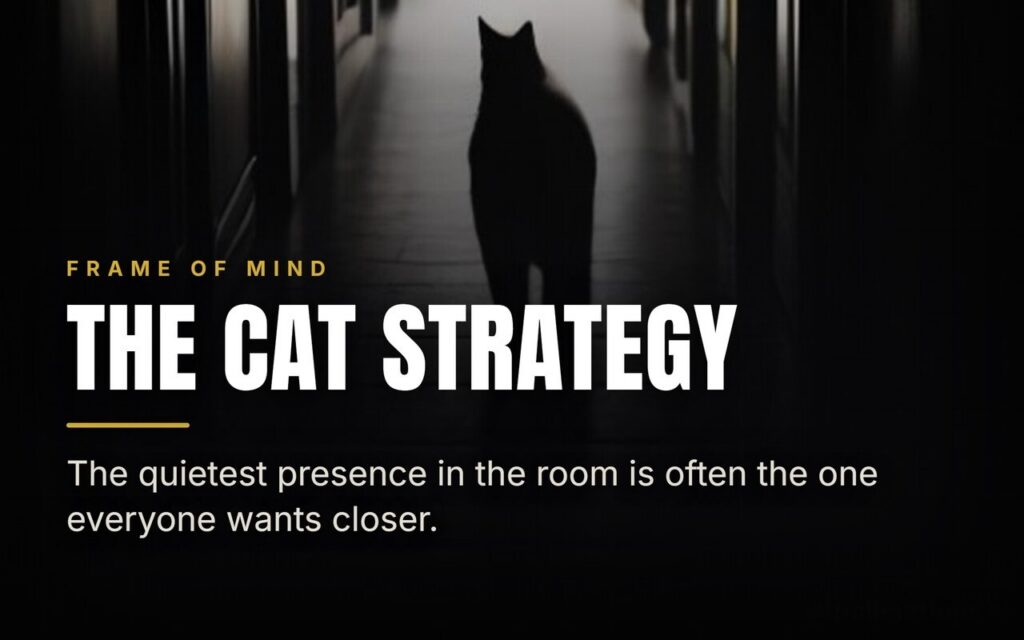
With the same quiet spirit that makes you watch a cat pass silently by without ever looking at you, “the cat strategy” reveals one of the secrets of social magnetism. In the world of relationships and influence, it’s not the loudest person who’s the most charming, but the one who has mastered the art of “attractive mystery.” A cat doesn’t chase anyone for attention, and doesn’t lay all its cards on the table in the first moment, and this spontaneous restraint is what stirs our “curiosity instinct” and makes us want to understand that closed-off world.
Jump to section
The Scarcity Principle
This strategy rests on a well-established psychological principle known as the Scarcity Principle, coined by Robert Cialdini, which proves that the value of something rises in our eyes the less available it is. A person who isn’t available all the time, doesn’t rush to reply to every signal, and doesn’t broadcast the details of their life in public, is seen as a precious, high-value entity — not out of arrogance, but because their presence isn’t overused, just like a cat, which only grants you its presence when it decides to, which is exactly what gives your moments of closeness with it a special flavor.
Mystery Is Not the Same as Closed Off
Mystery here doesn’t mean being closed off or lying — it’s “selective disclosure,” or what’s called in the science of attraction “gradual self-disclosure.” Studies confirm that full, rapid openness burns through interest too early, while holding on to part of your private world creates a lasting space for curiosity and pursuit. As Robert Greene says in his famous law: “Always say less than necessary,” because few words grant their speaker gravitas and force others to fill in the blanks with their own imagination, which is often more beautiful than the exposed reality.
The Power of Emotional Independence
This quiet presence gives an impression of “emotional independence,” one of the strongest drivers of attraction; people are instinctively drawn to those who have their own world and their own independent interests, who don’t wait for a like to feel their own worth. A cat comes close when it wants to and pulls away when it needs to, and this power of withdrawal is what makes others dread losing it. Relationships built on “excessive dependency” suffocate passion, while relationships that respect distance and mystery are the ones that keep their glow for years. This “cat energy” shows up in people who master the art of presence rather than noise, like the cinematic or leadership figures who need only a steady gaze or a brief sentence to change the course of events.
Social psychologists tried to test this directly back in 1973, when Elaine Walster and her colleagues ran a series of experiments on precisely the hard-to-get effect the cat seems to embody. The results were messier than the folk wisdom predicted. Being uniformly difficult to reach, cold to everyone, unavailable on principle, didn’t actually make a person more desirable across the board. What did work was being selectively hard to get: warm and responsive to the one person doing the choosing, while visibly indifferent or in-demand with everyone else. The cat that ignores the whole room but occasionally chooses to sit on your lap is a far more accurate model than the cat that ignores everyone including you. Scarcity attracts, but scarcity without any warmth just reads as absence.
The metaphor holds up better than most animal comparisons because it’s grounded in something real about the animal itself. A 2019 study published in Current Biology, led by researcher Kristyn Vitale, found that cats form attachment styles toward their owners in patterns that map onto the same secure and insecure categories developmental psychologists use for human infants and their caregivers, and a substantial share of the cats tested came back securely attached without ever behaving in the clingy, constantly-seeking-approval way dogs typically do. Security, in other words, doesn’t require constant proximity, even for the animal that inspired the phrase. A cat can be fully bonded to you and still spend the afternoon somewhere else entirely, which is closer to what psychologists mean by healthy independence than most human relationship advice manages to capture.
That distinction matters because the cat strategy curdles fast into something manipulative the moment it’s performed rather than genuinely lived. Deliberately withholding interest as a calculated technique, rather than because you actually have a full, independent life going on, tends to produce a specific kind of exhaustion in the other person once they notice the gap between the performance and the reality, the classic complaint about someone who’s clearly counting the hours before texting back rather than someone who’s simply busy living. Real emotional independence can’t be faked convincingly for long, because it shows up in what a person does when nobody’s optimizing for effect, not in the timing of a reply.
Which is really the whole difference between the cat and someone playing cat. A cat isn’t withholding affection as leverage; it’s simply not built around seeking approval in the first place, and its occasional warmth reads as a gift precisely because nothing was riding on your reaction either way. Attraction built on strategy has an expiration date, because strategies get noticed eventually. Attraction built on someone who genuinely doesn’t need your validation to feel complete has nothing to expose, which is exactly why it doesn’t fade the way a performance does.