What Is a Homeland? Rousseau, Belonging, and Identity
A simple question with a long history: what is a homeland? On Rousseau's social contract, collective identity, and loving a place while questioning it.

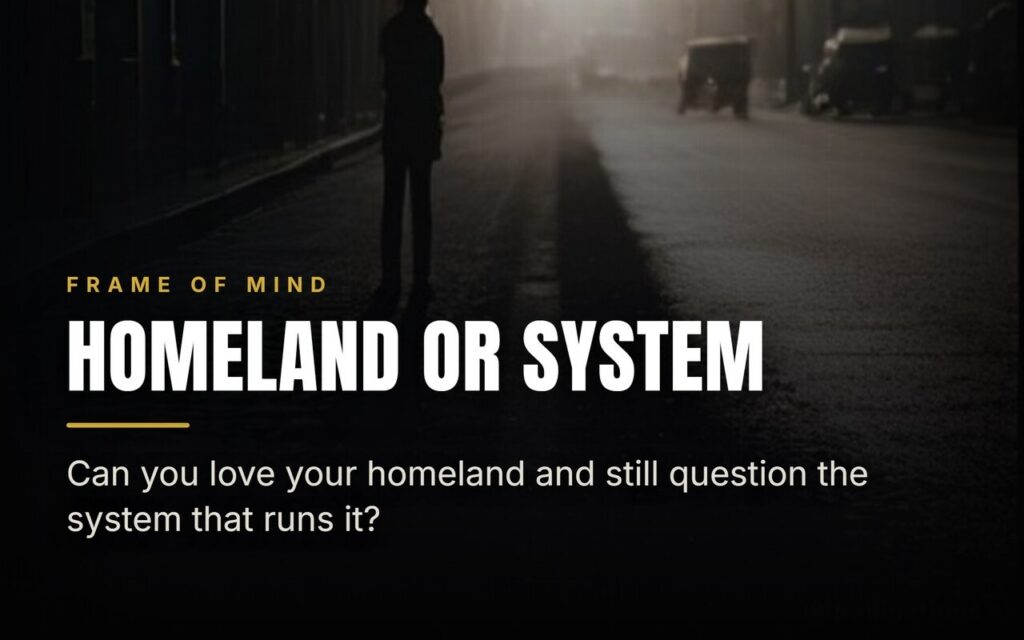
What exactly is a homeland?
It sounds like a simple question, but behind it are stories that have cost millions of people their lives, driven millions more into exile, and inspired poems, novels, films, wars, and revolutions. A question that looks obvious until you actually try to answer it.
From Shelter to Identity
From the moment humans learned to live in groups, they needed a place to feel safe in. A small tribe around a fire at night, a wall to keep out attackers, land to grow food on. Back then the idea was purely practical: this place protects you, so you hold on to it. Lose it, and you’ll probably die. Over time, the land came to mean something bigger. It became a language, songs, food, childhood memories, the faces of people you love. It became part of how a person sees themselves. That’s why when someone says “my country,” they’re usually not talking about soil. They’re talking about the first street they played in, their first love, the smell of their grandmother’s house, the sound of morning vendors, the laugh they used to hear every day.
The political scientist Benedict Anderson gave this feeling its sharpest modern description in 1983, calling nations “imagined communities.” His point wasn’t that nations are fake, but that they’re built on a specific kind of imagination: you will never meet most of your fellow citizens, never shake their hands or learn their names, and yet you feel a bond with them strong enough to grieve for strangers who share your flag and feel oddly detached from tragedies just across a border. Anderson traced part of this to the rise of printed language — newspapers and novels that let millions of strangers read the same words on the same morning and start to imagine themselves as one “we.” A homeland, on this account, isn’t just land or law. It’s a shared story large enough for people who will never meet to feel like characters in the same one.
The Land and the System That Runs It
The problem is that this is exactly the moment when two completely different things start getting confused: the land, and the system that runs the land. I can love the place and reject the way it’s run. Many people see this as a kind of betrayal, even though it’s actually one of the oldest political and philosophical questions in history. The philosopher Jean-Jacques Rousseau spoke of the idea of the social contract. Put simply, a person gives up part of their freedom in exchange for protection, rights, and services. There’s an implicit agreement between the individual and society. The individual gives. Society gives. There’s a balance. That’s why questions like: is education available? Does the law protect me? Do I have a chance to live with dignity? Does my passport protect me abroad? Can I express myself? These aren’t questions against the homeland. They’re fundamental questions about what belonging even means. Because real belonging is rarely born from orders. It’s born from feeling respected.
Not everyone who has thought about this agrees with Rousseau’s version, either. Where Rousseau grounded belonging in consent — a contract citizens implicitly accept in exchange for protection and rights — the German philosopher Johann Gottfried Herder argued something close to the opposite a few decades later: that a nation is defined by its Volk, its people, bound together by shared language, culture, and ancestry rather than by any agreement anyone signed. That split between a civic homeland, built on rights and participation, and an ethnic homeland, built on blood and inherited culture, still runs under most modern arguments about who really belongs somewhere, even when the people arguing have never heard either philosopher’s name. It’s the same fight the essay’s earlier questions were circling: is a homeland something you qualify for by being treated well, or something you’re simply born into regardless of how it treats you?
Collective Identity
People love the place where they feel seen. There’s a concept called collective identity. It means part of your personality is shaped by the groups you belong to: family, friends, religion, your club, your country. When that group makes you feel valued, your attachment to it grows naturally.
The people who’ve thought hardest about this are often the ones who’ve lost it. The critic Edward Said, writing from decades of exile, described that condition as a kind of permanent unease — not the romantic image of the free-floating cosmopolitan, but a real, ongoing sense of being unhoused, of measuring every new place against a first place that no longer exists in the form it was left in. That’s the detail easy to miss in comfortable arguments about flags and belonging: the clearest accounts of what a homeland is have usually come from people describing its absence, not its presence. Maybe that’s the real answer underneath Rousseau’s contract and Herder’s blood — a homeland is easiest to define at the exact moment it’s gone.