Why the Toughest People Are Often the Most Afraid
The loudest, most controlling person in a room is often defending against an old fear, not standing on real strength. What psychology says about it.

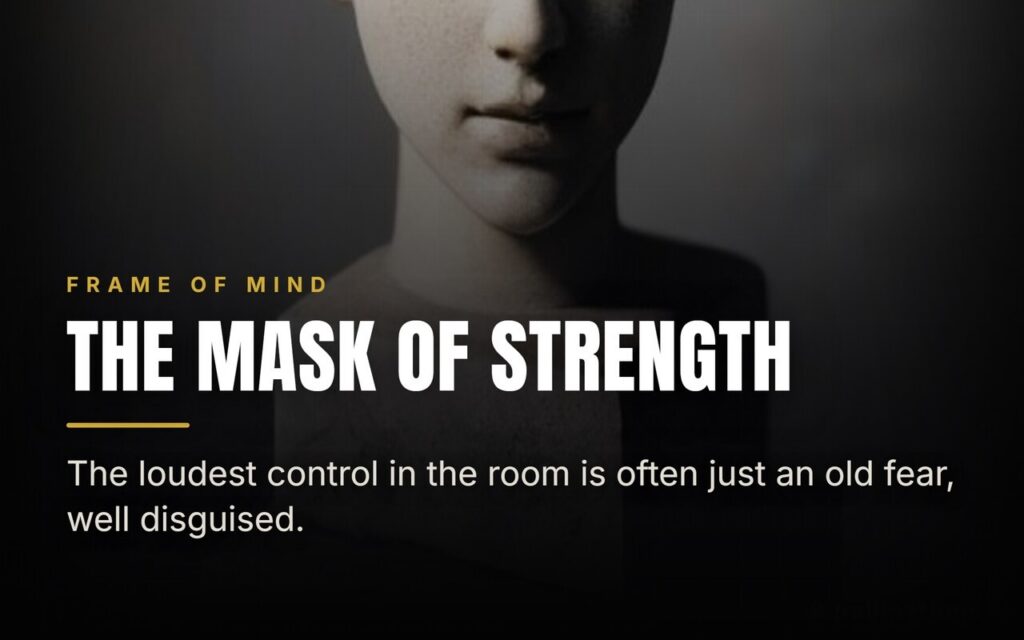
In many societies, the image of the strong person is cast in a fixed mold: a loud voice, a sharp presence, the ability to force one’s opinion on others, and a constant drive to dominate. This image looks convincing on the surface, but underneath it can be a hard shell covering something far more complicated. The strength displayed in public is often a psychological response to an old experience of fear, humiliation, or helplessness. And when that experience turns into an inner wound, a person begins building a shield of hardness so that wound is never seen again.
Jump to section
The Mask Nietzsche Saw Through
In his writings on will and power, Friedrich Nietzsche explored the idea that many social behaviors that look strong may actually stem from an inner struggle with a feeling of weakness. Nietzsche believed that a person sometimes constructs a solid image of himself in order to escape confronting his own fragility. Over time that image becomes a social identity: people see the mask, the mask gets reinforced further, and it turns into part of the personality itself. This explains why some people show excessive control — the greater the need to prove strength, the more likely an old fear is working in the background.
Alfred Adler put a name on this mechanism decades before it became pop-psychology shorthand. Adler, who broke from Freud partly over this very point, argued that everyone begins life in a position of real physical inferiority — small, dependent, unable to do what the adults around them can do — and spends the rest of life compensating for that early imbalance. Some people compensate by developing genuine skill. Others, Adler thought, get stuck in what he called an inferiority complex and build a grand, brittle image instead of an actual capability, what he termed overcompensation. The tell isn’t the confidence itself. It’s how the person reacts when the image is challenged — whether they can absorb a correction or whether even a mild challenge reads to them as an attack that must be crushed immediately.
Control as a Substitute for Safety
Psychology calls this phenomenon psychological compensation, where a person tries to make up for an inner sense of deficiency through behavior that’s the exact opposite on the surface. The social analysis Erich Fromm offered in his book Escape from Freedom shows that some people resort to strict control because they feel a deep anxiety toward freedom and uncertainty. Control offers a temporary sense of security: when a person imposes authority over others, he feels, for a moment, that the world has become predictable.
From here emerge personality types that seem very strong at work or in relationships, but in truth rely on control as a mechanism to protect themselves from feeling weak. Strength here becomes a defense mechanism, not simply a personal trait.
When Strength Is a Defense Mechanism
Within analytical psychology, these patterns are known as defense mechanisms. Freud first described them, and psychologists later expanded on the concept. These mechanisms work unconsciously, and their purpose is to protect the individual from feelings he can’t bear to face. One of these patterns is called reaction formation: a person displays behavior that’s the opposite of what he feels deep down. Someone who fears rejection may appear arrogant, and someone who fears loss may seem intensely cold.
There’s a real complication worth sitting with, though: decades of pop psychology assumed low self-esteem was the engine behind aggression and control, and the research doesn’t fully back that up. The social psychologist Roy Baumeister, reviewing the evidence in the 1990s, found the opposite pattern was more consistent — it’s inflated, unstable self-regard, not low self-worth, that predicts violence and domination, particularly when that self-image gets punctured in public. A person can be genuinely, quietly insecure and never raise his voice. A person can also be narcissistic rather than wounded, and control others simply because he believes he’s entitled to, with no old fear underneath at all. The pattern this essay describes is real and common, but it isn’t the only route to a controlling personality, and treating every hard exterior as a cry for help risks getting the diagnosis backwards.
The hardness others see isn’t always an expression of inner strength; sometimes it’s the result of a continuous effort to hide an old anxiety.
What both accounts agree on is the tell, even if they disagree on the cause: watch what happens the instant the image is questioned. Someone compensating for old fear, in Adler’s or Fromm’s sense, tends to escalate control precisely because the alternative — sitting with the original helplessness — feels unbearable. Someone with a stable sense of self, earned rather than performed, can simply be wrong, or challenged, or momentarily weak, and let it pass. The loudest person in the room isn’t always hiding something. But the one who can’t survive being contradicted almost certainly is.