Schopenhauer’s Case That Reason Never Runs the Show
Philosopher Arthur Schopenhauer argued that reason doesn't lead our decisions, it justifies them. A clear look at his idea of the Will behind the mind.

Right now, as you open your phone, you probably meant to glance for five minutes and stop — and suddenly an hour’s gone by without you noticing. You probably think you’re in control, that every choice you make comes from your own mind. But if a philosopher were sitting next to you right now, he’d likely smile and say: “You think you’re deciding, but the truth is something else entirely is doing the deciding.” That philosopher is Arthur Schopenhauer, one of the most controversial minds in the history of philosophy — the man who turned the idea of rational man upside down, and said reason is just a minor employee working for a master far greater than itself, a master he called “the Will.”
The story began the day one man decided to doubt everything, and ended with another man saying the problem was never in thinking at all.
Reason as a Servant, Not a King
Long before Schopenhauer, the European world was infatuated with reason. René Descartes gave us his famous line, “I think, therefore I am,” as if thinking were the foundation of human existence itself. Then came Hegel, building a massive philosophy that saw history itself moving by logic and reason, humanity advancing step by step toward a better understanding of the world. The whole mood said reason was the true leader.
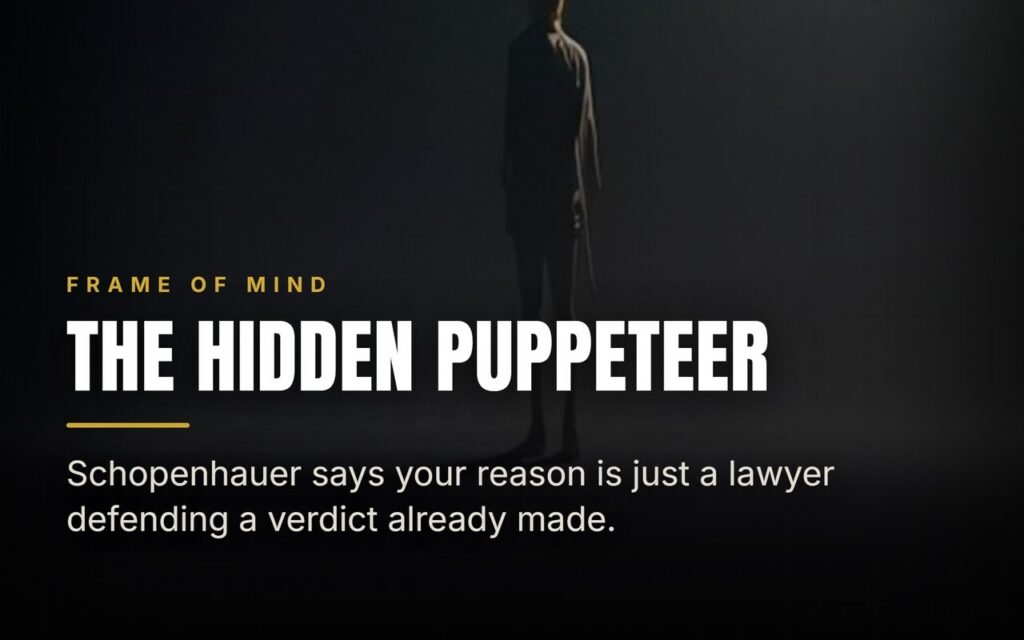
But Schopenhauer walked in and said: “You’re staring at the storefront, and missing the real engine.” To him, reason isn’t king — reason is just a secretary justifying decisions that were made before it even walked into the office. That was the opening of his most famous book, The World as Will and Representation, a book many still consider one of the most important philosophical works of the modern era, because it changed the question itself. Instead of asking “How do we think?” it asked “What makes us think in the first place?”
The World We See Is Not the Full Truth
To understand a human being, you first have to realize that what you see in front of you is probably just a mask.
Schopenhauer split the world into two halves. The first he called “Representation.” The word sounds complicated, but it’s simpler than you’d think. Imagine you’ve worn glasses your whole life, and everything you see passes through them — to you, that’s reality. But is it really? Representation is the world we see with our eyes: the colors, the sounds, the houses, the streets, time, space, the laws — all of it the picture our minds paint so we can make sense of reality. In other words, the world we live in is the version our consciousness can process, not necessarily the full truth.
But beneath this picture lies a much deeper layer, he called it “the Will.”
None of this came from nowhere. Schopenhauer built his entire system on a distinction he inherited from Immanuel Kant, between the world as it appears to us, shaped by the mind’s own categories of space, time, and causality, and the world as it is in itself, which Kant considered permanently out of reach. Kant called that hidden layer the noumenon and mostly left it alone, a locked door he didn’t claim to have opened. Schopenhauer’s boldest move was to claim he’d found the key anyway. He argued that in one case, our own body, we don’t just perceive from outside, we experience the thing-in-itself directly, as craving, as drive, as the blind push to keep existing and keep wanting. That’s the Will. Not a ghost behind the curtain, but the very thing you feel every time you’re hungry before you’ve decided to be.
The idea didn’t stay contained to one philosopher’s system. Friedrich Nietzsche read Schopenhauer as a young man and was shaken by him, before eventually turning the concept inside out. Where Schopenhauer saw the Will as a source of suffering to be dampened through art, compassion, and eventually renunciation, close to the ascetic ideals he found in Buddhist and Hindu texts, Nietzsche took the same raw force and called it something to be affirmed rather than escaped, rebranding it the will to power. Two philosophers, one shared premise that desire runs deeper than reason, and two opposite verdicts on what a person should do about it: quiet it, or ride it.
Schopenhauer himself didn’t leave you stranded with the diagnosis. He thought there were moments when the Will’s grip loosens on its own, chiefly in aesthetic experience, when you’re absorbed in music or a painting so completely that the wanting, striving self briefly goes quiet and you become, in his phrase for it, a pure subject of knowing rather than a bundle of appetite. That’s a strange thing for a famously gloomy philosopher to offer: not a cure, but a handful of minutes here and there where the machinery stops grinding. The reason his book still gets read past its bicentennial isn’t the pessimism people remember him for. It’s that the experience he’s describing, catching your own mind mid-justification, noticing the decision was already made before the reasons arrived, is one most people recognize the moment it’s named, whether or not they ever open the book themselves.