What Oldboy Teaches Us About Free Will and Fate
Behavioral conditioning, learned helplessness, and Schopenhauer's illusion of will: how Oldboy turns a revenge thriller into a philosophy lesson about fate.

The story begins with a man who doesn’t scream… doesn’t resist… he simply wakes up every day in the same room, as if time decided to repeat itself in some absurd way — a shoddy copy of yesterday, carrying no explanation. In Oldboy, the hero isn’t tortured with beatings or hunger, but with something far more precise… he’s given a television, food, and regular doses of the “outside world”… but without context. News that means nothing, faces with no connection to him, a life shown to him as if it belonged to another planet.
Jump to section
Behavioral Conditioning and Learned Helplessness
This is where what’s called “behavioral conditioning” begins — the concept developed by Burrhus Frederic Skinner, where a person’s behavior can be completely reshaped if you control their environment… not through force, but through repetition. But the film doesn’t stop there… because it adds a crueler touch. “When every attempt to understand fails… your mind starts to give up.” This is “learned helplessness,” the concept proven by Martin Seligman through his famous experiments. If a person is exposed to conditions beyond their control for long enough, they’ll stop trying… even if the door is later opened. Imagine yourself inside a room, not knowing why you’re there or when you’ll get out, and every attempt to understand is met with silence… after a while, you won’t try to escape anymore… you’ll just try to endure.
And here comes the film’s most dangerous turn… when the hero is finally released, you naively assume, as a viewer, that the real story is only just beginning… that this is a journey of revenge, of reclaiming dignity, of settling scores. And here the film smiles at you with quiet mockery… because you, just like him, fell into the trap.
The Illusion of Free Will
The German philosopher Schopenhauer believed that a person thinks he’s free because he “wills” things, but never asks himself where that will came from. The film applies this idea savagely. The hero doesn’t move freely… he moves along a path drawn with precision. Every step, every burst of anger, every attempt to understand… was part of someone else’s plan. What does that simply mean? You’re not taking revenge… you’re playing the role of the avenger.
Tragic Fatalism
And here appears the “tragic fatalism” that Greek tragedy knew so well, especially in works like Oedipus Rex, where the hero flees his fate… only to find it waiting for him at the end. Same game, just in modern clothes instead of the gods — there’s a “jailer” writing the script instead of a prophecy, and a precisely engineered psychological plan instead of an oracle.
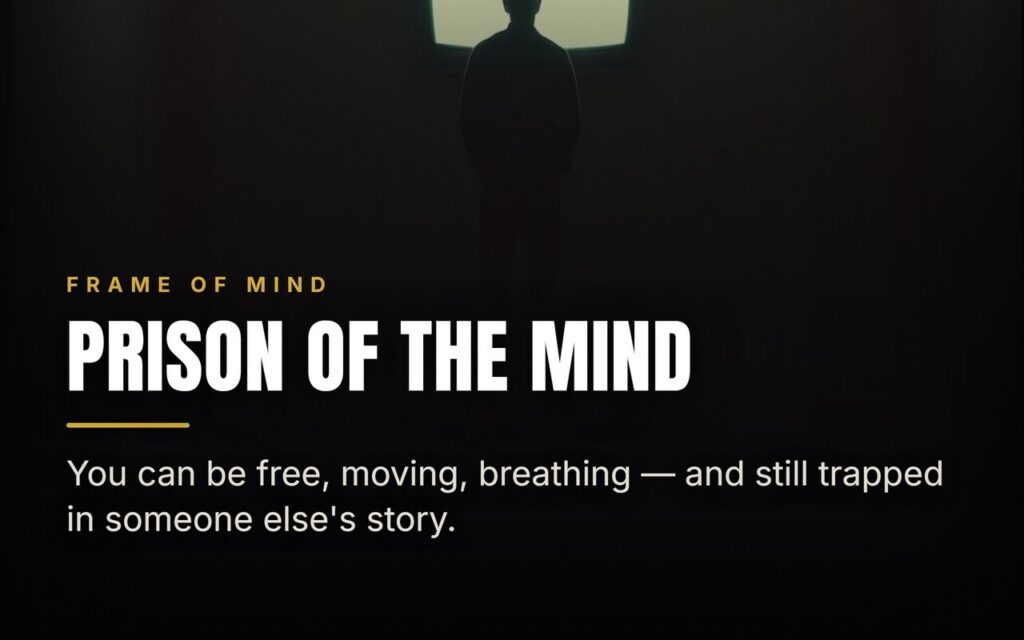
And here we reach the film’s most dangerous point… the “prison of the mind.” The film is originally based on a Japanese manga, but it became iconic because it touched a terrifying idea: walls aren’t necessary for a prison. You can be free… moving… breathing… and still be trapped inside a story someone else wrote.
The most famous scene in the film almost works against its own argument. Oh Dae-su’s single-take battle down the narrow corridor, swinging a hammer with a strength his fifteen years of captivity should have drained out of him, plays like proof that a body can still fight its way toward truth. But it is a decoy the film hands you on purpose. The real mechanism controlling him was never in his fists. It was in the hypnotist, Mr. Han, whose sessions with both Oh Dae-su and Mi-do do something Skinner’s rats and pigeons were never subjected to: they don’t just shape behavior, they manufacture desire itself. Falling in love with Mi-do isn’t an accident that happens to fit the villain’s plan — it is the plan, installed long before the two of them ever share a plate of live octopus.
It would be too easy to read Oh Dae-su as pure prey, a man who did nothing to deserve the machine built around him. The film doesn’t let him off that lightly. The entire fifteen-year sentence traces back to a rumor he spread as a teenager, a piece of gossip about Lee Woo-jin’s sister that he told carelessly and then forgot, the way people forget the small cruelties that cost them nothing at the time. That detail complicates the fatalism considerably. Oh Dae-su isn’t simply erased by someone else’s will; he supplied the first line of the script himself, years before he knew a script existed. Read that way, the film sits closer to Sophocles than to a pure conditioning experiment — a single careless act returning, decades later, with interest no one could have calculated at the time it was committed.
By the end, even his one apparent act of agency, cutting out his own tongue rather than let Woo-jin tell Mi-do the truth, arrives inside a trap he can no longer see the edges of. The final scene refuses to resolve the question cleanly. Oh Dae-su asks the hypnotist to erase his memory of what he now knows, and the last shot leaves his face unreadable in the snow, smiling in a way that could mean relief or could mean nothing has actually changed. If forgetting is itself something administered to him by another person’s hand, then even his escape from the truth is one more instance of the will he thought was his own being managed from outside. Schopenhauer would recognize the joke instantly: the man finally free of his story is free only because someone else decided he should be.